ARCHIE KIRK'S LEAP FOR LIFE.
Reading edition
BY LILLIE E. BARR.
"Alice, may I? Say I may. I can do it, dear sister"; and as he spoke, Archie Kirk bent eagerly over his sister's chair.
Three weeks before, he and Alice had been rescued—the only survivors—from a fine ship that had gone to pieces off the coast of the island of St. Kilda, which is a little speck of land in the wide waters of the Atlantic, forming a part of the Hebrides.
They had been tenderly cared for by the good islanders, and the request which Archie had made of his sister, and which she was very reluctant to grant, was, that he might go with Hakon Bork—the son of the good woman who had given them food and shelter—in search of the eggs and down of puffins, a species of sea-bird upon which these simple people depend mainly for their subsistence.
THE PUFFIN-HUNTERS.
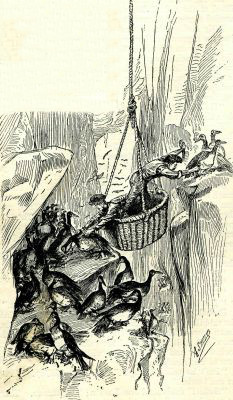
"You are so young, and it is such a terrible way to earn your bread," replied Alice, who shudderingly remembered watching Hakon but the day before fasten his rope to a stake, and then lower himself down the awful precipice, with nothing but his firm grip to save him from falling into the foaming, raging sea beneath. "You are too young, Archie."
"Why, Alice, I am ten years old, and boys much younger than I go down all alone. These people are very good to us, but they are also very poor. I feel mean to accept their charity, and do nothing in return, when Hakon says I can help him if I will."
"It is so terrible, Archie, and if I should lose you too!" cried Alice, whose heart was still full of sorrow for her lost parents.
"God is good, my sister," said Hakon, "and I will watch thy brother carefully."
"You are right, Hakon; go, Archie, I will trust you to God's care."
So Archie bravely pulled his bonnet over his brows, and set out with Hakon and another man. After climbing to the summit of the great rocks, Hakon and Archie stepped fearlessly into the basket, and were slowly lowered over the side of the precipice, on whose edge a piece of wood was made fast to prevent the jagged rocks from cutting the rope. Down, down they went, the boiling sea below, the frightful precipices above, but in all the little shelves and fissures the puffins had made their nests. By a separate line they indicated to the man above when they were to be lowered or raised, and thus they labored away cheerily for hours, collecting many eggs and much down.
Archie showed great skill and coolness, and won great praise from Hakon, and after this he went with him on all such excursions, and as time went on was readily trusted down in the basket alone.
So the months slipped away, and Archie had, with Hakon's help, made himself a rope, such as is used for the perilous work of puffin-catching. The mode of making these ropes is as follows: A hide of a sheep and one of a cow are cut into slips, the latter being the broader; each slip of sheep's hide is then plaited to one of cow's, and two of these compound slips are then twisted together, so as to form a rope of about three inches in circumference. The length of these ropes varies from ninety to two hundred feet, and they are so valuable that a single one forms a girl's marriage portion in St. Kilda. Archie prized his very highly, not only because it was in a measure his own making, but because all his friends had denied themselves in some way or other to procure it for him.
Archie's life was very simple and very hard, but he enjoyed it, and for many months he was very useful to Hakon. Then one day the neighbors brought home a mangled body and laid it down on Dame Bork's hearth-stone. No need to tell the wailing mother, or the sorrowful Archie and Alice, poor Hakon's fate. The men went silently out, and the neighbor women spoke such words of comfort as their own losses, or the constant danger of their loved ones, prompted. Tenderly the dead was buried, and then the little household awoke to the duties of the day.
When their humble breakfast was over, Archie took his bonnet and rope, and said to the old dame, as he had said with Hakon many a morning,
"Give me your blessing, mother."
"Oh, Archie," said Alice, "must you go—all alone must you go?"
"I have a brave heart, Alice, which is good company." And then, glancing at Hakon's old mother, he whispered: "For Hakon's sake, as well as for her own kindness, we owe her every duty;" and then kissing Alice, he went off to the rocks.
As Archie had not Hakon now to help him, he had to leave his basket at home, and adopt the much less common but much more dangerous practice of reaching the birds' nests by fastening a simple rope to a strong stake securely driven into the earth a short distance from the edge of the precipice, and then gradually lower himself to some projecting cliff likely to contain the eggs and down of which he was in search.
So this morning, having reached the cloud-capped peaks, he secured his rope carefully, and then cautiously lowered himself until he reached a spot where the rocks overhung and sheltered a wide ledge.
He was sure that he would be likely to reap here an ample harvest, and he dexterously swung himself forward and gained a resting-place. As he expected, he found a great number of nests, and was soon eagerly filling the large pockets which are used for this purpose with the eggs and down, the patient birds scarcely disturbing him by a flutter.
But in his ardor he had forgotten to fasten the rope tightly around his body; it slipped from his grasp, and after swinging backward and forward for some time, but without coming within his reach, at length settled many feet from the spot where he stood. For a moment he stood aghast. The sudden blow almost deprived him of the power of thinking, but gradually he recovered his senses, and began anxiously to look around for some means of escape.
Fearful was the prospect. The rock for hundreds of feet above was smooth as if chiselled by the mason's hand; many hundred feet below, the raging waters burst with terrific noise upon the pointed crags, while the depth to which he had descended, the solitude of the spot, and the roar of the waves, precluded all possibility of making himself heard.
One desperate chance alone remained: by a bold leap he might catch the dangling rope. It was an awful hazard, for if he failed, instant death would be the result. Yet if he remained on the rock, death, though slower, was no less sure. His resolution was taken. He lifted his eyes to heaven with one short strong prayer for help, then like a winged creature sprang forward, and grasped the rope.
Many a year passed before Archie Kirk told his sister and adopted mother of his leap for life on that day, when he, a lad twelve years old, had determined to fill the place of Hakon. He became the most expert bird-catcher and climber in the Hebrides, but he never again forgot to secure his rope. Nor in telling the story did he ever take any credit to himself. "God is good," he used to add, reverently; "the rope was in His hands, or I had not caught it."