OLD TIMES IN THE COLONIES.
Reading edition
BY CHARLES CARLETON COFFIN.
No. I.
HOW THE INDIANS WERE WRONGED, AND THEIR REVENGE.
At three o'clock Tuesday morning, December 11, 1688, James II., King of England, rose noiselessly from his bed, passed with stealthy steps from his palace, entered a carriage in waiting, and was driven rapidly to the bank of the Thames, where he stepped into a boat, and was rowed swiftly down the stream. As the boat shot past the old palace of Lambeth, he flung into the river the Great Seal of England, used in stamping all the royal documents to give them validity. He was fleeing from his palace, his throne, his kingdom, and from people whom he had outraged in his attempt to set up an absolute and personal government—to do just as he pleased without regard to law. He believed that the King had the right to be above all laws. The people had risen against him, and had invited his son-in-law, William of Orange, to come over from Holland to aid them in overthrowing James. William had landed at Torbay, and had been so warmly welcomed that James was seeking refuge in France with Louis XIV., whose adopted daughter, Mary of Modena, as she was called, was James's wife.
"You are still King of England, and I will aid you in securing your throne," said Louis XIV.
It was not simply a generous act on the part of Louis to a fellow-sovereign who was in trouble, but there were ideas behind it. Louis XIV. believed with James in the absolute right of kings to do just as they pleased: that the people must do their bidding.
"The state—it is me!" said Louis, striking his hand upon his breast, to indicate that there was nobody else who had a right to say or do anything in regard to law and government.
The people of England, on the other hand, believed that they had the right to make their own laws through a Parliament of their own choosing, and that it was the duty of the King to obey and execute those laws.
James had done what he could to crush out the Protestant religion in England; Louis had driven the Huguenots, who were Protestants, from France, waging a cruel war upon them. Thousands had been killed. More than eight hundred thousand had been compelled to flee to other countries. The war was waged not merely that James might regain his crown, but it was a great struggle for civil and religious freedom. It extended to other countries: battles were fought on the banks of the Rhine, the Danube, the Po; in the meadows of Holland; on the plains of Germany; amid the vineyards of Italy; in the wilderness of North America; on the Penobscot, Piscataqua, Merrimac, and Mohawk.
All through the years Jesuit priests had been laboring to convert the Indians of Canada to Christianity, and had made them the allies of France. When the war broke out, all the Indians in Maine and New Hampshire sided with the French.
The English, especially the men who bought furs of the Indians, had not always treated them justly.
The traders cheated them when buying their beaver skins. They would put the furs on one side of the balance, and bear down the other with their hands, saying a man's hand weighed a pound. The Dutch fur-traders on the Hudson used their feet instead of their hands. The simple-hearted red men, knowing nothing of balances and weights, could only look on in astonishment, wondering at the lightness of the skins. The Indians of Maine and New Hampshire had a grudge against Major Waldron, who lived at Dover, New Hampshire.
"His hand weighs too much," they said.
But they had another and greater grievance. To understand it we must go back a little.
In 1675, Philip, who lived on a hill overlooking the peaceful waters of Narragansett Bay, begun war upon the English, which lasted nearly two years, during which the New Hampshire Indians murdered some of the settlers. The Governor of Massachusetts sent Captain Sill and Captain Hathorn, with their two companies of soldiers, to seize all the Indians, although only a few had taken any part in the murders. Major Waldron invited the Indians to come to Dover; and they, regarding him as their friend, came from their wigwams along the lakes and rivers, to see what he wanted.
"Let us have a sham fight," he said.
The Indians agreed to it. They ranged themselves on one side, their guns loaded with powder only, and the white men on the other.
"You fire first," said Major Waldron.
The Indians fired their guns in the air, and the next moment found themselves surrounded by the white men, who made them prisoners, taking away their guns, putting them on board a vessel, sending them to Boston, and selling two hundred of them into slavery.
One Indian made his escape from the soldiers, ran into Elizabeth Heard's house, and the good woman secreted him in the cellar, and saved him from being sold into slavery.
The war between England and France began. The Jesuit fathers were making their influence felt among the tribes, winning them to the side of France.
Previous to this the Indians had made themselves at home in Dover, coming and going as they pleased. There were five strongly fortified houses in the town, in which the settlers slept at night.
It was the evening of the 27th of June, 1688, when two squaws called at Major Waldron's garrison, and asked if they might sleep there.
"Indians are coming to trade to-morrow," they said.
Major Waldron was pleased to hear it, for trade with the Indians always meant a good bargain to the white man.
"Supposing we should want to go out in the night, how shall we open the door?" asked the squaws.
They are shown how to undo the fastenings.
MAJOR WALDRON'S TERRIBLE FIGHT.
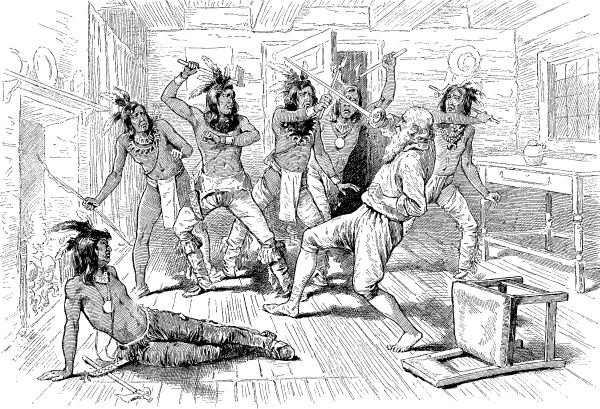
Major Waldron is eighty years of age, white-haired, wrinkled, but there is force yet left in his arm, and he is as courageous as ever. He has no fear of any Indian that walks the earth, and the vague rumors and whisperings of an uprising are as idle as the wind to him. He lies down to sleep. The lights in all the houses are extinguished. No sentinel walks the street. In the darkness dusky forms glide noiselessly through the town. The doors of the houses open. The terrible war-whoop breaks the stillness of the summer night. A half-dozen Indians burst into the room where the brave old man is sleeping. He springs from the bed, seizes his sword, and single-handed drives them from his chamber into the large room. In the darkness one steals behind him, strikes a blow, and he falls. It is their hour of triumph. He has been a ruler and a judge. The Indians can be sarcastic. They seat him in his arm-chair, lift him upon the table. It is his throne.
"Get us supper," is their command to the family.
They eat, and then turn to their bloody work. One by one they slash their knives across his breast.
"So I cross out my account," they say. They are settling an account that has been standing thirteen long years.
An Indian cuts off one hand. "Where are the scales? Let us see if it weighs a pound."
One cuts off his nose, another his ears. The old man's strength is gone, and as he falls, one holds his sword, so that it pierces his body.
In one of the garrisons is a faithful dog, whose barking awakes the inmates. The Indians rush upon the door. Elder Wentworth throws himself upon the floor, holds his feet against it, and braces himself with all his might. The bullets whistle over him, but do him no harm, and he holds it fast, keeping the Indians at bay, and saving the lives of those within.
Elizabeth Heard and her children on this evening have come from Portsmouth in a boat. They are belated, and the Indians are at their bloody work when they arrive. Her children flee, while she sinks in terror upon the ground. An Indian with a pistol runs up and stands over her, but he does not fire.
"No harm shall come to you," he says. He permits no one to touch her. It is the Indian whom she befriended thirteen years ago.
When the morning dawns it is upon the smouldering ruins of burning dwellings, upon the mangled bodies of twenty-three men and women, and upon twenty-nine women and children going into captivity—a long weary march through the woods to Canada to be sold as slaves to the French, or kept as prisoners by the savages. Yet amid the ghastly scene, through the blood and flame and smoke and desolation, there is this brightness—the remembrance of the kindness of Elizabeth Heard, and its reward.
REVIEW OF THE CAVALRY BY THE INFANTRY.—Drawn by Sol. Eytinge, Jun.