HOW DO THEY GROW?
Reading edition
LITTLE JENNIE AND THE GARDENER.
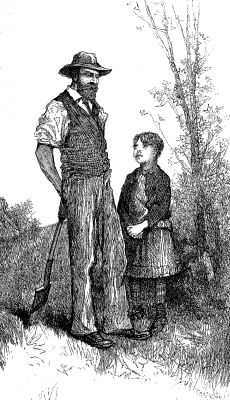
While the children were waiting for the Professor one bright summer morning, they overheard through the open window little Jennie asking John Grant, the gardener, "Where do the flowers come from?"
"Why, don't you see?" said he; "they grow up out of the ground."
"How do they grow?" continued the little questioner, whose curiosity was clearly on the increase.
Before John could collect his wits sufficiently to frame an answer, the Professor made his appearance with a pretty rose-bud in his hand.
"Will you not tell us," said Gus, "how flowers grow? There's John out there digging among them all day, but he seems to know nothing about them, after all."
"Oh yes, he does," said the Professor; "I presume he knows more about them, in a practical way, than either you or I. He can take care of them through the winter, and train them, and get them early into bloom, far better than I could, I am sure. But very likely I know more of what the books have to say on the subject, and can more readily find words to express what is called the theory in the case. The growth of plants has given rise, perhaps you know, to the science of botany."
"Please don't be very scientific," pleaded Gus, "but tell us in a plain way how they grow."
"Well, let us begin with the seed. In the first place, the sun warms the ground in which the seed lies buried. Then the seed swells and bursts, and sends downward a little root; the root drinks in the water from the soil, and so gets larger, and spreads around; and by-and-by it sends up a stem above the ground. As soon as the sunlight falls on the little plant, it gets stronger, and is able to take food as well as drink from the soil, so as to get its full shape and size and green color."
"Has it a mouth to eat and drink with?" asked Gus, in some doubt.
"Yes, a great many mouths scattered all over the root, or on very little branches reaching out from it. While it is under-ground in the dark, it is thirsty, and cares only to drink water; but as soon as it comes up, and has enjoyed the light and heat of the sun, it begins to get hungry, and takes in solid food with the water. The fresh air and sunshine sharpen its appetite, just as they do in our case."
"The little spring flowers seem to come up so suddenly," said Joe, "as if they did all their growing in one night. We don't see them at all until they are standing in full bloom."
"It takes them some days to develop and blossom," said the Professor. "The stem rises slowly from a little point, getting longer and longer, until it reaches its full size. Shrubs and trees begin in the same way, mounting upward until they reach their proper height. If you examine the ground closely, you will find plenty of little plants just peeping out. Most of them are grass, and keep on about the same as they begin; but some change very greatly, and take all kinds of shapes and directions. They soon put out their leaves, one by one, or two by two, along the stem, short spaces apart. Just above the leaves, in the larger plants, branches start out, and grow much like the stem, with their own leaves."
"How do the flowers come?" asked Gus.
"Sometimes they grow on a little stem of their own, called a scape, that springs up separately from the root. But usually the main stem or one of the branches is changed into a flower-stem. Now suppose we cut this rose-bud in two, and then I can show you."
"Please, Professor," said May, "don't cut the poor rose-bud. There is a book down stairs with one in it cut in two."
ROSE-BUD CUT VERTICALLY.
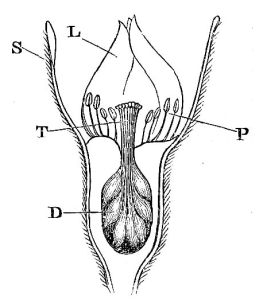
Gus brings the book, and the Professor exclaims, "That is what I want exactly. Here are lines pointing to the parts; and now I'll explain them. You see, S is the sepals."
"What are they?" asked Joe.
"The sepals are the outer covers of the flower. They lie all over and hide it when it is in the bud, but are folded back when the bud opens. There are five, which is a very common number for flowers to have. Some have only two or three, others none at all. The petals are marked L. They are the gayly colored parts that lie next to the sepals, and inside of them. Sometimes the petals are separate from each other, and sometimes all fastened together. They are also called the corolla, which means a little crown, and are the showiest portion of the flower. Wild flowers are apt to have only one row of petals, but those cultivated in gardens often have a large number. The good care that they get has the effect to make them deck themselves out with more petals, which are the parts chiefly admired for their brilliancy."
"What are these little threads near the middle?" asked Joe.
"They are called stamens. In the picture they are marked P. Inside of them, in the very centre, is what are called the pistils, T. Down below them are the seeds, in the middle of what becomes the fruit, as you have noticed in an apple or pear, which is somewhat like a rose when ripe, though very much larger. After the petals have fallen off the rose, the part that is left gets ripe with the seeds inside, just as if it were an apple or a pear."
FISHERMAN'S LUCK.