Part 1 — PREPARING FOR THE FOURTH OF JULY.
Reading edition
BY A. W. ROBERTS.
Fourth of July is coming, boys, and we must do something to celebrate the anniversary of the glorious Declaration of Independence.
Let us see if we can not plan something that will be better and pleasanter than setting off fire-crackers, firing pistols, guns, and toy cannons. All these things make a hideous racket, which annoys sick and delicate persons, to say nothing of the serious accidents that have so often turned the great national holiday into a day of pain and sorrow for many a boy who started out in the morning to have a good time, and ended before night with bandaged hands and aching heads. It will be much better for you to be content with seeing the public display of fire-works which will take place in almost every village, managed by men who are used to handling these dangerous articles, than to run the risk of losing an eye or a hand in the reckless use of explosive toys.
There are many pleasant ways in which you can celebrate the Fourth without any danger. There is no reason why you shouldn't have a supply of lanterns for one thing, and make the woods and lawns and the inside and outside of your houses just as bright as possible. I am going to have a great illumination. My lanterns were all finished up a week ago, and now I am going to tell you just how I made them, so that if you like you can have as many and as great a variety as are now piled up in one corner of my room all ready for the evening of the glorious Fourth.
Fig. 1.
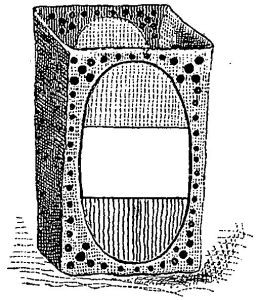
My first lantern (Fig. 1) is made out of a Chicago corned-beef can, of which I procured a number from our grocery man. Having thoroughly washed them out with hot water and soda, I took them to a friendly tinsmith, who cut out from the sides the squares, circles, and ellipses. Over these I pasted red, white, and blue tissue-paper, while, to make the lantern still more luminous, holes were punched through the tin sides in various designs. This lantern can be either suspended with wires, or stood on window-sills, balconies, etc.
Fig. 2.
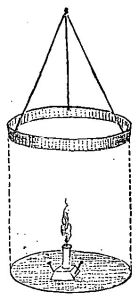
My next lantern (Fig. 2) is an imitation of the Chinese "bucket" lantern. The top consists of a strip of pasteboard one inch in breadth, the ends of which are sewed together, thus forming a circle, with a diameter of about seven inches. The bottom consists of a circular piece of pasteboard. The body of the lantern is composed of one piece of tissue-paper, either red, white, or blue in color, which is pasted to the top band and to the circular bottom piece. The lantern is suspended by means of three pieces of stout thread or fine wire as shown in the illustration.
Fig. 3.
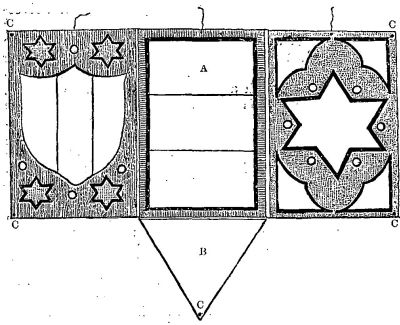
Fig. 3 is a folding lantern made of three pieces of pasteboard of uniform size, on which designs in stars, shields, squares, and circles are drawn previous to cutting them out with a chisel and scissors. The small circles or holes shown in the illustration are burned through the pasteboard with a red-hot wire or poker. Red, white, and blue tissue-paper is pasted on the inside to produce the colored effects. The sides of pasteboard are fastened together on the inside with strips of silk, muslin, or calico by means of glue. The bottom of the lantern consists of a triangular piece of pasteboard, A, which is fastened to the bottom of the middle square, B, also by means of a strip of silk. At the corners, C, C, C, C, C, small holes are made with a very coarse darning-needle. The three square sides of pasteboard when brought together form a triangle equal to that of the bottom piece, B. Fine wire or coarse thread is then passed through the holes, C, C, C, C, C, and tied. The result is a very light and showy lantern of triangular form, which can be suspended by fine wire or thread. The advantage of this lantern over others is that after using it it can be untied, folded together, and packed away until the next Fourth arrives. The can lantern can also be used for many years by re-covering it with tissue-paper when necessary, thus saving expense and trouble.
In making designs for lanterns always have them bold and strong. The effects will then be satisfactory, whereas fine and finicky work on a lantern is all lost when viewed from a short distance.
Fig. 4.
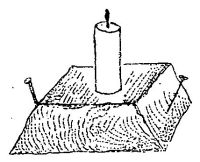
What bothered me most in my lantern venture was to obtain holders for the candles that would not take fire when the candles burned down, and thus endanger the wood-work round about. At last I hit upon three styles of home-made fire-proof candle-holders. The first is shown in Fig. 4. It consists of a raw potato cut into square slices three-quarters of an inch thick. These are bevelled at the sides as shown in the figure. Half-way through the centre of the slice a hole is bored, into which the candle is inserted. This holder is fastened to the bottom of the lantern by means of pins, which are driven through the sides of the potato and into the pasteboard.
Fig. 5.
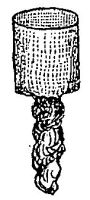
Fig. 5 consists of three thicknesses of tin-foil, formed on a piece of wood of the same diameter as that of the candle. To form the end of the holder the tin-foil is solidly twisted together to the extent of an inch. When using this holder a hole is bored into the bottom of the lantern, through which the twisted end of the holder is passed and clinched on the under side.
Fig. 6.
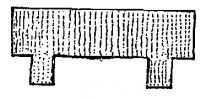
Fig. 6 is made of a strip of thin tin or sheet-lead, the ends of which, when brought together, form a circle. The two square projections on the bottom of the strip are passed into two slots in the bottom of the lantern, and bent back so as to fasten the holder securely. The price of adamantine candles in New York city that will burn three hours is three dollars per hundred. All the illuminating material above described is very inexpensive, and more effective than the imported Chinese lanterns. The fun of making them, the lessons learned in utilizing and putting together various materials, the combining of colors in various designs, more than repay one for all the trouble.
Fig. 7.
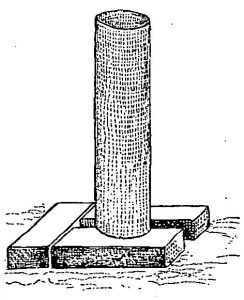
In a previous number of Young People something was told you about gas balloons. They involve the use of chemicals. To my mind, the hot-air balloon is a great deal better and less expensive to manage. Make your balloons after the manner described in the article in No. 136. Now comes the business of inflating them. There are some difficulties to contend with, but with a little care you will be successful. The following is the best method according to my experience. Secure a short piece of old stove-pipe, and place the lower end on two bricks (Fig. 7), a space being left between them which is to answer as a draught-hole. The back and sides are then built up with bricks to prevent its falling. A fire is kindled in the stove-pipe, which is then filled with charcoal to one-third of its depth. As soon as the bottom of the pipe becomes red-hot, the mouth of the balloon is held over the top of the pipe so as to allow the hot air and gas to pass into and inflate it.
Fig. 8.
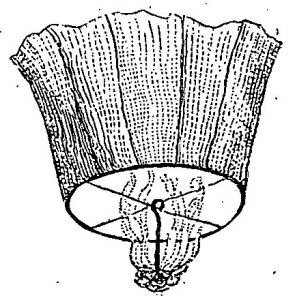
In balloons bought at stores the fire-ball is fastened where the fine wires intersect one another at the mouth of the balloon (Fig. 8). When inflating the balloon by means of the stove-pipe, the fire-ball will have to be removed, as otherwise it would be destroyed when holding the mouth of the balloon over the top of the pipe. After removing the ball, fasten it on a thin wire hook so that the instant the balloon is inflated the fire-ball can be lit and hooked on to its position in the centre of the mouth of the balloon (Fig. 8). By this means the balloon will remain inflated at least one half-hour longer, and will travel many miles further than when relying entirely for a supply of hot air from the fire-ball alone.
When sending off a fire-balloon at night, the hook must be shortened up close to the mouth of the balloon, so that the entire body of the balloon is illuminated; for daylight effect the hook is made longer, as shown in the picture. The best material for making the fire-ball is cotton batting saturated with a solution of two-thirds alcohol and one-third turpentine. It is a good plan to attach a postal card on which your address is written, and a request to the finder of the balloon that he will mail the card back to you with a memorandum on it where and at what time the balloon arrived. In this way you will know exactly how many miles and at what rate of speed your balloon has travelled.