Part I.
Reading edition
In 1740 the English fitted out a fleet against the Spaniards, among which was the Wager, an old East India-man that had been transformed into a man-of-war.
In those days there were no iron-plated vessels, and the main difference between traders and ships of war lay in their guns. But the Wager was not a good ship, to begin with, and was now laden and encumbered with every description of military stores. Moreover, her crew consisted chiefly of "pressed men"—men who, having just returned from long voyages on their own account, had been seized, perhaps just as they reached their native land, and made men-of-war's men against their will, as was then the custom.
In England and America we should think the system employed by other nations of compelling men to become soldiers, their lot being decided by a number drawn from an urn, most intolerable; but the old system of "pressing" for the navy was far worse. Going to sea was not then looked upon as now as an honorable profession, with its compensations and pleasures, and not more difficult and dangerous than many another way in which the poor man has to earn his living. A sea-faring life, owing to the miserable equipment of the ships and the insolence and brutality of the officers, was considered by many a lot to which death was almost preferable. To obtain sailors for merchant vessels was so difficult that gangs of men were sent out who would overpower and seize any able-bodied man they might find in the streets, carrying him aboard a vessel at night, and keeping him in confinement until away from land, when he would be released and compelled to do his share in managing the vessel. Any attempt at remonstrance would be promptly quelled by blows and injuries of a fouler character.
It is not to be wondered at, therefore, that among the crew of the Wager, made up as it was in this way, a spirit of insubordination and a hatred of authority existed. This will explain many things that happened on this unhappy voyage that would otherwise be hard to believe.
The vessel had always difficulty in keeping up with the rest of the squadron; and meeting with a gale on the 7th of April, was so greatly shattered and disabled that she lost sight of her sister ships altogether, and could obtain no help from them. The place of rendezvous was the island of Socoro; but the weather was too bad to take an observation, as it is called, whereby to judge of her position. There were no charts on board of the neighborhood whither she had been driven, but an "abundance of weeds and the flight of certain birds" indicated her approach toward land of some sort.
The gale by this time had reduced the vessel to a mere wreck, and every endeavor was made to keep her from going ashore. It was difficult enough to set the top-sails, since "it was so extremely dark that the people could not see the length of the ship, and no sooner had it been accomplished than the wind blew them from the yards."
At four in the morning of the 14th, though she had her head to the west, and was therefore standing off shore, the Wager struck violently on a hidden rock. It helps us to picture the force of waves in storm to learn that the people on board at first took this concussion for the mere striking of a heavy sea. But the next minute the ship was laid on her beam ends, and the sea made a fair breach in her.
The consequence of this was an almost universal panic. Those who were not drowned in their berths rushed up on deck, and many appeared deprived of reason. One man, armed with a cutlass, struck at every one about him, and had to be knocked overboard, and another, "though one of the bravest men on board," was so dismayed by the terrible aspect of the breakers that he tried to throw himself over the rails of the quarter-deck. Others abandoned themselves to sullen despair, and were carried to and fro, with every shock of the ship, like inanimate logs.
The man at the wheel, however, kept his station, though both rudder and tiller were gone, and Mr. Jones, the mate, cried out, in order to encourage the crew: "What, my men, did you never see a ship among breakers before? Come, lend a hand; here's a sheet, and here's a brace; lay hold. We shall bring her near enough land yet to save our lives." This was the more creditable in him, as he knew what "breakers" were, and had a firm conviction in his own mind, as he afterward confessed, that nothing short of a miracle could save them.
But the ship drove on, and contrived to strike just between two large rocks. One of them partially sheltered her from the beating of the sea, which nevertheless threatened every minute to rend her to pieces.
As soon as day dawned, the barge, the cutter, and the yawl were launched, though with the greatest difficulty, and so "many leaped into the first that she was greatly overloaded." The bonds of discipline, it will thus be seen, were already relaxed; nor must the saying of the Captain, that "he would be the last man to leave the ship," be set down as very heroic, for Captain Cheap had recently dislocated his shoulder, and would have found getting into a boat a very difficult job indeed. Of all those in authority with whom we have to deal in these scenes of peril and privation, Captain Cheap, of the Wager, was, I think, the most selfish and incompetent. At the same time, as will be seen in the sequel, he had plenty of courage. Even on the present occasion, as Midshipman Byron witnesses, the Captain issued his orders "with as much calmness as ever he had done during the former part of the voyage."
But only a very few obeyed him. Many of those who had not gone in the boats "broke open every box and chest they could reach, stove in the heads of the casks of wine and brandy," and got so helplessly intoxicated that "they were drowned on board, and lay floating about the decks for days afterward."
Those who had reached land in the boats, the number amounting in all to no less than 140 persons, had but little to congratulate themselves upon. Whichever way they looked, horror and desolation presented themselves: on one side the wreck, containing all they had to subsist upon; on the other, bleak and barren rocks. They found, however, a deserted Indian hut, into which they crowded for shelter from the storm which still raged.
In the morning the pangs of hunger seized them. Most of them had fasted for forty-eight hours, yet only three pounds of biscuit dust had been brought ashore with them, while all the land afforded had been a single sea-gull and a handful of wild celery. These they made into a kind of soup, which, little as it was among so many, caused the most violent sickness and swooning. The biscuit dust had been put into a tobacco bag which had not been entirely cleaned out, and thus the whole party was very nearly poisoned to death.
The Captain and officers had now come on shore, but many of the crew had refused to do so. The storm continuing worse than ever, however, they got frightened, and since the boats could not be got out to them immediately "they fired one of the quarter-deck guns at the hut" as a gentle reminder.
The men on land occupied a rocky promontory so exceedingly steep that they were obliged to cut steps to ascend and descend it, which they called—not inaptly—Mount Misery. The knowledge that their comrades were in a state of open mutiny did not tend to raise their spirits. They would have been willing enough, perhaps, to leave them to their fate, but for the necessity of getting provisions.
WITH ONE BLOW CAPTAIN CHEAP FELLED HIM TO THE GROUND.
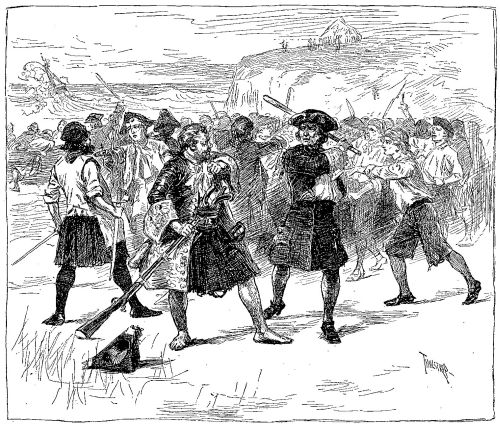
When at last they were brought to land, they presented an extraordinary appearance. They were armed to the teeth, and only by the resolution of the officers, who "held loaded pistols to their breasts," could they be induced to give up their weapons. They had rifled the chests in the cabins, and put the laced clothes they found in them over their own greasy raiment, and the boatswain, their ring-leader, was rigged out in the most splendid attire. One is glad to read that, without respect to the figure he made, Captain Cheap felled him to the ground with his cane, and for a few hours order was restored.
As the hut could only hold a few people, the cutter was turned keel upward, and fixed on props, which made a very tolerable habitation. But food was still so scarce, though the scanty provisions from the ship had been hoarded with great frugality, that the men were glad to eat the carrion crows that preyed on the corpses from the wreck, which every tide cast on shore.
The ship was now under water, except the quarter-deck and part of the forecastle, and all that was procurable from it had to be drawn up by large hooks—"an occupation much obstructed by the bodies floating between-decks."
It was not until the 25th of May (eleven days after the shipwreck) that provisions began to be regularly issued from the store tent, which was guarded by the officers night and day. On the 28th, three canoes with Indians came alongside the wreck, and from them they purchased "a dog or two and some very fine mussels."
The language of these men was utterly unintelligible: their clothing was composed of skins and feathers, and they had evidently never seen a white man before. But the castaways contrived to ascertain from them that they were on some island on the coast of Patagonia, about three hundred miles north of the Straits of Magellan.
[to be continued.]