PART I.
Reading edition
It was in a children's hospital. All down the long ward ran two rows of little iron bedsteads, each covered with its own red quilt with the white cross in the middle; but one cot was different from all the rest. It was all of shining brass, to begin with, and it had a little canopy, which none of the others had, and pretty soft curtains of pale blue, with a pattern of white daisies scattered all over them; even the bands that caught back the curtains were wreaths of daisies; and the dainty blue coverlet had the bright little flowers raised on it so naturally that you wanted to try and gather them.
Just opposite it, on the wall, hung a picture of little fleecy lambs, and the Good Shepherd carrying the smallest and weakest in His arms; and the frame of the picture was of daisies too. All down the walls of the ward there hung bright pictures, but none was so pretty as this, and it hung just where any one lying in the cot could see it best.
Everybody in the whole hospital knew the Daisy Cot and its story: and the nurses had to tell it half a dozen times a day, sometimes; for every fresh visitor who came into the girls' ward was sure to say: "What a pretty little bed! What makes it so different from the others?" And then the Sister (they called the nurses "Sisters" there) would tell how the cot and the picture had once belonged to a dear little girl named Daisy, and how, when the angels came and took her away from this world, her heart-broken mother could not bear to look at the empty bed, but sent it here, that some poor sick child might always use it, and stay in it until she was quite well again. More than once, before Sister Theresa's simple tale was done, a bright round drop fell quietly down among the daisies, for some of the visitors were mothers themselves, and couldn't help thinking of the precious babies at home.
One day there was a small excitement all down the ward. Heads popped up from one bed after another, and black eyes and blue exchanged signals, while half a dozen shrill voices at once called across to each other: "Oh, I say, just look here! There's a new Daisy in the cot."
So there was; and such a queer little flower this time! A tiny, tiny girl, with a white still face—as white as any of the daisies on the quilt—and such a wonderful head of tight red-gold curls as none of them had ever seen in all their lives.
"Daisies oughtn't ter have red hair," said one small damsel, with a great idea of the eternal fitness of things.
"Oughtn't they?" laughed the Doctor, who was busy tying a card to the brass rail at the foot of the cot, with the new Daisy's name, and her illness, and the food she was to have, written on it. "But I've seen daisies with red tips in Scotland, I can tell you. All the same, I like the big white ones better. There, nurse," he went on, as Sister Theresa's noiseless step drew near, "there's your new patient; Mercy Trafford is her name, and I shouldn't wonder if a story went with it. What did the people say who brought her in?"
"Yes, there is a story, and a sad one too," said the sweet-voiced Sister. "It seems her mother died last winter, and her father, a poor artist, was killed in a street accident a few weeks ago. Since that, the people in the house where she was have taken some sort of care of her, until last night, when the place caught on fire, and she was just saved from death, poor baby! But there must have been a fall, you know, to account for that broken leg, and the other injuries."
"Humph!" said the Doctor. It was rather a favorite exclamation of his, and had earned him, with some of his lady patients, the character of being a regular bear; but the bear had a warm and tender heart under his great rough coat, and the smallest baby in the hospital would look up in his face with a laugh, and try to snatch at his shaggy locks, as he bent over its crib.
Many, many long days went by before the new Daisy could do anything but lie with closed eyes and a drawn white face. Ah! those were weary, sorrowful days; and sometimes they began to fear the poor wee mite would never run about again, and that made them very sad, for her sweet, patient little ways had taught them all to love her. But at last there came a day when the Doctor looked less grave, and the Sisters nodded to each other over the cot, and said, "I really think she'll do now, do you know?" And then, at last, two big blue eyes opened wide, and a sweet high voice was heard to say, "Oh, please, I is so hungry!"
I don't know why they should all have accepted her from that very moment as the pet of the ward, but so they did; and never did Queen reign with more gracious dignity than did Miss Mercy.
Not that she went by that name, however; for the very first time any one ventured to call her by it, she answered, with stately emphasis, "I not Mercy now; I Daisy." So Daisy it became with everybody from that time forth—except the Doctor, that is.
"You a Daisy?" he said, standing before her, with both hands in his pockets. "Fiddlesticks! you're nothing but a white mouse. Mercy's a mistake—it's Mousie;" and Mousie he persisted in calling her.
THE NEW DAISY.
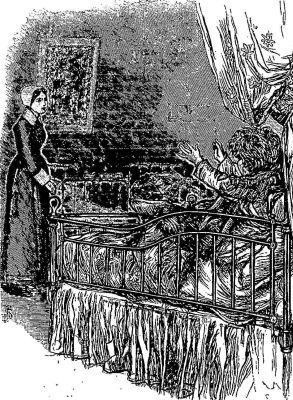
It was not long before she began to catch up the little story she heard so often about her own cot, and "My lady, my tind lady," became her great interest and topic of conversation. She tied up her handkerchief into something like a doll, and called it "my pitty lady," and she would lie and talk to it by the hour together in low cooing tones. Her picture, in its daisy frame, was a great delight too; she had a name for each of the fleecy lambs, and wished them all "dood-morning" as soon as she awoke, in that clear ringing voice of hers. So sweet a voice it was, and so like a bird's, that the Sisters used to declare it was like listening to an angel to hear her sing grace; and you would sometimes see a Sister in white cap and apron speeding down a passage with suspiciously wet eyes, murmuring "Bless her!" as the last "Amen" sounded through the wards.
Christmas-eve came, and with it a grand stir and bustle in the hospital: something was going to happen, though nobody quite knew what. Many and varied were the surmises. "I guess it's going to be real bears and lions from the show," said one girl, who was blessed with a rich imagination; but several nervous little patients shrieked so energetically at the idea that she hastily added, "But perhaps they'll be dead and stuffed." Curiosity had full swing, for each bed had been carefully shut in all day by its own folding-screen, and not a glimpse could be got, even through the cracks, of what was going on in the middle of the room.
DR. SANTA CLAUS.
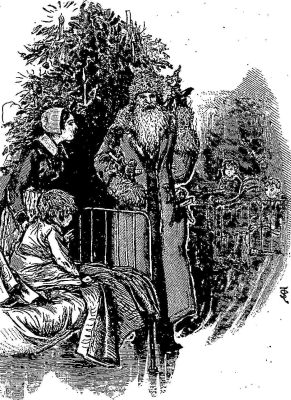
But at last, when the gas was lit, the Doctor's voice was heard to give a word of command, and all the screens were folded up as if by magic, while a cry of wonder and delight burst from every mouth. The walls were all festooned with evergreens and paper roses, and in the midst there rose a Christmas tree, the most magnificent and imposing tree any of them had ever beheld, lit up with countless brilliant candles, hung with toys and beautiful glittering things, and presided over by— Could it be the Doctor? Oh no; it was a real Santa Claus, who had borrowed the Doctor's voice for that evening only. And with what delightful jokes and funny speeches did he unfasten the strange, beautiful fruit from its tree, and distribute it to the rows of eager, excited little people! There was a present for everybody—even the Sisters were not forgotten; and when all the laughing and rejoicing had begun to subside, and tea came in on the tiny wooden trays, there was not only the usual mug of milk and the well-known pile of bread and butter, but real poached eggs, and actual baked apples too!
As for the little Daisy, she had, besides the toys from the tree, a box of great golden oranges, and a perfectly lovely doll, with eyes that opened and shut, and a head that turned round; and box and dolly were labelled, "For the Daisy Cot, from E. M. B."; and as she had already begun to know from past experience of similar gifts, "E. M. B." was "my tind lady."
Long, long after tea was eaten and cleared away, and the ward tidied up and settled for the night, wee Mercy's blue eyes were still wide open, as she lay with the queer shining rings of red-gold hair pressed into her white pillow. The fact was that the busy brain wouldn't go to sleep; for Mercy was trying with all her baby might to think of something she could give the lady who had been so "tind" to her. But she had nothing of her own—not a single thing; and while impossible visions of dolls and candy and all the possessions which seemed to herself most desirable flitted through her mind, she grew wearier and still more weary, until at last they all ended in the land of dreams.
[to be continued.]
SCRAPING ACQUAINTANCE.—Drawn by S. G. McCutcheon.