Chapter VI
Reading edition
When the boys awoke, soon after dawn, a thick fog hid everything except the oyster sloop from their view. The crew of the latter were already on deck, and as soon as the Captain saw that the boys were putting away their blankets, and getting out their breakfast dishes, he invited them to come to breakfast. There is nothing more cheerless than cooking your own breakfast in a cold wet fog, and the young yachtsmen, who were feeling rather tired in consequence of loss of sleep and the excitement of the previous night, were glad to accept the Captain's invitation. Harry, foreseeing that the oystermen's coffee would not be quite suited to his fastidious taste, and also desiring to make some return for the Captain's kindness, asked to be allowed to furnish the breakfast table with coffee made by himself. The oystermen were pleased with the proposal, and Harry, taking the Ghost's coffee-pot to the galley, made what the Captain declared was the "bulliest" coffee he had ever drank.
They sat down to breakfast in the cozy little cabin of the sloop, and the Captain told them all about the oyster fishery. He was on his way to Amityville, where he lived, with a cargo of clams; for during the summer months, when there was no demand for oysters, he loaded his vessel with clams and scallops, which are in season all the year round. He prophesied that the fog would last all day, but assured the boys that by steering due northeast by compass, they would reach the northern shore of the bay, and could then safely pursue their voyage by keeping close to the land, where the deepest water in the Great South Bay is usually found. During the night the tide had ebbed, leaving the sloop aground in the mud, and it would be several hours before she would be afloat again. The boys would have preferred to let the sloop lead the way, and to follow her through the fog, but they did not care to wait until she would be afloat. So bidding their new friends good-by, they hoisted their sails, and with a fair breeze, just strong enough to give their boat steerage-way, they started to cross the bay.
They neither saw nor heard any other boats during the hour that they sailed silently on the course given them by the Captain of the sloop. At first they felt a little nervous, and had a dread of being run down by some big schooner or other craft; but in a little while they began to enjoy the novelty of sailing in a dense fog, and were rather sorry when the Ghost unexpectedly ran her bow against the low shore of the mainland of Long Island.
What to do next was the question. Nobody wanted to spend the day moored to the shore, and waiting for the fog to lift; and as Charley, in consulting the chart, found that the shore-line was very irregular, indented with a succession of long narrow bays separated by low sandy capes, neither he nor his comrades liked the idea of keeping close to it, and thus wasting time in a very uninteresting way. While they were still studying the chart, they heard what was evidently a breakfast bell ringing a little to the west of them.
"That bell must be in Amityville," said Charley, "and we must be close by this little creek that is laid down on the chart. Now let's find that creek, and then we'll know exactly where we are, and can tell what course to steer without following the shore."
"I'll go ashore," said Harry, "and hunt up the creek, and get some eggs, and a loaf of bread. It will be twice as much fun to sail straight ahead through the fog as it would be to keep along shore, just as if the Ghost was a canal-boat."
"I'll go with you," said Joe. "I am getting the cramps sitting still in this boat so long."
The two explorers stepped ashore, and immediately vanished in the fog. Charley and Tom presently heard a dismal exclamation in Joe's unmistakable voice, and in a short time he returned, announcing that the creek was only three or four boat-lengths distant. He was dripping with water, having found the creek by unexpectedly walking into it from off a boat-landing.
"Wet again, boys," he remarked, sadly, as he proceeded to find a dry shirt and trousers. "The next time we go cruising, I'm going to wear a water-proof suit like Captain Boyton's. This is our fourth day out, and I've fallen overboard twice, been rained on once, and walked off a pier once. I wonder how it would do to rub myself all over with oil. Do you think I'd shed water then?"
"You couldn't rub yourself with oil, and then put your clothes on, without getting them all greasy," observed Tom.
"Then I won't try oil; but the least you fellows can do is to wring me out. I can never get myself dry by rubbing with a towel."
"We'll wring you as soon as we get time," said Charley, kindly. "We'll begin with your neck, if you say so. But here comes Harry with the provisions. Shove the boat off, Tom, and we'll steer for a big cape that is just this side of Islip. The end of the cape ought to bear just east-northeast from the mouth of the creek Joe discovered."
IN THE GREAT SOUTH BAY.
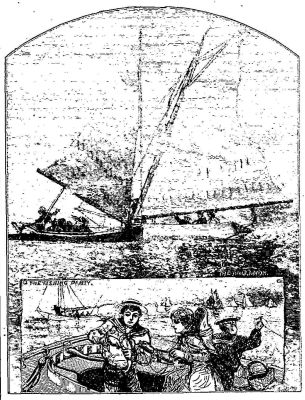
The Ghost was soon under sail again, and the shore was lost in the fog. The breeze freshened a little, but the fog remained as thick as ever. Occasionally a fog-horn could be faintly heard in the distance, but whether it was blown on board a vessel on the bay, or a vessel at sea a little distance beyond the beach, it was impossible to tell.
"We ought to have brought a horn along with us," remarked Charley; "and it would be a good idea to stop somewhere and buy one. We ought to have green and red side-lights too. We haven't any right to sail at night without them."
"Why don't you insist on having a surgeon and a chaplain, and two or three life-boats, while you're about it?" said Joe. "You forget that the Ghost isn't a man-of-war going on a three years' cruise. We can get along without such luxuries as side-lights and surgeons. I'll tell you one thing we do want, though."
"What's that?" asked Charley.
"We want somebody on the look-out in a fog like this."
"That's so," exclaimed Charley. "I forgot all about it. Go to the bow, Joe, and keep the sharpest kind of a look-out. Boys, I'm not fit to be Captain, for I've neglected one of the first duties of an officer."
"We'll forgive you," said Harry. "Especially as I don't believe there's another boat on the bay to-day."
"Of course there isn't really much danger of running into anything, unless it may be a sloop lying at anchor. Still, we—"
"What's that?" exclaimed Tom.
"Sail on the port bow!" yelled Joe, at the top of his lungs.
While Joe was still speaking, the mainsail of a big cat-boat suddenly loomed up through the fog, and before the least thing could be done to avoid a collision, the strange boat struck the Ghost amidships, and a chorus of girls' voices cried out, "Oh, my!"
"No harm done," called out Charley. "Let go the jib-sheet, Joe. Now hold on to the side of that boat, boys, and don't let her get away till we see if she is damaged." So saying, he put the helm hard down, bringing the Ghost up into the wind. The other boat had already dropped her sail, and the two vessels were soon lying quietly side by side.
On board the cat-boat were four girls, three of them about fourteen years old, and the fourth about ten. There was also a boy, who did not seem to be as old as Joe, but who was apparently one of the "Bay boys," who spend most of their time during the summer in sailing boats of various kinds, and who at twelve years old are often thoroughly good sailors. The boy did not seem in the least alarmed, but the girls were terribly frightened.
"Do, please, help us," implored the tallest and prettiest of the four, addressing Charley almost as respectfully as if he were a man. "We are awfully afraid to be out here in this fog."
"May I ask how you came to be out here?" asked Charley.
"Why, we started to go on a fishing picnic, and there wasn't any fog when we started. Father and all the ladies and gentlemen are in the other boat, and we've got all the provisions. We were going to an island somewhere—I don't know where—to have dinner, and to go fishing; but the fog came up, and we got lost, and we're so frightened!"
"I ain't lost very much," said the Bay boy; "that is, I can find my way back to the shore by the wind; but I hain't got no compass, and I don't feel very sure about fetching the island."
"When did the fog come up?" asked Charley.
"About three hours ago. It come up from the south-west, and if you've come that way, you've had it longer than we have."
"I don't exactly see how we can help you," said Charley to the girl who had spoken to him; "but we'll all be delighted to do anything we can. If you like, we'll keep together, and try to find the island."
"Oh, I do wish you would!" exclaimed the girl. "It's so dreadful to be all alone in this awful fog."
"Do you know how the island bears from the place where you started from?" Charley asked the Bay boy.
"Put me back there, and give me a compass, and I could hit it to an inch. Just try me once."
"We've got a compass," said Charley. "Let's run over to the shore and get our bearings, and then we'll head for the island."
This proposal delighted the girls, and accordingly both boats set their sails again, and running side by side, soon reached the shore. The Bay boy declared that he now knew exactly where he was, and what course to steer for the island.
"We want to steer a little east of south, and we'll fetch it," he said. "You go ahead with your boat, and keep her south, half east, and I'll follow right after you."
"You won't run away from us, will you, sir?" asked the pretty girl: and Charley thought that he had never seen anything half so pretty before.
"If you don't mind," he said, "I'll come on board your boat, and then you'll feel sure that our boats will keep together. Only you mustn't call me 'sir.' You take the helm, Tom," he continued, "and keep her south, half east; and you'd better slack the peak a little, or else you'll out-sail us."
Without waiting to have his offer accepted, Charley sprang on board the cat-boat, and after trimming the sheet, sat down, half frightened at his rashness in thrusting himself among a boat-load of girls.
"Are you staying near here, sir?" asked the pretty girl.
"No. We're from New York, and bound on a cruise through the South Bay. That is, the other boys are from New York, but I am from Annapolis. I'm in the navy."
"In the navy!" exclaimed all the girls together. "Aren't we in luck, Nina," added one of them, addressing the girl who had won Charley's admiration, "to have a naval officer to take care of us? Now I don't mind the fog one bit."
"I'm not much of an officer yet," said Charley, laughing; "and you've got somebody here who can manage a sail-boat better than I can."
"Are you a lieutenant, sir, or a captain of the fore-top?" asked Nina.
"I'm only a cadet midshipman; but you really mustn't call me 'sir.' My name is Charley Smith, and I'd be awfully obliged if you'd call me Charley."
"And mine's Nina Stone; and as everybody calls me Nina, I suppose you ought to."
So in a few minutes Charley and Nina were talking like old friends, and the young Captain of the Ghost found the time pass so pleasantly that he was sorry when, after a long sail, the island was reached, and the missing boat found at anchor, with all her passengers engaged in fishing for weak-fish.
Mr. Stone, the father of the pretty Nina, was greatly relieved at the arrival of his daughter; and when she had told him how the Ghost and her Captain had gone out of their way to escort the cat-boat to the island, he shook Charley and his companions warmly by the hand, and insisted that they should stay and join the picnic party at dinner. The fog was already beginning to grow thinner, and there was every prospect that it would soon vanish, and that the sun would come out. The boys were getting hungry, and were not at all averse to spending the afternoon in fishing. So they accepted Mr. Stone's invitation, and the whole party went ashore, and had a delicious dinner of fresh weak-fish, broiled on the coals. After dinner they went on board the boats, pushed out in the channel, and anchoring, devoted the rest of the day to fishing. The sun was now shining brightly, the fish were abundant and ravenous, and the pretty Nina was fishing by the side of Charley, who baited her hook, and took off her fish as fast as she caught them. When the two cat-boats finally hauled up their anchors, and prepared to return home, the boys felt as if they were parting from old friends. Mr. Stone invited them all to come and see him in New York, and Miss Nina told Charley that she should never forget his kindness to her. When her handkerchief could no longer be seen waving over the waters, Charley said that he was tired of fishing, and thought the cabin had better be rigged up, and that all hands had better turn in early.
It was a rather gloomy ending of a delightful day. The young Captain evidently felt very little inclined to talk.
"If we meet any more pretty girls," whispered Joe to Harry, as they were lashing down the sides of the cabin, "we'll have to get a new Captain. I can't see what some fellows see in girls. They can't play foot-ball, nor wrestle, nor do anything rational, and I'd like to know what use they are, anyway."
"Girls are all very well in their place," said Harry; "but I don't think they ought to go sailing. They can do sums, for instance, for my sister does mine for me sometimes. But I say, that was a pretty girl, though, wasn't she? and she seemed real nice and jolly."
"She's the best girl I ever met," exclaimed Tom.
"That's so," said Joe. "I was only pretending not to think so, because I didn't want to make Charley jealous. I tell you what, boys, we'll get her to go fishing again with us some day."
[to be continued.]
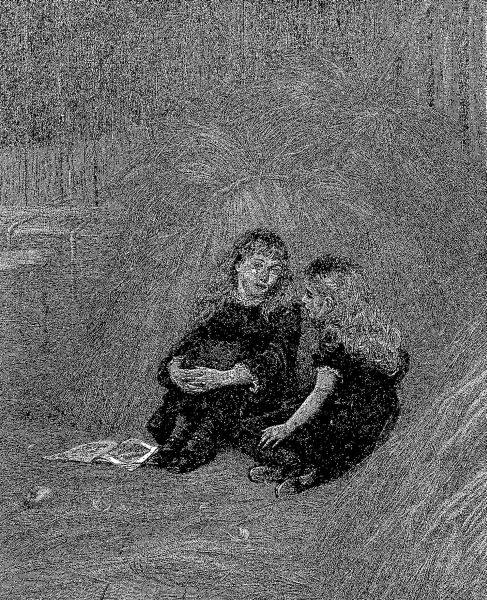
"IN THE BARN."—From a Painting by H. Allingham.