Part 2 — WONDERFUL FIRE-WORKS.
Reading edition
BY A. W. ROBERTS.
Among the many ingenious devices of the Chinese and Japanese in the way of Hirayama, or day fire-works, is a huge bomb, which, when fired off, ascends to a great height and explodes, at the same time releasing hundreds of highly colored paper figures of both patriotic and comic designs.
Other varieties of this new Japanese day fire-work set free innumerable miniature Japanese fans, parasols, and small toys, or produce grotesque and beautiful designs in colored smoke. I have tried to give you in the illustration an idea how they look.
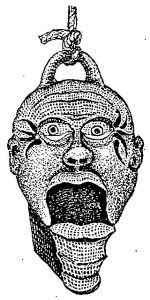
As each one of you boys who are well enough to go about is sure to set off a certain number of "paper caps" before night comes on this Fourth of July, 1882, I want to call your attention to a little toy that is not only most novel and comical, but which will insure you against all dangers from these explosives. It consists of a clown's head with a movable jaw. At the top of the head a long string is fastened. A paper cap is placed in the clown's mouth, and by means of the string the head is caused to strike the pavement, the concussion causing the cap to explode. All first-class conscientious dealers in fire-works are refusing to sell the dangerous and so very often fatal toy cartridge pistol, for which the clown's head forms such an excellent substitute.
BROTHER JONATHAN.
The origin of this term, as applied to the United States, is as follows:
When General Washington, after being appointed commander of the army of the Revolutionary war, came to Massachusetts to organize it, and make preparations for the defense of the country, he found a great want of ammunition and other means necessary to meet the powerful foe he had to contend with, and great difficulty to obtain them. If attacked in such condition, the cause at once might be hopeless.
On one occasion, at that anxious period, a consultation of the officers and others was held, when it seemed no way could be devised to make such preparations as were necessary. His Excellency Jonathan Trumbull the elder was then Governor of the State of Connecticut, on whose judgment and aid the General placed the greatest reliance, and remarked, "We must consult Brother Jonathan on the subject."
The General did so, and the Governor was successful in supplying many of the wants of the army. When difficulties afterward arose, and the army was spread over the country, it became a by-word, "We must consult Brother Jonathan." The term Yankee is still applied to a portion, but Brother Jonathan has now become a designation of the whole country, as John Bull has for England.
"DUCK."
"Duck" is a game that should be played by a number exceeding three, but not more than six or eight. Each of the players being provided with a large pebble or stone about twice the size of a cricket-ball, called a "duck," one of them, by chance or choice, places his duck on a large smooth-topped stone fixed in the ground. An offing being marked at eight or ten yards' distance from the stone, the other players cast their ducks at it in turn, endeavoring to knock the duck off its place.
Each player, as soon as he has cast his duck, watches for an opportunity of carrying it back to the offing, so as to cast again. If the player whose duck is on the stone can touch another after he has taken up his stone, and before he reaches the offing, provided his own duck remain on the large stone, then the player so touched is out, and changes places with the player at the stone. It sometimes happens that three or four of the players' ducks lie so close together that the player whose duck is on the stone can stand in a situation to be within reach of all of them; in this case they can not, without running the risk of being touched, pick up until one of those who are at the offing is lucky enough to strike the duck off the large stone; then, before its owner can replace it, which he must do before he can touch a player, they all take up their ducks and run to the offing, where, of course, they are safe.
Another way of playing this game is to mount three or four brickbats one on top of the other, and to try to dislodge the upper one by throwing the duck at it before the keeper of the castle can touch the thrower. The player so touched becomes keeper.
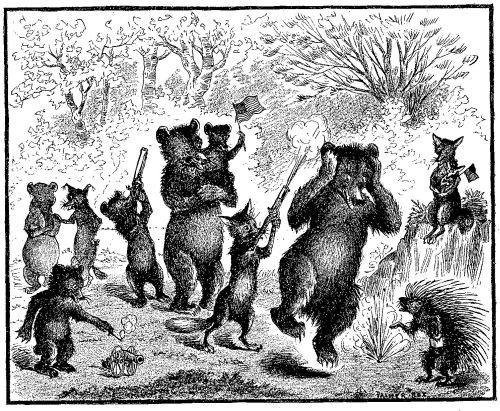
CELEBRATING THE FOURTH OF JULY IN THE WOODS.