Part II.
Reading edition
With their privations, insubordination increased. Some separated themselves from the rest, and settled a league away; some built a boat, and going up the lagoons about the island, were never heard of more. Worse than all, some in authority misbehaved themselves, especially a midshipman named Cozens, who had gained some influence over the men.
Cozens had a dispute with the surgeon; then he quarrelled with the purser, and was unquestionably of a mutinous disposition. Still it is certain that Captain Cheap exceeded his powers when he drew out a pistol and shot Cozens down. What was worse, he refused permission for the wounded man to be carried into the tent, "but allowed him to languish for days on the ground, and with no other covering than a bit of canvas thrown over some bushes," until he died.
Unhappily Captain Cheap distinguished himself in nothing but severity. He never shared the sufferings of his men when he could help it; and though our narrator, Midshipman Byron, stuck to him to the last, it is plain he thought him a worthless creature.
This loyal young fellow was of good family, and became grandfather of the great Lord Byron, into whose imagination never entered stranger things than actually befell his ancestor.
The midshipman had built a little hut, just big enough to contain himself and a poor Indian dog he found straying in the woods. To this animal in his misery he became much attached. But a party of seamen came and took the dog by force, and killed and ate it. Indeed, three weeks afterward, when matters became much worse, Byron himself, recollecting the spot where the poor animal had been killed, "was glad to make a meal of the paws and skin which had been thrown aside."
The straits to which they were by that time reduced sharpened their ingenuity to the utmost. The boatswain's mate, having procured a water puncheon, lashed a log on each side of it, and actually put to sea in it, like the wise men of Gotham in their bowl, and with the assistance of this frail bark he provided himself with wild fowl while the others were starving. Eventually he suffered shipwreck, but was so little discouraged by it that out of an ox's hide and a few hoops he fashioned a canoe "in which he made several voyages."
In the mean time the hope of all these poor people lay in the building of a vessel out of the materials of the long-boat, with other timber added. This task was at last accomplished. Captain Cheap's plan was to seize a ship from the enemy, and to join the English squadron; but the majority of the hundred men, to which number starvation had reduced the castaways, were in favor of seeking a way home through the Straits of Magellan.
About this there arose a quarrel, and eventually the men threw off the Captain's authority altogether, left him on the island, and sailed away. A lieutenant of marines, Byron, and a few others remained with him. These were presently joined by some deserters who had settled on another portion of the island, so that their number now amounted to about twenty.
Their only chance of escape was in the barge and yawl, which in the absence of the carpenter were patched up so as to be fit for a fine-weather voyage. Even now their scanty stock of useful articles was diminished by theft, and two men were flogged by the Captain's orders, and one placed on a barren islet void of shelter. Two or three days later, on "going to the island with some little refreshment, such as their miserable circumstances would admit, and intending to bring him off, they found him stiff and dead."
All this time the weather was very tempestuous, but the occurrence of one fine day enabled them to hook up three casks of beef from the wreck, "the bottom of which only remained." These being equally divided, recruited for the time their lost health and strength.
On the 15th of December they embarked, twelve in the barge and eight in the yawl, and steered for a cape apparently about fifty miles away. But ere they reached it a heavy gale came on. The men were obliged to sit close together, to windward, in order to receive the seas on their backs, and prevent them from swamping the boats, and they were forced to throw everything overboard, including even the beef, to prevent themselves from sinking. As it was, the yawl was lost with half its crew.
The survivors, with the occupants of the barge, reached a small and swampy island, where bad weather confined them for days. There they ran along the coast, generally with nothing to eat but sea-tangle. At length they ate their very shoes, "which were of raw seal-skin."
It now became evident that the barge could not accommodate the whole party with safety, and as it had become a matter of indifference whether they should take their wretched chance in it or be left on this inhospitable coast, they separated. "Four marines were left ashore, to whom arms, ammunition, and some necessaries were given. At parting they stood on the beach and gave three cheers" (what cheers they must have been!) "for their comrades. A short time afterward they were seen helping one another over a hideous tract of rocks. In all probability they met with a miserable end."
Finding it impossible to double the cape, which had been the object of their journey, the rest returned to Mount Misery and Wager Island. Here they found some Indians, the chief of whom, on promise of the barge being given him, promised to guide them to the Spanish settlements.
Upon this voyage their sufferings, notwithstanding what they had already undergone, may be said to have commenced. Mr. Byron at first steered the barge, but one of the men dropping dead from fatigue and exhaustion, he had to take his oar. Just afterward, John Bosman, "the stoutest among them," fell from his seat under the thwarts with a cry for food. Captain Cheap had a large piece of boiled seal in his possession, but would not give up one mouthful. Byron having five dried shell-fish in his pocket, put one from time to time into the mouth of the poor creature, who expired as he swallowed the last of them.
Having landed in search of provisions, six of the sailors took an opportunity of deserting in the barge, leaving Captain Cheap, Lieutenant Hamilton, Mr. Byron, Mr. Campbell, and the surgeon—in short, all their surviving officers behind. The Cacique, as the Indian chief was called, had now no motive to assist them save the hope of possessing Byron's fowling-piece, and of receiving an immense reward should they ever be in a position to pay it. It was with difficulty that they could persuade him to continue his assistance. His wife, however, arrived in a canoe, and in this frail craft, which held but three persons, the chief took the young midshipman and Captain Cheap on a visit to his tribe. After two days' hard labor, in which we may be sure the Captain did not share, they landed at night near an Indian village. The Cacique gave the Captain shelter, but the poor midshipman was left to shift for himself. He ventured to creep into a wigwam where there was a fire, to dry his rags. In it were two women, "one young and handsome, the other old and hideous, who had compassion on him, gave him a large fish, and spread over him a piece of blanket made of the down of birds." The men of the village, fortunately for him, were absent, and for some time he was well cared for by his two kind hostesses.
Byron's life here was a romance in itself. The occupation of the women being to provide fish, he accompanied them in their canoe with the rest. "When in about eight or ten fathoms of water, they lay on their oars, and the younger of the women, taking a basket between her teeth, dived to the bottom, where she remained a surprising time. After filling the basket with sea-eggs, she rose to the surface, delivered them to her companion, and taking a short time to recover her breath, dived again and again."
When the husband of these two women returned, he expressed his dissatisfaction at the kindness they had shown the stranger by taking them in his arms and brutally dashing them against the ground. But notwithstanding this, these good creatures "still continued to relieve the young midshipman's necessities in secret, and at the hazard of their lives."
After a while the whole party returned to Mount Misery, where they found those they had left on the verge of starvation, and in the middle of March they embarked in several canoes for the Spanish settlements. The surgeon now succumbed to his labors at the oar; Campbell and Byron rowed like galley-slaves, but Hamilton, strange to say, did not know how to row, and Captain Cheap "was out of the question." He and the Indians had seal to eat, but the rest only a bitter root to chew; and as to clothing, Byron's one shirt "had rotted off bit by bit."
BYRON CARRYING THE CAPTAIN'S SEAL.
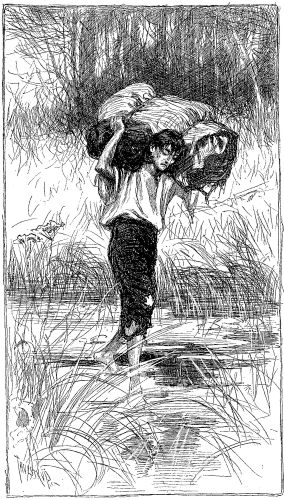
The party landed, and the canoes were taken to pieces. Every one, man and woman, with the usual exception of Cheap, had to take his share of them; Byron had, besides, to carry for the Captain some putrid seal in canvas. "The way being through thick woods and quagmires, and stumps of trees in the water which obstructed their progress," the poor midshipman was left behind exhausted.
After two hours' rest, and feeling that if he did not overtake his companions he was lost indeed, he started after them without his burden. But on coming up with them he was so bitterly reproached by the Captain for the loss of his seal and canvas that he actually returned five miles for them. After two days of absence from his companions he again rejoined them, in the last extremity of fatigue, but "no signs of pleasure were evinced on their part."
Eventually, after days of terrible suffering, they reached the Spanish settlements at Castro, where, strange to say, they were received with humanity. But as to eating, "it would seem as if they never felt satisfied, and for months afterward would fill their pockets at meals in order that they might get up two or three times in the night to cram themselves." Even Captain Cheap was wont to declare that "he was quite ashamed of himself," from which we may certainly infer that their conduct was gluttonous indeed.
The Englishmen, though well fed, received no clothing, and were carried through the country by the Governor of Castro in a sort of triumphal progress. At one place a young woman, the niece of the parish priest, and bearing the appropriate name of Chloe, fell in love with young Byron. He did not wish for this union, but he confesses that what almost decided him to become her husband was the exhibition by her uncle of a piece of linen, which he was promised should be made up at once into shirts for him if he would consent. "He had, however, the resolution to withstand the temptation."
From Castro the English officers were taken to Santiago, the capital of Chili, where a Spanish officer generously cashed their drafts on the English consul at Lisbon. They received the sum of six hundred dollars, with which sum they purchased suitable equipments. They remained at Castro two years on parole, and eventually reached France, and thence escaped to England, after a series of hardships and adventures such as have rarely been equalled, and which were "protracted above five years."
The adventures of the eighty men who had left Wager Island in the long-boat were little less terrible. Many perished of starvation, and those who had money or valuables offered unheard-of prices for a little food. "On Sunday, the 15th of November," for example, "flour was valued at twelve shillings a pound, but before night it rose to a guinea." There was a boy on board, aged twelve years, son of a Lieutenant Capell, who had died on the island. His father had given twenty guineas, a watch, and a silver cross to one of the crew to take care of for the poor boy, who wanted to sell the cross for flour. His guardian told him it would buy clothes for him in the Brazils, whither they were bound. "Sir," cried the poor boy, "I shall never live to see the Brazils; I am starving. Therefore, for God's sake, give me my silver cross." But his prayers were vain. "Those who have not experienced such hardships," observes the narrator of this scene, "will wonder how people can be so inhuman.... But Hunger is void of compassion." Of the eighty men only thirty survived to reach England by way of Valparaiso.