SEA-ANEMONES.
Reading edition
BY SARAH COOPER.
Many of you, no doubt, have learned, when at the sea-shore, the delight of climbing over wet rocks covered with slippery sea-weed, and peering into the little pools left between the stones to see if the great waves have dropped any treasures from the ocean. Those who have enjoyed this pleasure will gladly recall the sparkling pools, carpeted with rich-colored sea-weeds which half conceal the timid animals that live there.
In such pools the rocks, the shells, and the sea-weeds all have richer tints from the bright water that covers them, and one who loves beautiful things will linger beside the pools as if gazing into enchanted gardens.
On searching these rock pools we should find many curious animals. None would interest us more than the sea-anemone, though when we find it hiding in some dark corner, with its tentacles all drawn in, and looking like a soft brown lump, it may not promise much beauty.
The sea-anemone adheres firmly to the rocks, so we will not pull it off. If we watch long enough we shall see it begin to rise in the middle, and from the summit will creep out, very slowly and softly, beautiful tentacles like a wreath around the top. It is now that this singular animal looks like a flower, and deserves the name that it possesses. I think, though, it is not so much like the anemone as it is like a chrysanthemum or some other flower with a great many petals. You would be charmed with the delicate light-colored tentacles waving gently in the water.
Fig. 1.—Stomach and Chambers of Sea-Anemone.
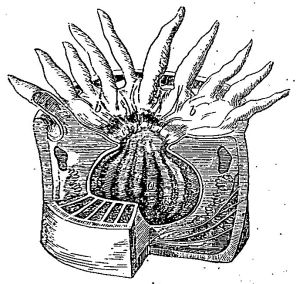
In the middle of the tentacles is the mouth, leading into a hollow sac, which is the stomach. The remainder of the body is divided by partitions from top to bottom into open chambers. In Fig. 1 you will see the stomach at a, and the chambers at b.
There is an opening at the bottom of the stomach through which the food passes after being digested. Sea-water also enters the body through the stomach, and both the water and the nourishment circulate freely through the chambers. Each tentacle is a hollow tube connected at its base with one of the chambers, and readily filled with water. Here we have an explanation of the mysterious manner in which the sea-anemone swells itself out and then shrinks away again. The body and tentacles are enlarged by drawing in water to fill them, and when they are suddenly contracted the water is forced out through the mouth.
The sea-anemone has no hard skeleton whatever; all parts of the body are soft, like a stiff jelly. It can draw its tentacles in out of sight, and it will do so upon the slightest alarm, rolling itself into an ugly lump like the one we found. Allow it to remain quiet for a while, however, and it will blossom out as gorgeously as ever.
When any little crab, or worm, or small fish brushes past the tentacles, the lasso-cells are darted out to paralyze it, and the tentacles seize the prey and pass it to the mouth. The bones or shells which remain after the meal are thrown out from the mouth. The tentacles hold the prey tightly, so that even cunning crabs can not escape, and you know it is not the easiest thing in the world to catch a crab and hold it.
Sea-anemones are greedy creatures. It takes a great deal of food to satisfy their appetites, and their mouths can be extended to receive quite large animals. They eat mussels and cockles by sucking the body out of its shell. Great numbers of sea-anemones, in their turn, are devoured by other animals, their soft bodies offering little resistance.
Fig. 2.—Cluster of Anemones.
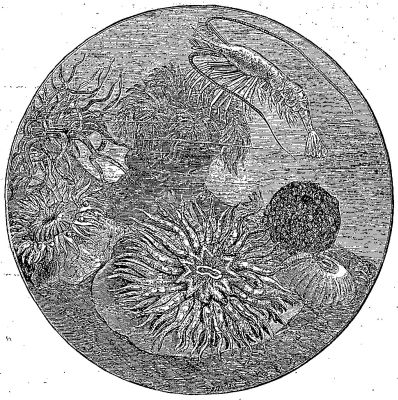
The variety of color in these animals is almost endless. Some of them are rich olive and chocolate colors, or purple dotted with green. One beautiful species has violet tentacles pointed with white; another, red tentacles speckled with gray. This one spreads out its green arms edged with a circle of dead white, while that one opens a milk-white top circled with a border of pink. In Fig. 2 is a cluster, of beautiful anemones. The two small ones at the right show how these creatures look when closed.
Some sea-anemones which live in exposed situations are of a dull, dusky brown, covered with rough warts, while animals of the same species, living in deep water, where there is less need of concealment, have smooth skins adorned with brilliant tints of rose, scarlet, or light green. This is a beautiful provision of Nature for protecting the little creatures by rendering them inconspicuous when left upon rocks by the retreating waves.
The number of eggs produced by sea-anemones seems almost incredible. A single animal is said to throw out three hundred eggs in one day. The eggs are little jelly-like lumps which are formed on the inside of the partitions, and are thrown out from the mouth. After swimming about by means of hair-like appendages called cilia, they settle on some solid body and begin to grow. Sometimes the young ones remain within the body of the parent until their tentacles have grown. They are then ready to settle down soon after reaching the water.
Sea-anemones increase by budding as well as by eggs. At the lower edge of the body little round knobs are sometimes formed, which separate from the parent and grow into perfect animals. If the tentacles or other parts of the body are removed, new tentacles soon grow in their places. If an individual is torn in pieces, each fragment has the power of forming for itself a mouth and throwing out tentacles, and becoming a new sea-anemone, perfect in all its parts.
Most species live in holes among the rocks, attached to stones or shells, over which they slide in a clumsy manner. They are especially fond of deep dark grottoes, and when they have taken full possession of such a place, they may be found clinging to the sides and roof of the cave, and displaying their charms without reserve. Although they do not enjoy the glare of the bright sun, they expand best in mild, clear weather, and remain closed when the sea is rough and stormy.
A few of these animals float on the ocean. One sea-anemone is fond of a roving life, and having no very good means of travelling about, it attaches itself to the back of a certain kind of crab, and accompanies the crab in all its wanderings. There seems to be an attraction between the two, and one is rarely seen without the other.
Another species is mostly found clinging to the shell of a whelk, but for certain good reasons it never clings to a living one. The whelk burrows in the sand. This would be disagreeable and inconvenient to the anemone, so it prefers a dead shell which has been taken possession of by a hermit-crab, and henceforth travels about with the crab. We would scarcely look for affection in a crab, but it has been said that the hermit grows fond of its companion, and that when it has outgrown its shell and has selected a new one, it will carefully lift the anemone from the old home and place it on the new one, "giving it several little taps with its big claws to settle it."
I hope that none of you will fail to hunt up these lovely rock pools when you have an opportunity. The pleasure of a visit to the sea-shore is greatly increased by an interest in the strange forms of animal life which we see there and nowhere else. A glass jar filled with sea-water is often a source of great delight. In it you may drop any strange-looking object that has excited your curiosity. Perhaps this strange object may prove to be some odd little animal which is not yet dead, but which will revive with the touch of the life-giving water.
Most of these animals are timid, but they will expand when they are left perfectly still. In this way we may watch their habits and their hidden beauties. Sea-anemones do nicely in such an aquarium, and as they cling to the side of the jar, we can observe all parts while they are in action. By far the pleasantest way to learn about them is to let them tell their own story. The water must be changed frequently, for impurities are constantly passing from the bodies of even these delicate animals. They will soon die if placed in fresh-water.