HOW THEY HELPED THE DEACON.
Reading edition
BY ADA CARLETON STODDARD.
"Cherries? I should say so! There's no end to 'em—trees are loaded, and red's a burning-bush. I was by there to-day."
It was an intensely eager voice, and Davy Kent, the speaker, ended his little speech with an expressive smack of the lips.
"He'd never miss the few we'd take, would he, boys?" That was Ned Rogers. It was upon a straw pile behind Mr. Rogers's barn that the boys were holding an earnest consultation.
"Miss 'em? No, not if we took twice as many as we will."
"A bushel will be enough to treat the whole crowd, won't it?"
"Oh, any amount."
"Now see here, boys"—and Clem Goodrich lifted himself into a sitting posture and knit his brows thoughtfully as he spoke—"I think—isn't this—doesn't it seem a little bit like stealing? Don't you suppose he'd give us a few if we were to ask him? It looks to me—"
But right here Clem's mild voice was drowned in a roaring, boisterous chorus.
"It's not staling, me boy," said Con O'Brien, with the faintest brogue in the world; "it's only helping ourselves to a few cherries, that otherwise might spoil for want o' the picking, and so be wasted intirely. And if Deacon Gammon don't know it, he'll be none the wiser, for he's got piles and hapes more'n he can take care of. Ten to one he'll be obliged to us for helping him out a little—he isn't a bad old gintleman at heart, you know. And it's for the fun of it as well as the ating we take 'em, and that's the truth."
"So 'tis," echoed a good many of the boys.
As for Clem, he gazed into Con's serious face doubtfully, yet, it must be confessed, very willing to be convinced.
"I suppose you know best," said he—"you fellows that have lived here all your lives."
"Of course," laughed Jerry Parker. "Why, my father says he always plants an extra melon seed for us boys as well as for the bugs."
So they reasoned away their doubts and made their plans; and somehow, before the little party broke up, each boy had pretty nearly succeeded in persuading himself that he would be doing the Deacon a favor by helping him make away with a small portion of his fruit. All the same, Ned Rogers couldn't resist a little feeling of guilt, not unmingled with dread, when his father said at the tea table that evening: "I wonder what Deacon Gammon thought of that mow of early-cut timothy? He was up to look at it this afternoon."
Nobody could tell what the Deacon thought of the hay, for nobody had seen him. But Ned was thinking that he would give something to know just at what time in the afternoon the Deacon came to look at that haymow.
That was what he said to his friends when they met next night all ready for the proposed raid on the Deacon's cherries. There were not a few blank faces in the little crowd when he told his story.
"He might have heard us if he was there when we were talking," said Ned, beating a lively tattoo on the bottom of his basket. "I don't say he did, but he might."
"Oh, pshaw!" exclaimed Con O'Brien. "The Deacon's deaf a little, and I don't believe he could hear what we were a-saying. Why didn't you go round, me boy, to the straw hape, and see if you could hear yourself into the bar-rn?"
A shout went up at that, which, to be sure, was exactly what Con wanted, since there is nothing better than a jolly-sounding laugh to put a boy on good terms with himself and everybody else.
"It's all right," said he. "Come on, now, and don't you be afraid o' nothin'."
Not a boy among them was afraid; but a good many of them couldn't keep their hearts from fluttering in a very queer way when they came, with their baskets and bags, to the gap in Deacon Gammon's orchard wall. The orchard was near the house, and the cherry-trees were scattered about among the apple-trees in a hap-hazard fashion. The house looked dark and still.
"It's just as I told you," whispered Con O'Brien, triumphantly. "The Deacon and his wife have gone to prayer-mating, and the coast is clear. 'Rah for we! Look at 'em, me boys!"
They did more than look at the great, delicious, clustering cherries, hanging from boughs which bent low down with their weight. They pulled them by handfuls, and bags and baskets were rapidly filled.
"But there don't look to be any less 'n there was when we begun," said Con, with a merry chuckle. "Now, boys, isn't this a big help to the old gintleman? He'd niver get away with 'em alone, sure."
There was no sound except the voices of the frogs in the marsh under the hill while the work went briskly on. It was when the boys were nearly ready to leave that they heard a voice in the direction of the Deacon's domicile:
"I don't know, but I'll walk out and see."
"It's ould Mrs. Gammon herself!" sounded Con's excited whisper. "Go for the gap, me boys, and don't spill your cherries over. Go, now!"
They were all only too ready to obey. Away they skurried, with long leaps, like frightened rabbits, through the orchard grass to the break in the wall. But they did not go beyond it. Up rose the Deacon on the other side, as cool—so Jerry Barker afterward said—as a frozen cucumber.
"Good-evening, boys," said he. He took off his hat as he spoke, and by the light of the moon the boys could see that he was making a desperate effort to keep his face straight. "Now I'm— Hold on there! Stop!"
For Con and Ike Harris had started to run. They stopped, however. There was nothing else to do when the Deacon spoke in that way, and they knew it.
"Let's see," said the Deacon, reaching toward Ned Rogers's basket, which was forthwith handed over to him with great alacrity—"let's see how many you've got."
He examined every boy's load in turn carefully and in silence, and all the while the boys looked into each other's faces without speaking. Oh! if the moon would but go under a cloud!
When the Deacon had finished his inspection, he spoke again, kindly, and with a pleasant smile:
"Now, boys, I'm much obliged to ye. I've laid out to go to town with a load o' truck to-morrow, an' I was wonderin' how I'd get my cherries picked. I'm reely obliged to ye, and I'll be more so if ye'll carry 'em to the house for me."
Not a boy felt like disobeying. Not one but silently picked up his burden of cherries and marched along before the Deacon to the house and into the porch.
"Set 'em right down here," directed Deacon Gammon, cheerily, "an' I'll see to 'em 'fore long. Now, boys, ye've worked consider'ble hard, an' you want some supper. Come in an' have some cherry pie an' cheese."
Every boy's face said he would rather die, and there was a sound of murmured negatives.
"Yes, you will," said the Deacon; "you've worked well, an' deserve your supper. Right in to the kitchen now, right in! Mother's a-waitin' for ye."
So she was—kind, motherly Mrs. Gammon. And there was a table loaded with goodies waiting for them too—sandwiches, and plum-cake, and cherry pie, and cherry tarts, and cherries—cherries everywhere.
"Good-evening," said Mrs. Gammon, beaming upon the boys.
"Take some chairs," ordered the Deacon, behind them; "and set right up and have some cherry pie and sech."
The boys wondered whether they were awake or dreaming as they filed shamefacedly past Mrs. Gammon, hats in hand, and took seats at the well-spread table.
"Now help yourselves," said the Deacon's wife. And each boy in his heart wondered if she knew, and hoped she didn't. But they helped themselves readily enough; and at length, between the Deacon's funny stories and the delicious cherry pie, they came as near to enjoying themselves as was possible under the circumstances.
"You ain't eat scarcely anything," said the Deacon, when the boys finished their meal. "Have some cherries? No cherries? Ho! ho! ho!"
"Now, father!" expostulated his wife, mildly, and then the boys knew she knew.
"I don't s'pose I'd ought to," said the Deacon; and he walked to the head of the table, and stood there looking down at his young guests with a queer little smile. "I ain't much of a speechifier," said he, "but I want to ask you boys a question. Which would ye rather be, when ye get ready to take your fathers' places, honest men or rogues?"
Every boy caught his breath. The old eight-day clock in the corner ticked painfully loud.
"The man'll be nigh about the same as the boy," went on the Deacon. "Now which'll you be, boys, rogues or honest men?"
"Hon—honest men," cried Con O'Brien.
Later on he said he couldn't help it, with the Deacon looking at him, and the Deacon's wife wiping her glasses in that anxious way; but he meant it all the same. And they all followed his lead, as they ever did, every boy.
"That's right," said Deacon Gammon—"that's just right; and we won't say another word about it."
"No, don't," said his wife.
But, after all, it was Con O'Brien who said the right thing in the right place, as he picked up his basket, which wasn't entirely empty, in the porch.
"Whenever you want any help about picking your cherries, Deacon Gammon, call on us," said he. "We'll be sure to come when you sind for us, and we won't come before, honest Injun!"
"That's right," said the Deacon—"that's right."
Then his eyes twinkled, as the boys filed out into the night. "Edward," said he to Ned Rogers, "tell your father that's the best mow of timothy I ever saw."
"It's just the way I thought," cried the boys, when they got out of the Deacon's hearing, "just exactly."
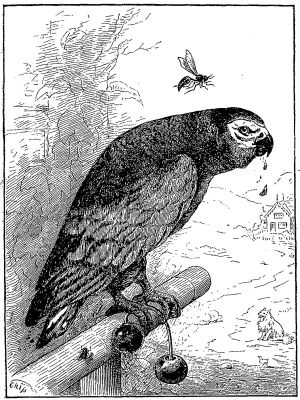
AN UNWELCOME VISITOR. "I'll 'tend to you in a moment, Mr. Hornet."

Middletown, Virginia.
A very dear friend of mamma's sent Young People to me as a Christmas present. I enjoy the stories so much! and am now very much interested in "Mr. Stubbs's Brother." I think the pictures lovely. I am saving every number carefully. Mamma intends having them bound. I see the little girls have been writing about their pets. We have a German canary; he sings by lamp-light. His name is Paul Pry. I am a minister's daughter, and live in the beautiful Valley of Virginia. This is my first attempt at letter-writing. I am ten years old, and would love to see my letter in Our Post-office Box.
M. Blanche M.
Huntsville, Alabama.
I have no pets to write about, but I will tell you of my nice trip. I went to Nashville and Columbia to play in the Huntsville Amateur Opera Company. I appeared as one of the little Dragoon Guards. The name of the play is Patience. Sir. G. is the director, and my papa is Bunthorne. Let me thank Mr. Otis for his nice story of "Mr. Stubbs's Brother." I grow so impatient for the paper each week. I am nine years old.
Edwin L. W.
Carlisle, Pennsylvania.
On the 6th of June my papa, mamma, and I went on the State Editors' Excursion to Washington and Mount Vernon. We arrived at Washington at half past one, and at the depot we were met by our friend Mr. Read, of the Patent-office. After resting awhile, we went around the city to see the sights until dinner-time, which was half past four. At nine o'clock that evening I went with my papa and mamma to the formal reception which the President gave the editors. Being a little girl, I felt shy, and almost slipped past him, but he said, "I don't want this little miss to pass me." So the secretary of the association took me, and told him who I was. He then shook hands with me very pleasantly, so I'm no more shy of the President.
The next morning we took the steamboat Corcoran to go to Mount Vernon. I liked the ride very much; it was very pleasant down the river. On entering the grounds the first thing visited was the tomb of Washington, and there we stood and looked and looked at the marble caskets that hold the bodies of George and Martha Washington. Mamma reached through the iron bars and got some pebbles that were put there for visitors to take. The next place we came to was the old tomb of Washington. We went down into it, and there we chipped some splinters off the old door frame. The mansion we came to next, and entered the hall, and there we saw the key of the Bastile (which is a very large key) in a glass case. The first room we entered was the state dining-room, and there a gentleman explained the different interesting things that were in the house. In this room, in a glass case, is a stone model of the Bastile. We then came into the east parlor; in it was what I thought was an old-fashioned piano, but I was told that it was a harpsichord. We next entered the west parlor; then the dining-room, in which was a large fire-place. From there we went into the kitchen, where there was a table spread, with old-fashioned dishes, knives, and forks. We then went upstairs, and entered the room where Washington died. The bed was very wide. We also saw the room of Martha Washington, and that of Eleanor Custis. Her bed was so high that she had to have three steps to go up to it. Lafayette's room and the guest-chamber were the two prettiest rooms in the house. All the rooms have the same furniture that they had in Washington's day. We went to the attic, and up into the cupola, and had a good view of the beautiful Potomac and the country around. A gentleman took a hen's egg out of a nest in the old brick barn. I gathered a bunch of clover heads and daisies from the yard.
What I like best at Mount Vernon are the grounds and the river-bank, where I would so much enjoy running and playing. I used to think that Washington was a very plain man, but since I have been at his home I have changed my mind, and now think that he liked fine things too. We started back to Washington city about two o'clock, and reached there in time for our dinner, which we enjoyed very much after our day of sight-seeing.
Next day we went into the Patent-office, the Treasury Department, the Smithsonian Institution, the Bureau of Engraving and Printing, the Agricultural Building, the Post-office, and the Capitol. All these buildings are very large and handsome, and contain many interesting and wonderful things. In the Dead-letter Office we met an old gentleman who was very kind to me. He said:
"Little girl, are you a Sunday-school girl, and what school do you go to?"
My answer was, "To the Second Presbyterian, of Carlisle."
The next morning we started for home. I was glad to get there, for I was tired, though I enjoyed Washington very much.
Maud Z.
This is a very charming letter to have been written by a little sight-seer who is not yet eight years old. The description of your pleasant day at Mount Vernon, little Maud, will please hundreds of other girls, and boys too, who have not yet been there, but hope some day to go and see the place which was once the home of the Father of his Country.
Blanchard, Ontario.
I am the eldest of six. I was thirteen years old on Midsummer-day, so I thought I would write to the Post-office Box of Harper's Young People. I have taken it since March, 1882. A lady teacher from Chicago spent her vacation with us last summer, and while here her little sisters sent her several numbers of Young People. I thought them just splendid. After going home she sent me a number now and again, but I wanted one every week, so my little cousin and I together sent for it. I have never been out of Canada, but my grandpa has been twice round the world, and I listen with much interest when he speaks of the various countries he has visited. We have a pretty school, and a nice walk to it through a wood by the side of a creek. There are wild flowers in the bush, and you may think what nice bouquets we gather. We all go to school. My papa is a farmer, and we have lots of cattle and horses and many feathered fowls. I must not forget to tell you the nice little present I got from Chicago on my birthday. The same dear friend sent me a pretty needle-book made by one of the Sisters of Charity in Chicago. I prize it highly. They tell me Ontario is very much like the State of New York. Have you ever, dear Postmistress, been in Ontario? Everything is lovely here; all nature seems alive. I have quite a number of pets: three cats (Bessie, Tom Barney, and Jennie), two pet lambs (Jack and Tom), and a shaggy little dog named Tip, the best of all. I think I will now close my letter by sending kind wishes to you and to my little cousins over the line.
M. Blanche D.
No, dear Blanche, I have never visited your pleasant home, but your description is so vivid that I can see with my eyes shut the pretty school-house, the walk by the creek, and the grove where the wild flowers bloom. What a number of pets you have to care for!
Mainhouse, Kelso, Roxburghshire, Scotland.
I am a little boy eight and a half years old, and I have a little brother nearly six. Our father and mother are in India, and we live with our grandpapa in the country. We have two Belgian rabbits, and I call mine Bunny, and John's Brownie. We have a pony named Sambo. There is a large retriever dog whose name is Don. We receive Harper's Young People every week from our uncle and aunt who live in America, and we like it very much. I like "The Talking Leaves." We have a canary, and he sings all day long. We have each a garden, and there are pretty flowers, and we like working in them after lessons are over. We do not go to school; auntie gives us our lessons. I write this letter myself, and John writes his name after mine.
Robert B. P. and John D. P.
Papa and mamma in India must be very much pleased with the letters they receive from their little sons if they are written as plainly and as well expressed as this one.
I am thirteen years old, and love Harper's Young People. We have great fun with a bear that lives near us; he is a young cub. We had a little rabbit and a pet canary, but a wicked old cat killed them both. I have a small but elegant stamp book, with 135 stamps in it; I would like offers for it. I am soon going to learn telegraphy. Could you tell me how all the people got their names?
Harry B. Wilson, 77 Pearl St., Chelsea, Mass.
Some names were given, in the first place, because of the occupation of the person with whom the family began. In all ages smiths have been very useful, and society would not have known what to do without them; so it comes to pass that a great many people bear the name of Smith. Wilson was originally Will's son, Johnson John's son, and so on. Sometimes a number of soldiers and retainers took the name of their chief, in the old warlike days, when a castle was defended by a great many warriors, and the lord of the castle in his turn protected whole villages of women and children. Some names are in memory of places, of rivers, or mountains where battles took place. Some are called after favorite colors. The history of surnames is very curious, and you will be interested if you look into it carefully.
I am glad you are about to study telegraphy.
Brookhaven, Mississippi.
I was much pleased with the letter from the little girl in Germany, for I want to know all about music. I am thirteen years old, and have been taking lessons five years. I play Jael's Faust, Sonnambula, Rigoletto, etc., and I am very anxious to go to Germany, the father-land of music. I am studying German and French, and taking lessons on the violin. My papa says I may go there some day if I study hard. I think our country is the grandest one on the globe, but still I would like to cross the ocean and study under such professors and composers as Joachim Raff, Frau Clara Schumann, and the violinist Hermann. I am sure they would inspire me to do more. "M. W." has certainly heard of our Edison and his wonderful electric light. I have been to Spanish Fort, in New Orleans, and seen the light; it is so brilliant that one almost imagines it is a smaller sun in the sky. Then, too, we have here the telephone and the audiphone, and these are only a few of the modern inventions.
Katie B. J.
You are certainly a very busy little woman, Katie. I hope your desire to go to Germany may be gratified. But do not forget health in your wish for improvement.
Wheeling, West Virginia.
I am a little girl eight years old. I have two dolls, and I love them very much. This is the first letter I have ever written. I have a canary-bird, and it is a beautiful singer. It is very tame. Once I was leaning over the cage, and before I noticed it birdie was pulling my hair. I have two sisters, Bessie and Florrie. My grandpa has a dog named Ben. He is very much afraid of fire-crackers. He spent Fourth of July behind the pantry door. We could not coax him out, even to feed him.
Lillie J. F.
No wonder the poor dog did not know what to make of such a fuss as the fire-crackers made. Your birdie is very cunning.
Columbus, Ohio.
I am eleven years old. My uncle gave me your paper for my birthday present, and I think it was a nice present. I have always read the letters in Our Post-office Box, and I thought I would write one too. I notice that all the little girls tell about their pets. I have a little turtle for my pet. It likes to eat flies; it will take them in its mouth, and eat them fast. My turtle is very small. Mamma said that I must take it back to the river, because it might die. Our schools are all out now, and I passed for the C. Grammar. We have a great many canaries, and I have a beautiful Java finch: it has a bright red bill, and it says tat, tat, all the day long. Good-by.
Winnie S.
Philadelphia, Pennsylvania.
I am very fond of pets, and have nine canaries, six of which I raised myself. Any little girl or boy may do the same, with care and patience. Mamma has two goldfinches. One of them she brought from Europe last summer. I don't like Europe as well as I do America. I was very homesick while I was in those countries where no English is spoken. I could not even find out what I wanted to eat by looking at the bills of fare. We are going soon to my grandma's beautiful country home near Niagara Falls, where I expect to be very happy.
Katharine H.
Conway, Massachusetts.
I am a little girl six years old. I live in a house where my great-grandpapa lived. There are high hills here, and a pretty little brook, and it has speckled trout in it; and we live in the shadow of big trees that my great-uncles planted when they were little boys. The birds come and sing in the trees, and little red squirrels chase each other through them, and bring nuts and eat them in the trees. My uncle says, when he was a little boy, and lived here, a red squirrel with a bushy white tail lived in these same trees, and he tried to catch it in a trap, but could not. I hope I will see one some time. I have two little kittens and a pet lamb. The lamb goes to the pasture now, but at night comes and bleats for us to feed him. And when it is almost dark, a whip-poor-will comes and sings to us. The laurel is now in bloom on the hills, and is both pink and white, and is very pretty. We sent some of it in a box to Chicago. I went a mile to school, and studied reading, spelling, writing, and arithmetic, but the school is closed now. My uncle sends me Harper's Young People. It comes on Tuesdays, and I like it very much. I am glad when Tuesday comes. I enjoy the Toby Tyler stories, and read them the first thing. I like to read about Jimmy Brown. He is a naughty boy but very funny. My mamma says I must not like the naughty boys, and I will try not to, but I read about them.
Florence R. H.
Oxford, Indiana.
I am a little girl eleven years old. My birthday was on the 23d of May; I received several nice presents. I have two little brothers. Johnnie, the oldest, is five years, and Norman is eleven months old, the dearest and sweetest little baby, I think, that ever was. I go to school in the winter, but we do not have summer school. I am sorry, for I love to go to school. We have Sunday-school half a mile from here. I think we live in a very nice place. A small grove is north of the house and barn, and Big Pine Creek is on the east. I often go fishing. The creek has been pretty high several times this spring and summer, almost a quarter of a mile wide just east of the house. My grandma gave me a little canary. His name is Billy; he is a great pet, and a very sweet singer, and also a great fighter. He will bite our fingers, and look very savage; and when he sings he nearly always gets under his swing, and makes it go with his head, and thus keeps time with it.
Zua E. T.
Germantown, Pennsylvania.
I am a little girl of thirteen, and my brother and I take Harper's Young People, and have done so for nearly two years. I think "Mr. Stubbs's Brother" is very nice, but I think "Toby Tyler" was better. I am now staying at my cousin's, and we thought it would be very nice to write to you. I have lived in America for only six years, as I was born on the island of St. Thomas, in the West Indies, where we had no winter, and I never saw snow until I came here. I thought it came down in great lumps, and I was very much surprised to see it falling in flakes. I have a dear little sister six years old whose name is Annie, but we call her Pansy, Nannie, or any other pet name we choose. She had a kitten, which she named Tabby, and when we moved, papa put him in a bag and sent him to the other house, but the next day he ran away. I am having the volume of 1881 bound, so as not to lose any of the numbers.
Eliza M. S.
A quart of pins, hair-pins, and needles was lately found in the nest of a mouse when some workmen tore down the piazza of an old hotel in Massachusetts. So that accounts for some of the pins which are always disappearing. They were taken away by a foolish little mouse, and could not have made a very soft bed for her family.
Louie Le B.—We will lay your little friend's pretty poem aside until cold weather comes round again. Thank you for sending it.
C. Y. P. R. U.
A Feast in Tahiti.—We are sometimes ready to imagine that we know better how to decorate our houses and dinner tables than the people do who live in the far-off East. But Miss C. F. Gordon-Cumming, who was invited to a feast in Tahiti, has given a very beautiful description of the style of entertainment. It would be hard to find anything prettier:
"Good Queen Pomare had lately died, and the islanders were in mourning for her. At the same time they were welcoming her successor, King Ariiane, with demonstrations of joy. He was making a royal progress over his domains, and stopping at Paea, he and his suite dined in the town-hall. Dinner was laid for three hundred guests. At one end was a table where the chiefs had prepared to entertain the royal party, and other tables had been spread by the families of the neighborhood for themselves and their friends. The building was decorated with palms and tree-ferns, and festooned all over with deep fringe made of hybiscus fibre dyed either yellow or white. There must have been miles of this fringe wreathed about the hall.
"On sitting down, the table seemed to have a series of white marble vases arranged along the centre. On looking closely, these vases turned out to be lumps of the thick, fleshy stalk of the banana near the root. They were of the purest white. In them were stuck branches of the thorny wild lemon-tree, and on each thorn were fastened bunches of gay artificial flowers, either made of colored leaves, or of the silken white fibre of the arrow-root, or of bamboo fibre. From some of the banana vases floated silvery plumes of aerial film like fairy ribbons. This was the snowy reva-reva, extracted from young cocoa-palm leaves. The worker who produces this lovely gossamer keeps a split stick stuck in the ground at her side; into its cleft she fastens one end of each ribbon as she peels it. It is so very light and soft that but for this precaution the first faint puff of air would blow it away.
"When the feast was at an end, the guests adorned their hats with these graceful plumes, and with the pretty, fanciful flowers. Then everybody adjourned to the grassy shore, and seated there, they watched the golden moon rising above the calm sea, while companies of glee-singers filled the air with soft, sweet music."
We would call the attention of the C. Y. P. R. U. this week to the article on "St. Elizabeth of Thuringia," by Mrs. Helen S. Conant, and to "Sea-Anemones," by Miss Sarah Cooper. The boys will learn how to help the ducks and fishes to an easier life in shady ponds by reading Mr. Allan Forman's article entitled "Trapping Torups."
Correct answers to puzzles have been received from Louis H. Hirsh, Max L., Helen Gardner, Mary Smith, Leonie Foster, Arthur and Freddie, A. E. Cressingham, Cortland F. Bishop, John P. Todd, Lina Sparks, "North Star," Lucy Meade, Carl Buckner, William Dick, "Eureka," Carrie B. Kunkel, Russel B. Beals, E. L. Barnes, Edgar Seeman, Bessie Hyde, Emma Nusbaum, F. Harris, William F. Harris, Blanche Foster, Kitty C., E. N. H., L. R. S., Lucy A. Morse, Harry Beck, Beryl Abbott, Ethel Cox, Florence Cox, Mamie England, Marion, Addie Goodnow, "Fidelis," L. D. and F. G., Kate Marshall, and Charlie Lamprey.
PUZZLES FROM YOUNG CONTRIBUTORS.
No. 1.
RHOMBOID.
Across.—1. A girl's name. 2. A receptacle for oil. 3. A sort of cloth. 4. A crime. 5. A Spanish title.
Down.—1. A letter. 2. To proceed. 3. To pinch. 4. A girl's name. 5. Withers. 6. To ascend. 7. A Spanish title. 8. A negative. 9. A letter.
Edgar Seeman.
No. 2.
DOUBLE ACROSTIC.
1. Part of a door. 2. Not fit. 3. A sort of engraving. 4. A soft sound.
No. 3.
THREE ENIGMAS.
1.
My first is in slate, but not in book.
My second is in cry, but not in crook.
My third is in man, but not in lady.
My fourth is in fade, but not in die.
My fifth is in Maggie, but not in Sadie.
My sixth is in crow, but not in cry.
My seventh is in crag, but not in rock.
My eighth is in plug, but not in sock.
My ninth is in rent, also in lease.
My whole is a place of peace.
S. Birdie Dorman.
2.
First is in left, but not in right.
Second is in quarrel, but not in fight.
Third is in whip, but not in flog.
Fourth is in haze, but not in fog.
Fifth is in fair, but not in just.
Sixth is in blast, but not in gust.
Seventh is in grieve, but not in pain.
Eighth is in profit, but not in gain.
Ninth is in sharp, but not in keen.
Whole is a famous English Queen.
Empire City.
3.
My first is in mica, but not in stone.
My second is in meat, but not in bone.
My third is in mice, but not in rats.
My fourth is in rugs, but not in mats.
My fifth is in might, but not in power.
My sixth is in lilac, but not in flower.
My seventh is in wrapped, but not in furled.
My whole belongs to the great New World.
R. B. Beales.
ANSWERS TO PUZZLES IN No. 140.
No. 1.
Ice-cream. Needle-work. Dough-nut. Eglantine. Pot-pourri. Elf. Nubia. Dimples. Easy-chair. Narcotic. Caramel. Eyrie. Dogstar. Albatross. Youth. Independence-day.
No. 2.
Croquet. Denmark. Locust. Strawberry.
No. 3.
CYS
AHABOAAPT
CHARMYOUNGSPAIN
ARTANNTIE
MGN
No. 4.
Washington.
No. 5.
SIGN
ILLE
GLEE
NEED
No. 6.
SEGAR
EVERY
GELID
ARISE
RYDER
[For Exchanges, see 2d and 3d pages of cover.]
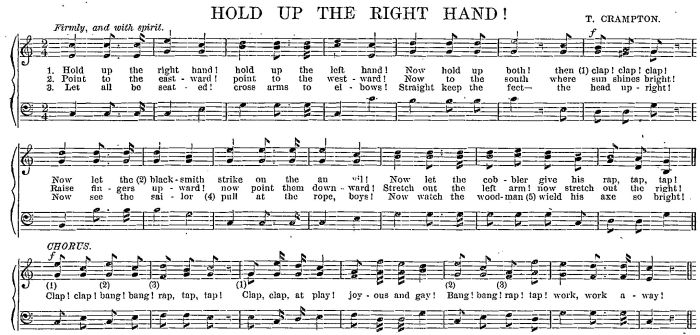
The words generally will indicate the suitable action. (1) Clap hands smartly. (2) Strike right arm and elbow downwards, with fist clenched. (3) Tap with right hand from the elbow. (4) Pull hand over hand, as on a rope. (5) Strike with both hands from the right shoulder obliquely, as if cutting down a tree.
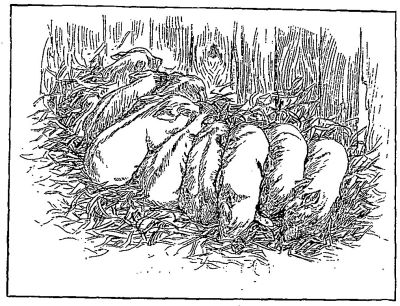
"SUCH A LOT OF US, AND WE'RE SO CLEAN!"