PEARLS—REAL AND IMITATION.
Reading edition
FROM ADVANCE SHEETS OF "THE BOY TRAVELLERS IN THE FAR EAST." PART SECOND.
BY THOMAS W. KNOX.
While on their way from Bangkok to Singapore, Frank and Fred were much interested in accounts of some of the wonders of the Eastern seas given them by Captain Johnson, a fellow-passenger. In answer to some of their inquiries about pearls, he gave them the following information:
"One of the favorite fishing grounds for pearls is at Bahrein, on the Persian Gulf. The divers bring in the oysters from the fishing banks in the Gulf, and pile them on the shore in great heaps. Here they lie till they are rotted; and the stench that arises is enough to turn any inexperienced stomach. When the substance of the oyster is quite decomposed, the shells are opened, and the mass of matter they contain is thrown into tubs, and washed with water. It is necessary to pass the pulp very carefully through the fingers, for fear that some of the pearls will be lost, and consequently the washing is very slow. When a pearl beyond a certain size is found, the washer receives a handsome present; but below the regulation figure he gets nothing but his daily wages. Large pearls are very rare, and consequently the chances that a pearl-washer will make a fortune by a lucky find are exceedingly small.
"There is a belief quite current through the East that the pearl is a drop of rain-water which has fallen into the shell of the oyster when he was at the surface, and been afterward hardened. This is a pretty bit of sentiment; but as the oyster never goes to the surface unless he is carried there, the story does not have much foundation to rest upon."
"If the pearl is so valuable, and so difficult to get, I should think there would be men who would try to imitate it," Frank remarked.
"You are quite right," was the reply; "and men have tried a great many times to make false pearls."
"Have they succeeded?"
"Partially, but not altogether. No counterfeit pearls have yet been made that could pass all the tests of the genuine; but their lustre is quite equal sometimes to the best pearls of Ceylon, and they can be made to deceive anybody but an expert."
"How do they make them?"
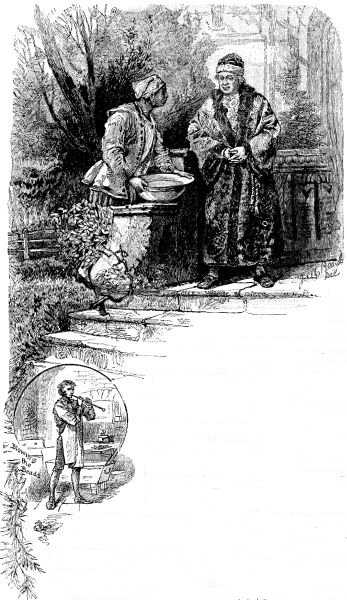
"The best of the false pearls," said the Captain, "are made by what is known as Jaquin's process. M. Jaquin was a manufacturer of beads in France, and he spent a great deal of time and money in trying to make his beads better than any other man's. One day he was walking in his garden, and observed a remarkably silvery lustre on some water in a basin. It instantly occurred to him that if he could put that lustre on his beads, he would have something decidedly new.
"So he called his old servant, and asked what had been in the water. She answered that it was nothing but some little fish called ablettes, that had been crushed in the basin, and she had neglected to throw the water out.
"M. Jaquin was very glad, for once, that she had neglected her duty. He began experimenting with the scales of the ablette, or bleak—a little fish about the size of a sardine, and very abundant in certain parts of Europe. After several trials he adopted the plan of washing the scales several times in water, and saving the sediment that gathered at the bottom of the basin. This was about the consistency of oil, and had the lustre he desired. Next, he blew some beads of very thin glass, and after coating the inside of a bead with this substance, he filled it up with wax, so as to give it solidity. Thus the fish scales gave the lustre, the glass gave the polish and brilliancy that we find on the genuine pearl, and the wax furnished a solid backing to the thin glass. It is fortunate that the bleak is very abundant, or he would run the risk of extermination."
"Is the manufacture of false pearls so great as that?" Fred inquired.
"It is pretty extensive," was the Captain's response, "but not enormously so. The fact is, it requires more than a thousand of these little fish to make an ounce of the 'essence d'Orient,' as the French call it, or essence of pearl. Other substances have been tried, in the hope of obtaining the same result for a smaller outlay, but none of them have been entirely successful.
"In China and Japan the natives have long followed the practice of putting small beads of porcelain inside the oyster, and then returning him to the water, where he is left undisturbed for three or four years. At the end of that time he is taken up and opened, and the beads are found to be coated with the pearly substance. They also have the trick of putting little images or idols into the oyster, and in course of time these become coated over in the manner I have described."