BIRDIE'S VANITY.
Reading edition
BY C. L.
Pussie and Kittie strolled out one day Into the garden to walk and play; They rolled on the grass, and jumped so high That the old drake "quacked" as he passed by. Said he, "I wish I could hop so light," And on he hobbled with all his might. Above, little Susie's Birdie swung; His cage from a lofty window hung. As soon as he heard the drake's lament, His head on mischief was quickly bent. "Oho, Mister Drake, you soon shall see That Mistress Puss can not outjump me; And although my legs are short and thin, I'll wager that in a race I'll win." So saying, he flapped against the door Till his pretty wings were getting sore. At last, with a snap, the door came loose, And Birdie flew out—the little goose! He flew right down to the very ground Where Pussie and Kittie played around. And now there began a lively race, Which gained excitement at every pace. Little Birdie chirped, and hopped about, And Pussie followed him in and out, Under the rose-tree and through the hedge, Until they came to the garden's edge; And then Mister Birdie, full of pride, Mounted a tree by the water's side; And there he perched, with a proud delight, Boasting and singing with all his might, Until, quite weary and worn, at last He drooped his head, and soon slept fast. Then up jumped Puss from her hiding-place, And mounted the tree with nimble grace; But so gently did her footsteps fall, Not a sound the sleeper heard at all. And now, alas! Pussie crouches low: Poor Birdie will soon be gone. But no! A shrill little scream is heard to rise, And there stands Susie with frightened eyes. Old Pussie scampers with might and main, And Birdie pops wide his eyes again. Now think of his horror when he saw How near he had been to Pussie's paw! I really think he deserved the pain, Because he had been so very vain; And I'll venture that he did not seek Another frolic within a week.
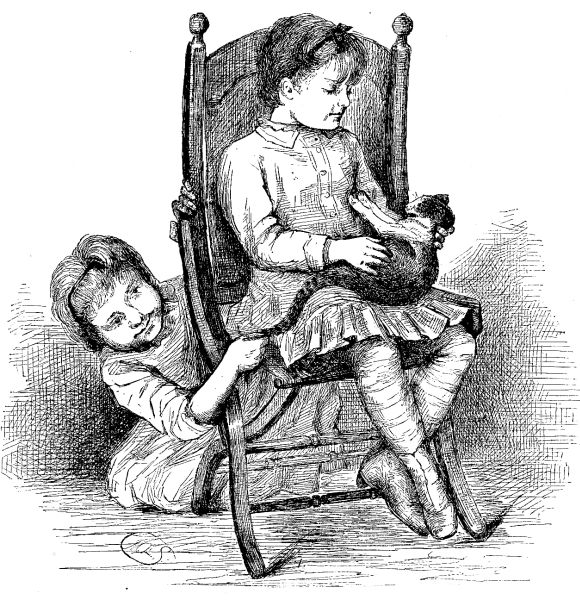
"KITTY, WHAT MAKES YOU SO CROSS?"
Our exchange department is increasing so rapidly that we find it necessary to offer a few suggestions to our young correspondents. In the first place, if you desire to exchange with other correspondents, always give your full address. If you live in a large city, like Brooklyn, New York, or Philadelphia, you should state your residence, street and number, or the number of your post-office box, as otherwise it is not probable that you will ever receive an answer to your request. You have all heard about hunting for a needle in a haymow; and if you stop to think, you will see it would be just as useless to hunt for any little boy in New York city, unless you knew the street in which he lived; and the faithful "little man in gray" who hurries from house to house with his load of letters certainly can not be expected to know the residence of every Johnny Smith in the city. With many of you who live in the country the case is different. Probably the postmaster himself knows you, and will give you your letter, even if it is not addressed to your father's care. In future we trust you will be careful always to give your residence or your father's address, otherwise, as Uncle Sam's postman does not keep a directory of every little boy and girl in the land, many of you may wait in vain for a chance to exchange your pretty pressed flowers and other objects of interest.
One thing more. When any correspondent offers exchange, and gives a full address, as many have done, it would simplify matters very much, and save us unnecessary trouble, if any one desirous of accepting the offer would write at once to the given address instead of to us. As we can in no case take charge of the transfer of specimens, which must always be directly between yourselves, it is useless for you to write and tell us you are willing to accept the offer of exchange made by any particular boy or girl. Write directly to them, and you will gain time, and save yourself unnecessary postage.
As our exchange department is intended to develop in our readers a knowledge of the flowers, trees, butterflies, birds' eggs, minerals, and other natural products of different sections of their own country, we pay no attention to requests for exchanges of useless things, which could lead at best to nothing higher than the gratification of an idle curiosity.
The following communication was written in Danish, but as we fear that language is not understood by many of our readers, we publish only the translation:
Riserup Parsonage, Falster, Denmark.
I am seven years old, and I live in Denmark. I like the pictures in Young People very much, and my aunt translates the stories to me, for I can not read English. We have made a drawing of Wiggle No. 11, and send it to you. I have a little white cat, and a big black dog called Sagax. Just outside of our garden there is a wood dove on its nest. I can stand close by it, and it is not at all afraid of me.
Emil Koch.
We are very sorry your Wiggles came too late to be printed among our answers to No. 11, for they are very pretty.
Marion, Iowa.
I take Young People, and I don't know what I should do without it. I am eleven years old, and I have three brothers, all older than myself. We have two colts. One of them kicked me on the hip, but did not hurt me very much. I wish some little girl would send a nice recipe for making cookies.
Nellie E. O.
Yonkers, New York.
I have read every number of Young People, from the first to the last one published. I enjoy reading the letters sent by the correspondents, and I like to read all the recipes for candy and cake. During vacation I am going to try them all. I have a pet canary-bird, which was a birthday gift.
I am pressing a few leaves that I gathered on the Palisades, and I am going to press a good many this summer. When they are ready, I shall try to exchange with some little girl.
Edith L. G.
St. Henrys, Ohio.
I like Young People better than any other paper I have ever taken.
I have a pet 'coon, a squirrel, a canary, a dog, and two cats. And I have a large doll. She is three feet and eight inches tall. Her name is Gervaise. I got her at the Centennial Exhibition.
I love to read the letters in the Post-office Box.
I went fishing this spring for the first time, and caught six fish. I am eleven years old, and now in the summer I am not going to school.
Will any little girl send me a recipe for cream candy?
Flora B.
Okolona, Mississippi.
I am a little girl six years old, and I can not write very well yet. I do not go to school, but mamma teaches me at home. I like Young People so much! I have a little dog named Snip. I live in the South, and it is pretty warm here now.
Two mocking-birds have a nest and four little baby birds in a rose-bush near our sitting-room window.
Mamma and I are going to Michigan in a few weeks to see my grandma and grandpa. My papa is a preacher. I have no brother or sister.
Bessie M. McL.
Belle Plaine, Iowa.
Captain William Eaton, the subject of the sketch, "An American Soldier of Fortune," in Young People No. 34, was my mother's great-uncle on her father's side. So on her mother's side was Colonel William Knowlton.
Cora F.
Cedar Falls, Iowa.
I thought I would write about my pets. They are two old cats, three kittens, and a dog. Two of the kittens are gray, the other one is Maltese. My dog meets me every night when I come home from school, and always accompanies me when I go after wild flowers. I live in the country, and I think it is a very pretty place to live. I have no canary, but the birds sing very sweetly out-of-doors, and I like that much better than having one in a cage. I think Misfits are very amusing. I have no sister, and only one brother.
Josie M. J.
Hokendaugau, Pennsylvania.
I tried the recipe for kisses sent by C. H. S., and printed in Young People No. 35, and the kisses were splendid.
B. H. T.
Excelsior Farm, Kansas.
A pair of mocking-birds are rearing a nest of young birds in our front yard, and I would like to tame two of them. Can you tell me how to feed them and care for them?
Sidney B. P.
Directions for feeding mocking-birds were given in Post-office Box No. 13, but no doubt some of our young correspondents in the South can give farther particulars respecting the care of young birds. We will gladly print any information they will kindly send.
Wilmington, North Carolina.
In the summer we go to the sea-shore, about eight miles from where we live. We ride there in carriages, and see many pretty flowers along the road. There is a very curious one among them. It is called Venus's-flytrap. If you put a fly in it, it will kill it and eat it.
I think Young People is the best paper I ever read. I am ten years old, and my name is
Lottie May W.
The Venus's-fly trap does not eat the fly, but at the end of each leaf, which springs from the root, it has a kind of appendage, armed on the edge by glands resembling hairs, which contain a sweet liquid attractive to insects. No sooner does a fly alight upon this sensitive leaf, than, with a sudden spring, it closes, and crushes its victim to death. When the fly is dead, the leaf again unfolds. This singular plant is a native of North Carolina.
Papa and I took a ride early this morning, before six o'clock. We saw three little squirrels, and we passed many chestnut-trees in full bloom (June 28), and saw wild raspberry bushes covered with ripe fruit.
My canaries have hatched, but one egg broke, and one tiny birdling died, but out of five eggs I have three fine young birds. Their names are Ganarra, Goldie, and Downy. They are hopping around on the perches now. The mother bird behaved so badly that I took her out of the cage, and now the father takes care of the little ones. Is such an action common on the father's part, or is my Neddy the sweetest, dearest little bird in the world?
I have tried almost all the recipes sent to the cooking club, and I send one myself, for white cake: Half a cup of butter; one cup of sugar; the whites of three eggs; half a cup of sweet milk; one and a half cups of flour; one tea-spoonful cream of tartar; half a tea-spoonful soda. Beat the butter and sugar to a cream, and froth the whites of the eggs before stirring in.
I think the Tree Album is very nice, and I would like to exchange specimens of our trees for some of other localities as soon as I have enough ready.
Altia R. Austin, Portland, Connecticut.
Elizabethtown, Illinois.
I varnish leaves with rosin. I sprinkle fine powdered rosin on the leaf, and then pass a hot iron over it. The rosin melts and spreads over the leaf, varnishing it beautifully. The method is both cheap and easy.
Here is a recipe for cream candy for the cooking club: Three pounds of sugar; one cup of rich cream. Stew until the syrup candies when dropped in cold water. Flavor with lemon, and pour into buttered tins, or pull, as you prefer.
Edith L.
Rodetta F. Bartlett and Margery R. H. send the cooking club recipes for sugar-candy. We acknowledge them with thanks, but do not print them, as they vary only slightly from recipes given in previous numbers.
Watervliet Centre, New York.
Here is a recipe for citron cake for Puss Hunter's cooking club: One tea-cup of sugar; two-thirds of a tea-cup of butter; two tea-cups of flour; half a tea-cup of milk; one tea-spoonful of soda dissolved in the milk; a little essence of lemon. Stir in bits of citron cut thin, and bake in hearts and rounds.
I have taken Young People since Christmas, and I look eagerly for it every week. I have two dolls, Nellie and Pearl. I am eleven years old.
Anna W. C.
I have a few specimens of trees arranged according to the directions given in Young People No. 31. I would like to exchange them with some little girl living in any locality except San Francisco.
As I live in the city, I do not have many opportunities to get specimens, but when I do go to the country I make good use of my time, and in spite of being very much afraid of cows, snakes, and lizards, I sometimes venture in pretty wild places for good specimens.
This year we went out to Napa Valley with a friend, who drove us all over the valley. We saw hundreds and hundreds of acres of vineyards, and passed lots of places where they were laying out more.
I am an only child, and I have no pets now except my flowers and dolls, and my own lovely piano.
Ida Belle Diserens, 734 Grove Street, San Francisco, California.
I would like to exchange pressed flowers with some little girl, and when the seeds are ripe I will exchange seeds. I have some nice flowering beans, and different kinds of larkspurs. I will exchange larkspur seed for pink seed. There are many varieties of ferns here.
Can any one tell me how to varnish leaves, and also if there is any way to keep pressed flowers from fading?
Mary Lowry, Elizabethtown, Hardin County, Illinois.
As a great many of the other little girls write to Our Post-office Box, I thought I would write too. Papa takes Young People, and we children like it very much. I guess he does too.
I have no pets, but my older sister has a pet calf, and it is very pretty. Its name is Lily May. She feeds it on meal and water. I have three dolls. Two are china, and one is a large wax doll, with beautiful brown hair.
I would like to exchange pressed flowers with any little girl.
Sallie M. Brown, London, Kentucky.
Since my letter was published in Young People No. 33, I have received so many letters from different States—several of them accompanied with eggs—that it is impossible for me to answer them all promptly. I wish to tell the correspondents, through the Post-office Box, that I will surely answer all their letters and return them eggs, but they must not be surprised if it is not immediately, for nearly all asked me for the same kind of eggs, and I can only send them as fast as my agents, who are colored children, find them and bring them to me.
Alice I. Paine, Ingleside Farm, Cherokee County, Georgia.
I would like to exchange birds' eggs with some one in a distant State or Territory.
George L. Rusby, Franklin, Essex County, New Jersey.
I am eleven years old. My papa is a doctor, and my mamma teaches a Kindergarten school. I have a little sister we call Fredie. We each have a kitten, and I have a canary.
I am making a collection of bugs, butterflies, shells, and minerals, and I would like to exchange with "Wee Tot" Brainard, or any other little girl. I have not a very large collection yet, but I am adding to it fast.
Jessie May Allen, Charlotte, Michigan.
Salt Lake Station, Utah.
My new telescope works a great deal better than my first one. We had to exclude about half of the light by putting a piece of pasteboard with a hole in it in front of the object-glass, which has a diameter of two inches, and a focus of sixty inches. It magnifies the moon about forty times, as near as we can judge. How can I tell exactly how many times a glass magnifies?
How many of the other boys have tried to make a telescope according to the directions given in Young People No. 1?
How can I make a cheap camera obscura?
Is it injurious to the eyes to look at the moon through the telescope without smoked glasses?
Olaf T.
The oculist from whom you obtained your lenses will tell you their magnifying power.—You do not need smoked glass when looking at the moon.—A simple form of the camera obscura (dark chamber) is a box furnished with a lens whose focal length is equal to the length and height of the box. At the opposite end of the box from the lens a mirror is placed at an angle of forty-five degrees, from which the image received through the lens is reflected upon a piece of glass, the under side of which should be ground, placed flat directly above the mirror. The image will of course be inverted. It will be more distinct if the ground glass be shaded from the light.
George L. R.—You will see by the letter of Alice Paine in this Post-office Box that she did give her right address. Why your letter miscarried we can not explain.
H. Scott.—Send your full address, and we will gladly publish your request for exchange.
W. Chapman, Mary L. L., and others.—Write directly to the address given by those with whom you desire to exchange.
Maud W.—Paste your leaves firmly to the paper, and leave them under heavy pressure until they are dry, and you will not be troubled by their curling up. When you take them from the press varnish them, and they will give you more satisfaction.
G. W. Davis.—A projectile kaleidoscope may be of any convenient size, varying from six to ten inches in length, fitted with two lenses—one at the object end, to throw light from a lamp through the instrument, and the other at the eye end, through which the image is projected on a screen, placed at the proper focal distance. Any ingenious boy can fit these lenses to an ordinary kaleidoscope, and fit it to a stand, which may be placed on a table.
H. T. Wilson.—The correspondent you inquire about did not desire exchange, and we have no authority to give full address. Any short communication you may wish to make in reference to minerals will be printed in Our Post-office Box.
Favors are acknowledged from Bertha B. Allen, "Dick Deadeye," Elsie H. Tatum, George Empey, S. F. W., Lizzie Allie Hill, Jessie H. R., May Bell and Laura Milles, John R.
Correct answers to puzzles are received from A. H. Ellard, Warren S. Banks, Frank E. Hayward, Anna W. Cragier, Jennie F. S., C. B. Howard, L. M. Fobes, Maud Mathewson, Eddie S. Hequembourg, R. D. C.
PUZZLES FROM YOUNG CONTRIBUTORS.
No. 1.
DIAMOND.
In Reynard. A performance. A seed. To attempt. In Reynard.
C. P. T.
No. 2.
WORD SQUARE.
First, an animal. Second, a border. Third, a sickness. Fourth, an aquatic plant.
S. H.
No. 3.
ENIGMA.
My first is in vain, but not in proud. My second is in wind, but not in cloud. My third is in cat, but not in dog. My fourth is in timber, but not in log. My fifth is in foot, but not in head. My sixth is in silver, but not in lead. My seventh is in ink, but not in pen. My eighth is in cave, but not in den. These hidden letters, set in place, Reveal a lady of royal race. Theresa.
No. 4.
EASY BEHEADINGS.
Behead an article of dress, and leave an animal. Behead a fastening, and leave a light. Behead skillful, and leave a mechanical power. Behead to dart, and leave a noise. Behead cunning, and leave a float. Behead clear, and leave suitable. Behead an article of dress, and leave a farmer's implement. Behead a small portion, and leave a boy's name. Behead an inclosure for animals, and leave ancient. Behead a learned man, and leave a period of time. Behead a support, and leave a contest. Behead affectation, and leave an insect.
Johnnie.
No. 5.
ENIGMA.
My first is in slipper, but not in shoe. My second is in chop, but not in hew. My third is in pistol, but not in gun. My fourth is in hop, but not in run. My fifth is in cap, but not in glove. My sixth is in hate, but not in love. My seventh is in turnips, but not in corn. My eighth is in day, but not in morn. My ninth is in cape, but not in coat. My tenth is in vessel, but not in boat. My eleventh is in tape, but not in lace. My twelfth is in lip, but not in face. My whole arises, mighty and grand, Above the plains of a sunny land. Minnie.
ANSWERS TO PUZZLES IN NO. 35.
No. 1.
TURK
UPON
ROSE
KNEW
No. 2.
S
SIR
SIOUX
RUM
X
No. 3.
PROSPER
LEPER
NET
N
ASH
DEEDS
BEARING
No. 4.
Pleasure.
No. 5.
RomanofF
OverskoU
BoabdiL
EgberT
RodrigO
TennysoN
Robert Fulton.
No. 6.
Titian, Rubens.