SPONGES.
Reading edition
BY SARAH COOPER.
SPONGES GROWING.
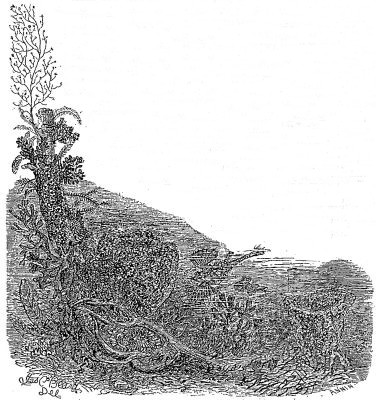
Sponges are so common and so familiar that many of us have used them all our lives without stopping to admire their curious and interesting structure, or to inquire into the history of their past lives. We may, indeed, have noticed that they can be squeezed into a very small space, and that they will return to their natural shape when the pressure is removed. We have perhaps noticed also that they are full of little holes or pores, and that they will absorb an astonishing quantity of water.
You know there has been a doubt whether sponges belong to the animal or to the vegetable kingdom. For a long time naturalists were in doubt about the matter, but it is now settled that they are animals, living and growing on the bottom of the ocean. The only part of the sponge that reaches us is the skeleton. The living sponge is a very different object. Shall we see what we can find out about it?
Upon naming the word "animal," a picture comes before our minds of some creature having a mouth to eat with, and eyes to see with, and possessing feet or wings, or some other means of moving about; but the sponges are far from this. They are probably the lowest animals with which you are acquainted. They have no nerves, no heart, no lungs, no mouth, and no stomach.
Fig. 1.—Group of Spicules.
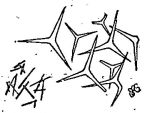
Live sponges consist of jelly-like bodies united in a mass, and supported by a frame-work of horny fibres, and needle-shaped objects called "spicules,", which you will see in Fig. 1, and which we must examine further after a while. This jelly-like flesh, covering all parts of the skeleton, is about as thick as the white of an egg, but it decays immediately after the death of the sponge. During life the flesh presents many bright colors; in some species it is of a brilliant green, while in others it is orange, red, yellow, etc.
The frame-work varies in different kinds of sponge. In those which are valuable for our use it consists of horny fibres interwoven in all directions until they form a mass of lacy net-work. This you can easily see with the naked eye, but by looking through a microscope you will see beauty you had not imagined, and which but for this valuable instrument would never have been dreamed of. In our ordinary sponges these fibres are all that remain of the former living-animal, the soft flesh having been removed. It is found that the horny fibres are composed of a substance very similar to the silk of a silk-worm's cocoon. They are exceedingly tough and durable. Most of us have discovered that a good sponge becomes like an old and tried friend, and that unless it is abused it seems as if it might never wear out.
Fig. 2.—Circulation of Water through the Sponge.
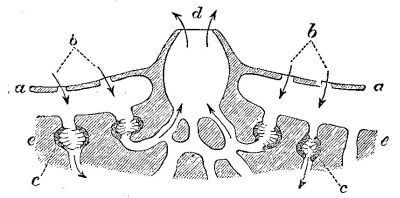
In looking at any sponge you will notice large holes through it, with many small pores scattered between them. The living sponge is constantly drawing in water at the small pores. This water passes through a set of branching canals, and is thrown out from the large holes on the surface, as seen in Fig. 2. (The arrows show the direction of the current.) With a microscope little fountains may be seen constantly playing from the large holes of a living sponge. The circulation is kept up in the canals by the movement of "cilia," which are delicate threads waving gently but continually. The word cilia means "eyelashes"; let us remember it, for this is a name we shall often want to use. The cilia are shown in those cup-like hollow places in the canals (Fig. 2). The stream of water thus passing through the sponge brings to every part of it small particles of food, and all the air it needs for breathing purposes.
Everything that lives must eat and breathe, but how is the sponge to eat without a mouth? When the food touches any part of its body, the soft, jelly-like flesh sinks in to form a little bag; at the same time the surrounding parts creep out over the morsel of food, until it is entirely covered and digested. After this the flesh returns to its original position, and any shell or other refuse that remains from the meal is washed away.
Sponges have a curious manner of producing their young. At certain seasons very small oval masses of jelly are formed on the inner surface of the canals, which finally drop off. They remain in the canals for a time, and become perfect eggs, after which they are thrown out by the stream issuing from the fountains, and instead of falling to the bottom, as we might suppose such helpless masses of jelly would do, they swim around as if they meant to have a little sport before commencing the sober realities of life.
You will be interested to know that while these jelly-like eggs were resting in the canals of the parent sponge, delicate cilia (which we learned about just now) were forming at one end of the egg. These cilia strike the water with a rapid motion, and the eggs are rowed about through it until they settle down and attach themselves to some rock or shell on the bottom of the ocean, and finally grow up into the perfect sponge. The waters are swarming with these eggs at certain seasons, and great quantities of them are eaten by larger animals.
SPONGE-FISHING.
Sponges are common in nearly all parts of the world, and they differ greatly in size and quality, but few species being useful to man. Some species are nearly round, others are always cup-shaped, some top-shaped, and some branched. A fresh-water sponge is frequently found in our streams, growing upon sticks and stones. It is of a bright green, and when seen under the water in a flood of sunlight it is very pretty.
The spicules of sponges grow in a variety of elegant shapes, but they are visible only with a microscope. They are composed of lime or flint, and are generally sharp-pointed. They are imbedded in the flesh as well as in the horny fibres, thus serving to protect the helpless creatures from being devoured by fish and other animals. In our fine sponges, the skeleton is almost destitute of spicules, while in some others the flesh is supported wholly by spicules, giving them so loose a texture that they are of no value for domestic purposes.
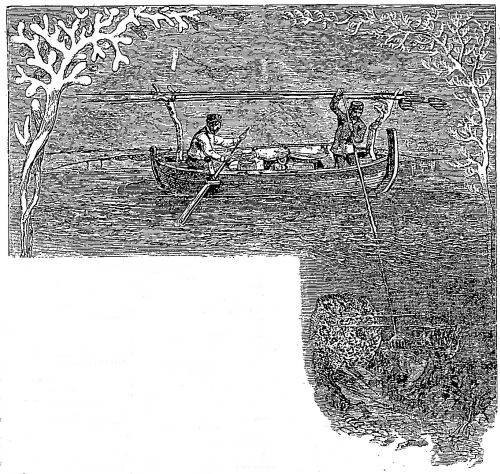
Fine sponges are used by physicians in surgical operations, and are sometimes very expensive. Should you at any time take a fancy to a dainty little sponge in the druggist's window, and step in, thinking to buy it, you will probably be surprised at the price asked for it. Our finest sponges come from the Mediterranean Sea and the Red Sea. They are obtained by divers, who search for them under rocks and cliffs, and who remove them carefully with a knife, that they may not be injured; The Turks, who carry on the trade, have between four and five thousand men employed in collecting sponges. The value of the sponges annually collected is estimated at ninety thousand dollars. Coarse varieties are found in the Gulf of Mexico and the Bahama Islands. They are scraped off the rocks with forked instruments, and consequently they are often torn.
The demand for sponges has increased so much during the last few years that there is cause to fear the supply will be exhausted, unless some way can be found to cultivate them by artificial means. With this view, attempts have recently been made to raise sponges in the Adriatic Sea by taking cuttings from full-grown ones, and fastening them upon stones on the bottom of the ocean until they attach themselves. These experiments have been successful, but the operation is a delicate one, requiring great care not to bruise the soft flesh. It is necessary to keep the sponge under sea-water during the process.
Fig. 3.—Glass Sponge.
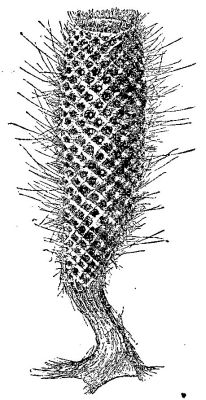
Some of the glass sponges are exceedingly beautiful. The delicate "Venus's flower-basket" grows in the deep sea near the Philippine Islands. It looks like spun glass woven into a beautiful pattern, and is so exquisite we can scarcely believe that it is the skeleton of a sponge. Fig. 3 shows a remarkable specimen of the sponge family, taken between Gibraltar and the island of Madeira by the scientific party on board the famous Challenger, which ship was sent out for the express purpose of exploring the animal and vegetable wonders of the great deep.
This sponge, reduced in the illustration to one-third its size, is composed of bands of spicules running lengthwise from end to end, with cross bands at right angles. The corners are filled up with a pale brown corky-looking substance, reducing the spaces to little tube-like holes, and rising into spirally arranged ridges between them. The ridges, instead of having a continuous glassy skeleton, have their soft substance supported by a multitude of delicate six-rayed spicules interspersed with what under the microscope look like little stars and rosettes. The whole sponge is covered with fine hairs, and the mouth is closed by a net-work of a jelly-like substance supported by sheaves of fine needles. The glass-rope sponge roots itself in the mud by twisted fibres.
The boring sponge spreads itself over the shells of oysters and mussels, boring them through and through, and dissolving the shell. It even bores into solid marble, and will, in time, utterly destroy it.
Flints are exceedingly hard substances—so hard that when we wish to be emphatic, we sometimes say that a thing is as hard as flint. Yet all the flints in the world are supposed to have been formed from soft sponges. By examining small pieces of flint under a microscope the texture of the sponge, in a fossil condition, is often clearly seen, and the spicules peculiar to sponges are recognized.