SOME CURIOUS ART WORKS AND ARTISTS.
Reading edition
The Marquis de Veere once gave each of his household a sufficient quantity of the richest white silk damask for a suit. Charles V. was about to make him a visit, and the marquis wished his court to make a splendid appearance when assisting him to receive the emperor. His painter, Mabuse, who was always in debt, was granted the privilege of seeing to the making of his own suit of clothes. Mabuse, however, sold the damask for a good price, and having made a paper suit, painted it so perfectly to represent the damask that when he appeared in it all were deceived.
When the marquis called the emperor's attention to the beautiful clothing of his court, and asked which suit he most admired, the emperor at once selected that of Mabuse. The joke was then explained to the emperor, but he would not believe that the suit was not of real damask until he had touched it with his hands.
It no doubt took Mabuse considerable time to paint his damask, but a much more celebrated artist once made a wonderful drawing almost in an instant. At the time of the Cæsars there was at Rome a panel on which was to be seen nothing but three colored lines. The lines were drawn one on top of the other, each thinner line dividing the next wider. This was considered one of the most wonderful art works at Rome.
The Grecian painter Apelles went one day into Protogenes's studio, and finding that artist out, drew on a panel the widest of the three lines in such a peculiar and beautiful manner that Protogenes knew at once his caller. When Apelles called the second time he found that Protogenes had drawn a colored line upon the first line, dividing it with the most delicate accuracy. Seeing this, Apelles divided the second line, to every one's astonishment. Protogenes lived at Rhodes, and the panel was taken to Rome to be admired by all who saw it. When the imperial palace was destroyed, the panel unfortunately shared a like fate.
In comparison, what a delicate flower is to a huge log, so the work of Apelles would be to such a vast oil-painting as the "Apotheosis of Hercules," painted by Lemoin, a Frenchman. This picture measured sixty-four feet one way by fifty-four feet the other, and the ultramarine to paint the clouds on it alone cost two thousand dollars.
Another huge painting, said to be the largest in the world, is Tintoretto's "Paradise," at Venice. It contains an almost innumerable multitude of figures, and fills the end of a large hall, over three hundred feet long and half as wide.
One of the most minute and beautiful of art works now at Florence is a glory of sixty saints carved on a cherry stone. It was carved by the Italian sculptress Rossi, who executed other similar carvings, besides working in marble.
Some of the old artists had peculiar methods of working. Aspertino taught himself to paint with both hands at the same time; and Goya, who died in this century, frequently used a stick or a sponge rather than a brush. There are pictures of Goya's done entirely with his palette knife and finger-ends.
One of the oddest of all artists was Bazzi, called Il Soddoma. Not only did he dress peculiarly, but his house was full of strange pet animals, such as monkeys and queer birds. Among the birds was a raven that could perfectly imitate his voice and manner of speech.
Sir Joshua Reynolds painted with brushes the handles of which were a foot and a half long, and used them so rapidly that he would paint a portrait in four hours. The finest of his pictures were those of children.
Other painters were noted also especially for their rapid work. One morning when some citizens called upon the Spanish painter Serra with an order for an altarpiece, he invited them to stay to dinner, and in the mean while to pass the time in his garden. When dinner-time came, the citizens were perfectly amazed to see Serra walk into their presence bearing the finished picture.
Rizi, another Spanish painter, went in early life to Salamanca to study theology, but he arrived there without money, and found that to be received at the college he must pay a hundred ducats. The abbot of the college gave Rizi but two days in which to get the money, or be refused as a student. Within that time, however, Rizi painted and sold a picture for the desired amount. He continued to paint to pay for his education, and in addition to becoming a famous painter he was made a bishop just before he died.
A celebrated painter of fairs and festivals such as took place among the Dutch was David Teniers. He usually painted on small or moderate-sized canvases, but the figures often were so numerous that one of his pictures contains nearly twelve hundred figures, while others with two hundred and three hundred figures are not rare. Teniers could imitate the style of other painters. At Vienna is a picture of his representing a gallery in which he and a gentleman are standing, and on the wall before them are hung fifty pictures of other artists. The pictures, of course, are quite small, but any one comparing them with the originals sees how striking is the imitation of different styles.
Another clever imitation of a very different kind was that of Peredo's, whose wife, a lady of rank, wished to have a servant with her whenever any one called. Peredo was not wealthy enough to keep merely ornamental servants, and he painted an old lady with glasses sitting in a chair, and who, apparently, when visitors saluted her, was so busily engaged in sewing as not to hear them.
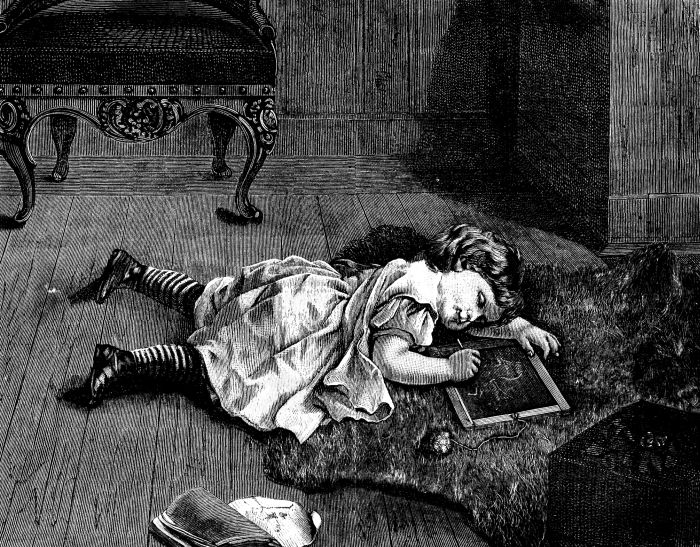
THE LITTLE ARTIST.