Chapter III
Reading edition
"A primrose by the river's brim A yellow primrose was to him, And it was nothing more."
"Princess Bébè! Princess Bébè! Princess Bébè!"
It was the little gate-keeper, running at the top of his speed, and shouting at the top of his voice.
Very much heated and very red in the face was the little man as he stood before the princess, holding out to her a loaf of bread almost as large as himself.
"This is for you," he said, in a choked voice, for he had run so far and so fast that he could hardly speak at all. "The wise old woman of Hollowbush sent it. Now eat, eat. Let me see what it is like—let me see how you do it."
While the princess ate her loaf of bread with more eagerness than any member of royalty ever displayed before or since, the gate-keeper watched her with wondering eyes.
"Well, I never saw anything like that before," he said at length. "And you go through that remarkable performance every day! Every day!" he repeated, in a tone of the most intense astonishment.
"But where did you find it?" asked the princess, who was more interested in the bread than in the gate-keeper.
"Find it!" he exclaimed. "I didn't find it. That wise old woman of Hollowbush, who has discovered the secret of the three knocks, knocked on the wall, and when I had opened the door, she thrust it in, saying she would bring you a fresh loaf every day."
"Then she has not quite forgotten me," sighed the princess, thinking of her last conversation with this same wise old lady. "But does she know that I must stay here the rest of my life?"
"Oh yes," answered the gate-keeper, shaking his head, and looking very wise. "That is—there is a secret—did it never occur to you, my dear princess," he added, suddenly, "that there might be a way of making your escape?"
"Oh, you dear delicious little gate-keeper!" exclaimed the princess, seizing him in her arms, and tossing him up and down. "I see how it is: you will let me out—you will do it. Oh, I am sure you will!"
"Not so fast, my dear," said the little man, struggling to free himself. "Put me down, and I will tell you all about it. But first of all you must promise to keep the whole matter a profound secret: if you should tell any one, the plan would fail."
"Oh, I can keep a secret," said the princess, smiling, and beginning to feel quite happy again.
"Well, then," said the gate-keeper, seating himself by the fountain—which was not a fountain at all, but only an imitation very skillfully done in aquamarine—"you are to stay here a year. Then, when the spring comes you are to be changed into a primrose, if you will consent to it, and grow up out of the ground like other flowers. Hidden deep within the woods, you must wait patiently, through sunshine and rain, till some one finds you, and breaks you from the stem. Whoever he may be, rich or poor, young or old, if he loves the flower well enough to take it home, and place it carefully in a vase of water, he will have the power of transforming it into a mortal, and you will be restored to your home in a world where the sun shines and where flowers grow."
"Dear! dear!" said the princess, "I suppose I must consent, if that is the only way of making my escape. But what if no one comes into the woods, and what if no one cares enough for the primrose to pick it?"
"Then it will wither on its stem, and you must come back to us, and be the Princess Bébè for another year."
The trial which was proposed to her seemed a very hard one, and the year which followed seemed very long. If it had not been for the kindness of the gate-keeper, who amused her by showing her all the curiosities which the kingdom of the mineral-workers contained, and explaining how the gems were cleaned and polished and cut, I am afraid the poor Princess Bébè would have died of homesickness long before spring. But at last the year came to an end, as all years must, and she started on her journey into the upper world.
Day after day she struggled through the earth, pushing her roots deep down into the soil, and stretching her slender leaf-like arms up into the sunlight. The dew came and kissed the little flower-bud with sweet moist lips, the sunshine warmed it, and the south wind sang to it, until at last a yellow primrose opened its eyes in the dark woods.
Day after day it lived there, trembling at the sound of every footstep, and wishing and praying deep down in its flower-heart for a friend.
June days had never seemed so long as these, for, despite her prayers, no one came, and the lonely primrose grew faint and weary with disappointment.
At last, however, a party of children playing in the woods caught sight of her bright face, and one of them—a merry, rosy-cheeked boy—broke the flower from its stem. He held it up to his companions, and they ran laughing after him.
"Oh, it's nothing but a yellow primrose," he said, as they tried to snatch the flower from his hand; and with these words he threw it away.
So it was all in vain that the little flower had lived and died, for the next day the Princess Bébè found herself back in the kingdom of the mineral-workers.
Her diamond necklace was just as beautiful as ever; her opal bed seemed all alive with trembling colors, soft white and flashing crimson; and the king welcomed her right royally, without a word of reproach for her long absence.
But for all that, her heart grew heavier every day. Even the attentions of the gate-keeper became tiresome; and when he tried to make her laugh with his merry ways, she could only smile sadly, and say, "Oh, it was such a disappointment to be picked, and then thrown away."
"Never mind—never mind," he would answer, cheerily: "better luck next time." And so the days dragged slowly by until another spring.
Then the princess began to hope once more; and when she found herself actually lifting her head into the sunlight, and felt the soft air blow over her, she wondered how she could ever have believed for a moment that anything was better or more beautiful than the deep blue sky above one, and the green earth beneath.
Contented and happy, she waited patiently through wind and rain, until it seemed as if her patience were to be rewarded.
A young man on a jet-black horse came riding through the woods. His face was bright and handsome, and he looked out upon the world with as merry a pair of eyes as you would care to see.
"Oh, if he would only take me home!" thought the flower. "I should like to be rescued by such a handsome youth as he." And in spite of her yellow primrose face, the little flower actually blushed.
"What a bright little flower!" said the young man, as he rode along. "If it were not so much trouble getting off my horse, I would carry it home to Marjorie. But it's only a commonplace little primrose after all," he added, and so rode on.
That night the little flower cried itself to sleep among the shadows, and before morning it had withered on its stem.
"I will never make the attempt again," said the Princess Bébè, when she found herself once more in the kingdom of the mineral-workers.
THE PRINCESS BÉBÈ AND ALECK.
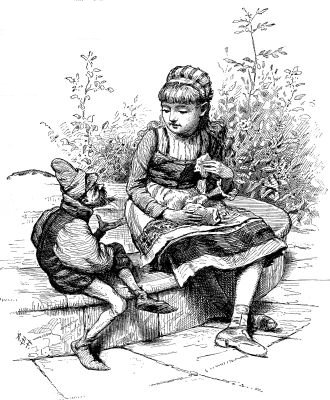
"Oh yes, you will," said the gate-keeper, who had come forward to meet her. "If life is worth having, it is worth struggling for. Next year I shall send you up for your trial, whether you consent or not."
"If that is the case, I suppose I may as well consent at once," said the princess, and so yielded the point.
And when the long, long days of another year had come and gone, she left the kingdom of the mineral-workers for the third time. For the third time she struggled through the ground, lifting up her head among the blue-eyed violets and slender waving grasses.
She shook out her petals in the sunlight, and smiled as sweetly as a primrose can smile; but the spring days went by, and the summer was almost over, before any one took any notice of her.
The poor little primrose was almost ready to die of despair, when one day, looking up quite suddenly, she saw the face of an old man bending over her.
He had gray hair and kind gray eyes; and as he looked at the flower he smiled tenderly, as if he were looking at something that he loved.
The flower smiled in turn, but could not speak.
"You must go home with me, little primrose," said the old man, stooping over the flower.
The fact that this gray-haired, gray-eyed old man was a poet will account, perhaps, for his talking to a flower as if it could understand what he said. At all events, he broke it from the stem, and when he reached his home placed it in a glass of water, saying,
"There you must stay, my little flower, until I can write a poem worthy of your bright face."
No sooner had he uttered these words than he saw standing before him a young girl with golden hair and softly shining eyes.
"Bless me! bless me!" exclaimed the old man, in great surprise, taking off the spectacles which he had so carefully adjusted across his nose, "where did you come from, my lady?"
"I came from the flower," she said; and she threw her arms round his neck and kissed him on the lips.
She was so delighted at her escape that she was not wholly responsible for her actions; and if she cried a little, I don't think any one will blame her.
Laughing and crying at the same time, and half wild with excitement, she told her new friend the story of her life for the past few years; and he, in his turn, smiled and wept a little, perhaps, and then he kissed her on the lips, and said,
"Henceforth, my dear girl, you shall be known as the Lady Primrose, and you shall stay with me as long as you will."
Whether or no he ever wrote a poem about her I can not tell. All I know is that she lived with him for the rest of her life, and was the sweetest and happiest Lady Primrose imaginable.
The house was as full of flowers as it could hold, and when the wise old woman of Hollowbush, who, you may be sure, had not forgotten her, asked her if she did not want another diamond necklace, Lady Primrose would answer:
"I don't care if I never see another diamond. The simplest flowers that grow in the woods are the loveliest jewels God ever made, and so long as I can have them, the lifeless flowers of the underground world may bloom for those who do not know of how little value the jewels they prize so highly really are."