LIFE ON BOARD A TRAINING-SHIP.
Reading edition
Training-ships, on board which boys are taught to become first-rate seamen, form an important portion of every navy; and in the accompanying sketches our artist has endeavored to convey correct ideas of the daily life of these boys to those of our readers who live far inland, are not familiar with ships and sailors, and who perhaps have never seen the sea.
FURLING SAIL.
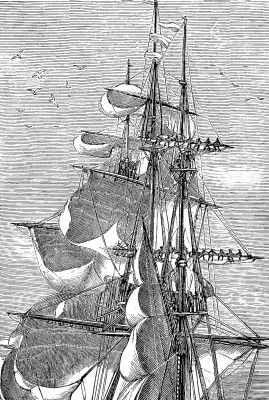
The first sketch is one showing the boys undergoing a part of their sail drill, and engaged in furling the mizzen top-gallant-sail and royal. The sails of a man-of-war are furled and stowed with the utmost care and precision, so that the ends of the yard look exactly alike, and sometimes the boys have to do their work over and over again before the critical eye of the officer watching them is satisfied. In storms, when the great ship rolls so that the yard-arms sometimes touch the water, lying out on them and furling sails is very difficult and dangerous work, and it is only on account of the constant drill they have received during fair weather that the boys are able to accomplish the task under these circumstances.
BATH-ROOM.
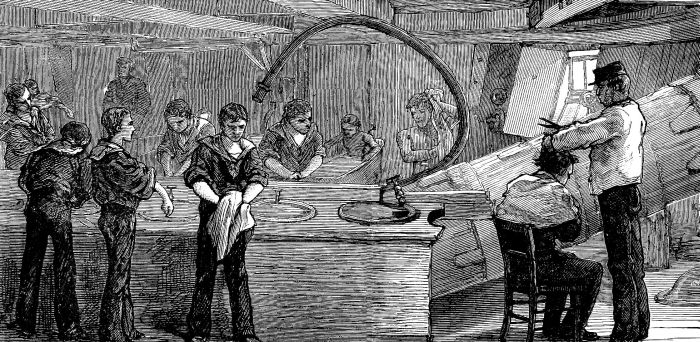
Above all things, on these training-ships the boys are obliged to keep themselves neat and clean. They are expected to bathe frequently, and are always compelled to do so on Sunday. The bath-room, provided with tubs, basins, and a plentiful supply of water, is located in the bows, in the extreme forward part of the ship.
SCHOOL-ROOM.
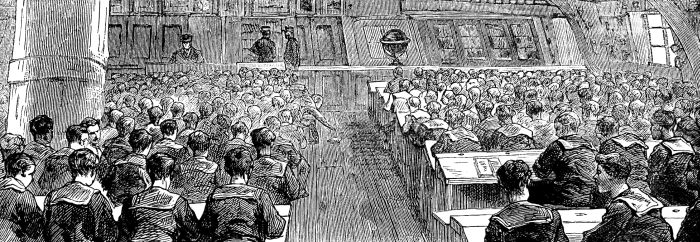
Generally amidships, but sometimes in the stern of the ship, is the school-room; for sailor boys have other things to learn besides the practical sailing of a ship. In this school-room the young sailors spend four or five hours of each day, and are taught reading, writing, arithmetic, history, geography, and grammar.
DINNER-TIME: EIGHT BELLS.
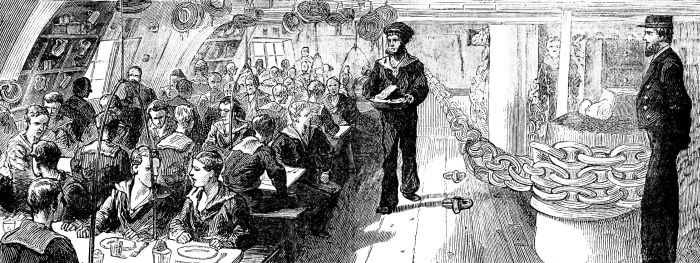
At noon, or eight bells, as they say on shipboard, the bugles sound the dinner call, and from all parts of the ship the boys tumble down the hatchways to the berth-deck, where is a long row of short tables swung from the ceiling, and where the young sailors eat the bountiful dinner provided for them as only healthy, hearty boys can eat.
ORLOP DECK, OR COCKPIT.
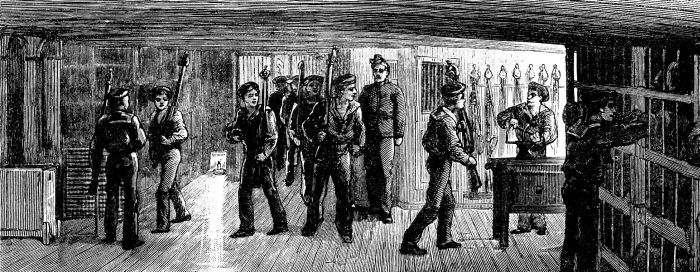
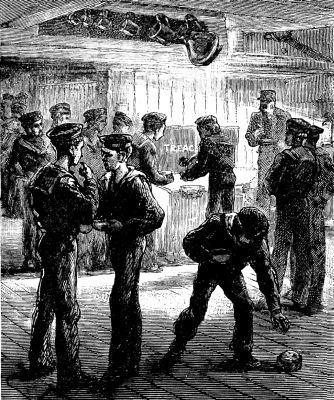
The fourth or lowest deck of the ship is called the "orlop deck," and it is here that the boys stow away their muskets and cutlasses after drill. On this deck also the boys receive at four bells, or six o'clock in the evening, the allowance of bread and molasses, or treacle, that composes their regular supper.
SERVING OUT BREAD AND TREACLE.
GUN PRACTICE.
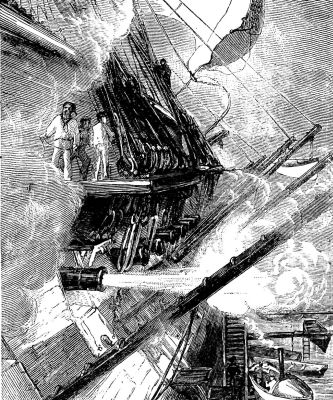
GUN-DECK—FIRING A SALUTE.
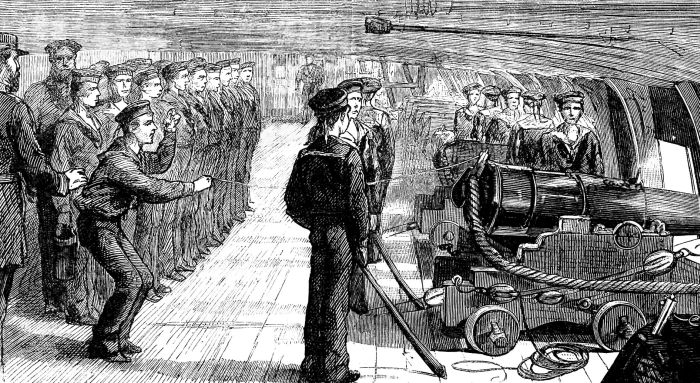
Next to the sail drill, perhaps the most important is the gun drill, or practice with the heavy guns. This gun drill is not important merely because the guns are to be used in case of a fight, but because they are also used in the firing of salutes. These salutes must be fired whenever another man-of-war comes into port or a distinguished officer comes on board, on national holidays, and at many other times; therefore it is very important that the boys should be familiar with the great guns. Each gun has its crew, each one of whom has an especial duty to perform. The long cord that the boy in the last picture holds in his hand is called a lanyard; and as he pulls it with a smart jerk, a hammer falls on the breech of the gun, and with a roar that shakes the ship, the great gun is fired.

San Francisco, California.
I am twelve years old, and go to the Lincoln School. It is so called because it has a statue of Abraham Lincoln in front of it. It was built in 1864, has over twelve hundred pupils enrolled, and I think it is the best school in the city. I have been making vases out of Farallon eggs to send East to my cousins. The eggs come from the Farallon Islands, twenty-one miles outside of the Golden Gate. They are of a blue color, and have marks on them that look like hieroglyphics. The birds that lay them are a species of gull. I was born in San Francisco, and have lived here most of my life. Four years I spent up in the mountains on a farm, or ranch, as they call it here.
Charles W. S.
Farallon, the name of these islands near the entrance to San Francisco Bay, is a Spanish word signifying a small pointed islet in the ocean. The islands, of which there are six, are so called because they consist of rugged towering peaks of granite! A more desolate place could not well be imagined. There is nearly always a fierce wind blowing, and the waves dash wildly into the numerous spouting caves along the rocky coast. There is a light-house here three hundred and sixty feet above the sea, and its keepers are the only human inhabitants of the desolate sea-bound rock; but thousands of sea-lions congregate upon the cliffs, and vast numbers of gulls and wild rabbits make their home there. During the egging season men visit the islands, and gather thousands of eggs for the San Francisco market. A very interesting account of these islands, is given in Mr. Nordhoff's book on Northern California, Oregon, and the Sandwich Islands.
Fort Assiniboine, Montana Territory.
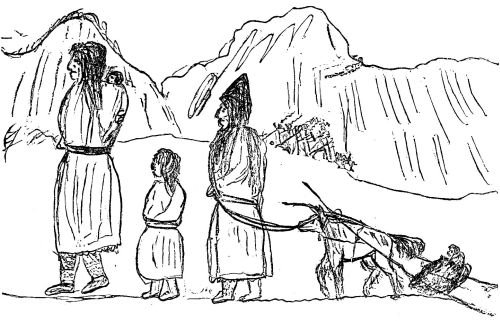
I am always glad to see Young People come with papa's mail. Out here in the wilderness we do not often see nice papers; but then we see what city people never see—plenty of Indians. Many of them are very poor, and so hungry that they pick bread and scraps of meat out of the swill barrels to eat—old stuff that the soldiers have thrown away. I think people should send the poor Indians something to eat. I send you a picture of some Indians as they look hunting for food this cold day. I am only nine years old, and can not draw very good pictures.
Bertie Brown.
INDIANS HUNTING FOR FOOD.—Drawn by Bertie Brown.
Worcester, Massachusetts.
I have a canary, which is the only live pet I ever had. It was eight months old the 17th of February. I plant canary-seed, and let it grow until it is about two inches high, and then I give it to my canary. It likes to eat it very much.
Louie E. Ware.
I live way off in Washington Territory, and thought I would tell you something about this distant country. We live near the Simcoe Mountains. They are covered with evergreen pines. We can see the snow-capped mountains every day in the year—Mounts Jefferson, Hood, St. Helen's, and Adams. It snows here sometimes in winter, but the wind comes up from the sea, and takes it away in a few days. I do not live near any school, but I study and recite my lessons at home. Six miles away, at the new town of Goldendale, there is an academy, and they are teaching in it now. I am ten years old, and was born in this country. Sometimes troops of Indians come riding past on their spotted ponies. They bring salmon from the Columbia River, huckleberries from the mountains, and now and then ponies to sell. I am very fond of reading, and am delighted with Young People. I read every word in it.
Gertrude Balch.
Heckatoo, Arkansas.
I am a little girl eight years old. I take Young People, and like it very much. I have a doll named Laura Martin. I live on a cotton plantation on the Arkansas River, and I can stand on the front gallery of our house and see all the boats that pass. We have never been to school, and we have no governess now, so mamma has to teach us. We have a great many pecan-nut trees here, and there is a pond near our house with a boat on it, and my sister and I row sometimes.
Cynthia R. Smith.
Utica, New York.
I am six years old. My birthday was the 18th of January, and mamma gave me a little party. We had a nice time, and sat down to tea all by ourselves, without any grown people. I have two birdies; they will put their little heads clear out of the cage, and take seeds from my mouth. Sometimes they nip my tongue, and one birdie will fly out right into the cup I keep seed in. I taught them to eat in that way by not letting them have anything until they would take it.
Bessie L. Carter.
Papa brought me the numbers of Young People a few days ago. I had been waiting anxiously for them, and I was so delighted when he gave them to me. I have known all about Harpers' publications for a long time. Mamma says that papa took Harper's Magazine long ago, before the war. I like the stories, letter-box, and puzzles in Young People very much, and I have succeeded in getting answers to some of the puzzles. My pets are cats and dogs, and I would like to get a parrot. Alabama was my native place, but now I live in Maryland.
Lidie B. Duke.
Russelville, Arkansas.
I thought you might like to know about "Dr. Pruitt's boys," so I concluded to write you a letter. I am Will, aged twelve; then there are Fred, Edward, and Charley. Papa takes Harper's Monthly, and mamma takes the Bazar, and when Young People was advertised papa proposed that each of us give something and take that too. We four boys earned just one hundred dollars picking cotton last fall, so we all contributed. We like the paper very much, and watch for its coming; and we read everything in it.
Will E. Pruitt.
Grand Island, Nebraska.
I am ten years old. My uncle takes Young People for me, and I can hardly wait until it comes. I have got the elephant on his four legs, and he looks well. I have a little prairie-dog named Jenny. It lives in a hole in the yard, where I think it must have a good nest, for I gave it lots of rags last fall to put in the hole. It comes to the house almost every day to get something to eat, and seems glad to see us. I have also a little dog named Frisk, only I sold one-half interest in him yesterday for twenty-five cents to a doctor who lives next door. He wanted him for his baby to play with. Can you tell me what kind of a place a junk-shop is?
Harry K. Heffleman.
A junk-shop is where old ropes, old anchors, old iron, and cast-off odds and ends of all kinds are kept for sale. There are many such shops to be found in every large city, and if it is a seaport, they are generally located near the waterfront, as a vast quantity of such rubbish is picked up along the wharves. In New York city junk dealers drive wagons round the streets, and buy old stoves or any worn-out household goods.
Lonoke, Arkansas.
I found in mamma's front yard, near a brick wall, a little pansy, which I send you. It bloomed out the 29th of January.
Sarah F. S.
It was fortunate for the little pansy that it was picked and pressed, for Katie Black writes, also from Arkansas: "There was a very pretty snow-storm here on the 2d of February. It began in the morning, and snowed all day."
Ward A. P.—Your puzzle is neatly done, but as we have already published one having the same solution, we can not use it.
Wheeling, West Virginia.
Can you tell me what five words in the English language end in "cion"?
S. R. W.
Can any correspondent answer this question?
J. R. B.—Jupiter will be evening star until March 15, morning star until October 6. Mars will be evening star until October 25. Saturn will be evening star until April 7, morning star until October 18. Venus will be morning star until July 13, evening star the rest of the year.
Kate.—You may write us any interesting things you know about prairie-dogs in Kansas.
"Jonathan."—You will find brief accounts of the ancient Roman road-builders in any history of Rome, also in Appleton's Encyclopedia under "Roads." Lemprière's Classical Dictionary also contains much information, especially of the Appia Via.
Mae W. T.—"The Youthful Philomathesians" would be a pretty name for your literary society. Philomathesian is a Greek word signifying loving to learn, or lover of knowledge.
Walter S. Dodge.—The picture on the first page of Young People No. 14 is a fac-simile of a pencil drawing reproduced by a photographic process.
Very neat "Wiggles" are received from R. V. R., Hattie Strong, and F. B. Myers, which we regret being unable to publish.
Louise S.—You write so prettily that we are sorry your enigma is not good enough to print. Do not be discouraged. Try again, and the next time see if you can not make rhymes.
John F. S.—Persevere with your locomotive-engine drawing, and some day you may be able to put it to good use. Engines and machinery of all kinds are good things for a boy to become familiar with, and if you are really fond of them cultivate your inclination all you can.
Netta Franklin, Freddie C., Emma S., Pussy K., and Robbie V. R. are very youthful correspondents who favor us with letters printed with remarkable neatness. May R. also writes a very legible "Wiggle." When you learn to print, little girl, write again.
Acknowledgments for favors are due to C. Fannie Anderson, William F. B., John T. I., Perceval Hill, Frank Yarington, Angie T. Tenny, Florence G., Istalina Beach, George P. R., Orie Maude, Albert A., Mary Buchanan, Jennie E. Anderson, Myrtle Gilman, Alice M. S., Minta Holman, Mary F. W., Walter Jennings, Locke S., Sue Dawson, Ida S., Annie Black, Freddie L., Minnie Parker, Della L. Grimshaw, Bert Wellman, Eliza E. Crowell, Clarence C. Culver, Ada R., Ida M. C., Mary Landon S., Arthur D. Miller, Eddie Carnes, Bertha B. H., Daisy J. M., Katie Bouck, W. C. B.
Correct answers to puzzles received from Effie K. T., P. S. Heffleman, C. F. Langdon, Louise Swift, Maude K. Smith, E. and M. D., Florence Schaffenburg, H. M. H., J. H. Merrick, Harry E. Sears, Lewis K. Davis, M. Barton, P. Karberg, "the Boys, Bessie, Mamma, and I," Katie W., Harry S., Pussy Kellogg.
ANSWERS TO PUZZLES IN NO. 14.
The following solution to "A Latin Word Square," on page 155, is from a correspondent in Pennsylvania:
ROMA
OLIM
MILO
AMOR
The square is made of magic spells That speak of Horace and of Homer; The third the glory that was Greece, The first the grandeur that was Roma. Tales of eating and of drinking, And of falling roofs upholden, Call up Milo; Milo backward murmurs Olim, These, all these, were in the olden Time long ago. Lo! in yon brilliant window niche My fourth—how statue-like he stands! His bow and arrow in his hands, Ah, Amor, from the regions which Are Holy Lands.
Answer to "Throwing Light," on page 168—"Draught, draft."
We have received numerous answers to the Puzzle Picture on page 168, which are correct with the exception that more beasts are there than any one has yet discovered. A great many little folks have found seven. Only one has found eight. There are nine concealed in the picture, and we give one more week in which to hunt for them before publishing the answer.