Chapter I
Reading edition
Do you remember Biddy O'Dolan, the little rag-picker and ash girl who found Lily De Koven's broken doll in the ash-can that cold winter's morning? I have not forgotten my promise to tell you the rest about her.
Biddy had a boy-friend, a little Irish boy, who called himself "Chairlier-Shauzy." I suspect his name was Charley O'Shaughnessy. He was just as poor and alone in the world as Biddy, and almost always staid in the same cellar at night.
When Biddy ran off with her doll that cold morning, she not only thought of the hospital and the little girl who had there brought her the flowers, but she thought how she would tell Charley that night about her doll.
The first thing to be done was to get Dolly a dress, and this was the way Biddy managed it. She took an old knife and hacked out a piece of her skirt, then she pulled out of her dingy pocket a little wad. A wad of what? Pins. Pins that she had picked up on the street in the summer, when she swept the street crossings, and had stuck thick and "criss-cross" in a bit of woollen rag. With some of these pins Biddy fastened together the two sides of the cut in her skirt. Next she took the piece of cloth she had cut out, and punched her tough little forefinger through it in two places, and through one of these holes pushed the whole arm and through the other the broken arm of her doll, and pinned the cloth together in the back.
Thus Dolly was dressed, and nearly as well as Biddy, too. Biddy had been very quick about this, and had often looked over her shoulders to see who came in and out of the cellar.
You who do not live in a cellar, and do not get shoved about and slapped as Biddy did, can hardly imagine how glad she was that no one happened to take notice of her.
She hid Dolly under the straw where she was to sleep at night, and then hurried out to pick over as many more ash cans and barrels as she could, in hopes of finding something this time which would please Mrs. Brown, so that she could dare to show her doll, and perhaps be allowed to sit up and play with it a little.
Mrs. Brown was the cross old woman who kept the cellar, and the children on the street called her "Grumpy."
Biddy did not find anything in particular, and got fewer pennies than usual for errands and for showing people the way to places, so that old Mrs. Brown was very cross indeed, and Biddy went to bed without daring to pull Dolly out where she could see her. She lay awake, with her hand on it, waiting for Charley.
Charley was a newsboy, but he was not a lucky little boy. He had the large and beautiful deep blue eyes you may often see in the children of Irish immigrants. But he was weak in body, and very shy. He lived as Biddy did, among rough people, who were all the more rough because they were so poor and miserable. So he got knocked about a great deal, and stood no chance at all among other newsboys, who shoved him aside, and called their papers so loud that Charley's thin voice could not be heard. Some newsboys make money selling papers—make so much that they can start in other kinds of business for themselves, and get on very well in the world among other successful men. I have seen this kind of newsboy. They have bright, sharp, old-looking faces. They have wiry, strong bodies, good health, and seem to be afraid of nothing.
Charley wasn't this sort of boy at all. He got poked, and pushed, and cuffed, and tripped up, and laughed at. The girls called him "fraid-cat," because they thought he was a coward. The boys said he was just like a girl, and shouted, "Hallo, Polly!" when they saw him. Charley did not say much to all this. He went with his papers every day, and managed to sell a few; and, besides, he did errands quickly and well. In these ways he earned enough to pay for his straw in Mrs. Brown's cellar, and to buy enough to eat to keep life in him.
Charley's straw was next to Biddy's straw, and when he came in that night Biddy whispered to him all about her doll, telling him especially how one of its arms was broken off at the elbow. Charley put out his hand in the dark, and asked her to let him take the doll a moment. He felt it over carefully, and gave it back without saying anything. Biddy whispered a little more, and then they went to sleep.
One day Biddy happened to come in a little after noon. She was going right out again; but first she stooped, and felt under her straw—the doll was gone! Biddy sat down, quite faint for a moment; then she sprang to her feet, darted up the cellar steps, and around the corner where old Mrs. Brown sat behind her apple and candy stand. Biddy reached over and put both hands in the knot of gray hair in the old woman's neck, pulling as if she would carry her off, stand and all.
Biddy's face was pale, and her eyes were like white-hot coals, as she gasped out:
"Give it me! Give it me! I'll never leave go till ye give it me!"
"Howld an, an' lave go av me!" cried the old woman. She grasped Biddy's wrists, and drew them toward her to ease the strain on her hair; but Biddy's little fingers were strong. She tugged hard, and kept on gasping,
"I'll never, never leave go till ye give it me. Oh!"
Never had such an "Oh!" come from Biddy's lips before, and with the very sound of it she had torn herself away from Mrs. Brown, and had seized and almost knocked over little Charley, who had vainly been making signs at her as he came up behind Mrs. Brown.
MENDING THE DOLL.
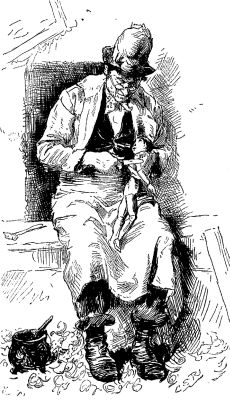
Mrs. Brown rubbed her neck, smoothed down her apron, and jabbering fiercely, came panting up to the children. Biddy had let go of Charley, and was sitting right down on the cold pavement holding her doll, and looking with wild delight and wonder at its wooden arm, new from the elbow. Charley knew an old man who used to whittle out all sorts of things with his jackknife, and who seemed as ready to give away as to sell his work. Charley had taken Biddy's doll to this man, who had willingly and quite skillfully mended it. He was on his way back to get it hid under Biddy's straw for a surprise for her, when he found Biddy struggling with Mrs. Brown. Charley's plan was perfect. The trouble was that he couldn't plan for Biddy too, and she had spoiled everything without knowing it.
"How ever could ye git a new arm?" said Biddy. "It's a miracle."
"Be whisht wid yer mary-cles!" exclaimed old Mrs. Brown, snatching the doll, holding it high out of reach, and spreading out her other hand to keep Biddy off.
But Biddy did not spring at her this time. She stood up, and put her hands together, and twisted them till the knuckles were white, and she spoke as if there were cotton in her throat when she begged the old woman to give her the doll. She promised never to be a bad girl any more; to give every cent she could get to Mrs. Brown—every one; to do everything Mrs. Brown asked her to do; and she called her over and over again "good lady," and "dear lady."
Mrs. Brown kept on talking too fast to be understood. She was very angry, and slapped Biddy's cheeks, and pushed her toward the cellar. Biddy stumbled along as she was pushed, and kept on praying for her doll, and making every promise she could think of to the old woman. When they reached the cellar steps, Charley pulled Mrs. Brown's dress, showed her a bright new quarter dollar, and said she might have it if she would give up the doll to Biddy.
Mrs. Brown took the quarter, looked at it, rang it on the step, and then handed the doll to Biddy, telling her that she might have it that night, but that she must pay extra every day for what she called the "craythur's boord an' lodgin'."
This idea seemed to please Mrs. Brown very much, for she called it a great joke, and put her hands on her hips and laughed. Then she looked savage again, and said, she would keep the doll herself on nights when Biddy could not pay extra. She went off to her fruit stand, with her hands on her hips, laughing and muttering by turns. Biddy sat down with her doll. Now and then she looked at Charley and smiled, and seemed to be thinking very hard about something.