TOM FAIRWEATHER'S HOLIDAY IN MADEIRA.
Reading edition
BY LIEUTENANT E. W. STURDY.
Tom Fairweather sighed as he stood on the quarter-deck. "Holiday-time, indeed!" said he. "What are the holidays without snow, I'd like to know? I'd give a good deal for a real old-fashioned coasting lark to-day, but I don't believe these people ever heard of such a thing."
It was a balmy day off the island of Madeira, where Tom's ship, or rather his father's, lay. Here spring and summer reign the year round.
"Old-time coasting is what you would like, eh, Tom?" said Lieutenant Jollytarre, with a twinkle in his eye. "Ask your father to let you go ashore with me, and I'll give you a frolic that you'll not be apt to forget."
Captain Fairweather gave his consent, and they hurried off.
A ten minutes' pull took them close to the island; but this Madeira shore is so steep that it makes an uncomfortable landing for a man-of-war's boat. Another boat, one belonging to the shore men, lay off waiting for passengers. Into this Tom and the lieutenant stepped, and were rowed close to the beach by two Madeira men.
As soon as the boat's bow touched the beach, two other men standing there made fast to it one end of a rope of which the other was attached to two strong oxen. At the word these oxen started, and up glided the boat over the round smooth pebbles, so easily that Tom was astonished to find himself at the top of the bank. With a laugh he jumped out. "That was a coast up hill, sure enough," he said. "Was that what you meant?"
The lieutenant looked mysterious. "No, it wasn't. Wait a while."
"What queer narrow streets!" said Tom, as he surveyed critically Funchal, the capital of Madeira. "And what a lingo—Portuguese—only it sounds even more like gibberish than it did in Lisbon. And what a lot of peddlers! They swarm like gnats."
Mr. Jollytarre was busy buying an inlaid box of one of the peddlers referred to, and did not answer.
CARRIAGE DRAWN BY OXEN.
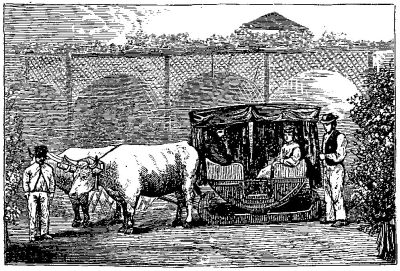
Meanwhile Tom's attention was attracted by a very odd carriage. This vehicle was drawn by oxen, and like a sleigh was set on runners, which offered less resistance than wheels would have done to the smooth round little stones of the pavement. These cobble-stones are very like the stones of the beach. The body of the carriage reminded Tom of a Sedan-chair; it seated comfortably two persons facing each other, had a top, and was draped on the sides by curtains drawn apart. Tom began to laugh, so much was he entertained by this strange equipage, whereat the lieutenant turned to see what had caught his eye.
"We might take a drive," said he, meditatively. "I want to take you to the Church of Nossa Senhora do Monte, on the top of that hill over there. What do you say, Tom?"
"I'd sooner walk," said our young friend. "I should think it would be slow work riding in an ox-cart, for that's all that amounts to, unless you choose to call it a sleigh."
HAMMOCK-RIDING IN MADEIRA.
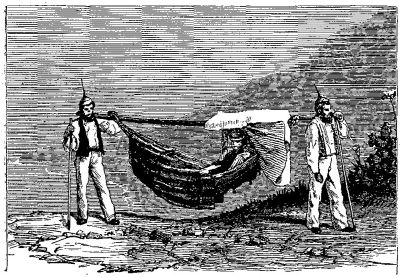
At this moment two men came slowly down the street bearing between them a pole on which was slung a curtained hammock, wherein reclined a pale sweet-faced lady.
As she passed Tom his bright face took her fancy, and she glanced at him with a smile.
"Wasn't that a beautiful lady?" he cried to Mr. Jollytarre.
"Indeed she was. But what do you think of her method of travelling? Slow as the ox-cart, eh?" Then suddenly, "Tom, I have it; we'll go on horseback." And almost in the same breath, cried, "Caballos."
The lieutenant's knowledge of Portuguese was limited, and he was obliged to make a little of it, mixed with Spanish, go a long way.
But the people about him were quick-witted, and it seemed to Tom that two horses with their two owners appeared on the scene as if by magic.
"Now, Tom," said Lieutenant Jollytarre, "you may walk if you please—I shall ride. The coasting I told you of is up there at that church. Will you take a horse?"
Tom replied by leaping into the saddle, and starting off at a slow canter.
As they rode away, the owners of the horses followed them, keeping up to the increasing pace by each clinging to his horse's tail.
This was all very well as long as they remained in the narrow streets, where a little steering was necessary; but as they left them, Tom grew impatient for a run.
"See here, now, this won't do," he called to his man. "I ain't a baby. I know how to ride. Leave go."
He slackened his pace to say this. The man slackened his pace, but did not drop the horse's tail. He grinned upon Tom, showing his even white teeth.
Tom waxed wroth. "Come now, let go," and he gave his horse a cut which started him into a gallop. The guide kept up, tugging away at the horse's tail.
"Come now, be off," cried Tom. "You keep my horse back. I say, Mr. Jollytarre, do put this into Portuguese for me. Tell this beggar I'll give him a cut if he don't let go."
"Cut away," said Mr. Jollytarre. "It won't make any difference. He understands you, but he wouldn't let go if you were to shout to him from now until doomsday. I know all about it. I've been here before."
"What does he hold it for?"
"Tom, I have often wondered. I suppose he knows. I don't. Wants to keep his horse in sight, perhaps; wants a run; likes our society. You see my fellow is doing the same thing. However, we are not going any slower in consequence. The horses are used to it. They don't mind in the least."
At this point the guides stopped both horses. They were in front of a little wine-shop half way up the hill.
The guides pulled off their caps, and urged the lieutenant to treat. This was another custom of the country, to which the lieutenant also submitted gracefully.
The waiters poured out a glassful all around.
"Take care, Tom; this is strong Madeira wine, although these people drink it almost like water. Better not do more than taste it."
"Never fear," replied Tom. "I wouldn't poison myself with the stuff. No, thank you" (to the waiter). "Drink it yourself, if you've a mind to."
"Temperance, are you?" said the lieutenant. "Well, that's a very good thing."
"I should say it was," said Tom, stoutly. "Anyway for a boy."
The rest of the road was very steep. But it was fun. Tom was sorry to reach the top, where, at the door of the church, they dismounted, and sat down to rest. The horses were led off.
When Mr. Jollytarre rose to his feet and announced that they must be going, Tom looked around for his horse in vain. Instead, two sleds approached, each pushed by two men toward our friends.
"Get on board, Tom," exclaimed the lieutenant; "that is, if you want to have the best coasting you ever had in your life. If your prejudices hold you back now, you'll regret it the longest day you live."
THE MOUNTAIN SLED.
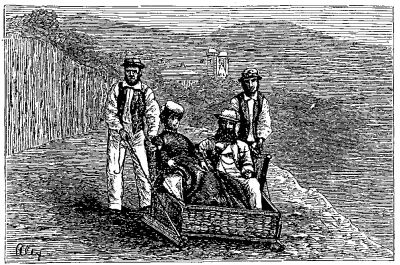
So saying, he scrambled into one of the sleds himself, and Tom followed his example, although still a little doubtful as to the success of the experiment. There were two thongs for steering tied to the front of each sled, which were held by the two men behind.
When everything was ready, the two sleds started together down the hill. It was like the wind. It was like chain-lightning. It was like a telegram. As they tore down the hill, they made a hissing sound like the cracking of whips. There were sudden turns in the road, beneath which lay dark and deep ravines. If Tom had known that sometimes in these wild rides persons had been hurled over the sides of such precipices, a still greater zest would have been imparted to his flying trip; for he was a thorough boy, and loved a spice of danger. However, he would have had hardly time to dwell upon this thought, for in less time than it has taken to write of it he was landed again in Funchal.