SCIENTIFIC PUZZLES.
Reading edition
Fig. 1.
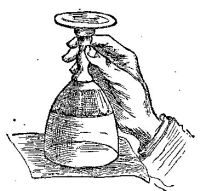
Fig. 2.
The experiment represented in Fig. 1 illustrates the pressure of the atmosphere. Fill a goblet with water up to the brim, and then cover it with a sheet of paper which touches both the edge of the glass and the surface of the water. Turn the glass upside down, and the sheet of paper, held in its place by the pressure of the air, will prevent the water from running out. It frequently happens that this experiment is only successfully performed after a series of fruitless attempts on the part of the operator. We therefore suggest that it shall be made over a basin, and not where there are expensive articles to be ruined by a douche of water.
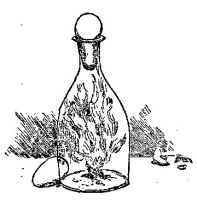
Fig. 2 represents another illustration of atmospheric pressure. Light a piece of paper, and when it begins to burn brightly, thrust it into an empty water bottle. Within a few seconds close the neck of the bottle with a hard-boiled egg from which the shell has been removed. The burning of the paper exhausts the air in the bottle, and the egg is gradually thrust in by the pressure of the outside atmosphere. It will finally pass completely through the neck of the bottle, giving a little explosive sound.
Fig. 3.
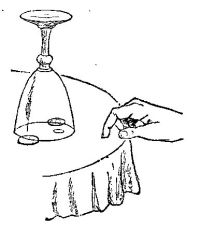
Fig. 4.
In Fig. 3 we have an experiment illustrating the laws of force. A dime is placed on a table covered with a cloth or napkin. The coin can be drawn from beneath the glass without touching it or slipping anything under it. If the cloth near by be simply scratched with the nail of the forefinger, the elasticity of the material communicates the motion to the dime, which moves slowly in the direction of the finger, until it finally comes out entirely from beneath the glass.
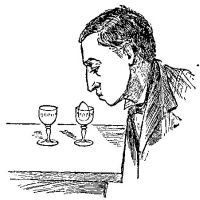
The experiment shown in Fig. 4 is certain to result in the smashing of several eggs; we therefore advise that they should be hard-boiled in order to avoid serious catastrophes. By blowing into a claret glass containing an egg, it is possible to cause it to jump out of the glass, and with practice it may be made to pass from one glass into another.