THE FAIRY FUNGI.
Reading edition
BY SOPHIE B. HERRICK.
The hill-sides of the southern part of France are covered with vineyards, where the luscious grapes round out under the late summer sunshine into globes of delicious sweetness. When the grapes are ripe, the peasants—men, women, and children—may be seen gayly trooping to the vineyards to pick them for wine. In the famous Steinburger vineyard the pickers are all girls about eighteen years old. Each girl has a row to pick, and they begin together, and move forward as steadily and evenly as a regiment of soldiers. With their gay petticoats looped up so that they may not brush off the ripe grapes, and their bright stockings and mittens, they make a very pretty picture moving along between the rows, snipping the ripe grapes, and letting them drop into their baskets. When the baskets are full they are emptied into a tub, which the men lift by leathern straps and carry to the road-side press. The juice which comes spurting out of the press is placed in vats or barrels, and there left to ferment, which changes the juice, or must, into wine. When the cook wants her bread to ferment, or rise, she plants it with yeast; but the wine has nothing planted in it, and yet it ferments.
Fig. 1.—GRAPE FUNGUS.
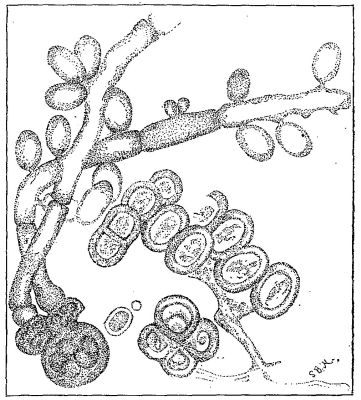
Pasteur, the great French chemist, made up his mind to find why this was. He was convinced from all his studies in fermentation that the reason would be found in some little plant which was growing in the juice and helping itself to whatever it needed to eat or to breathe. He set to work to find out where the plants came from which turned the grape juice into wine. All his experiments are so fully and clearly explained that any one who is willing to take the pains can try them for himself.
He found that there was no fungus growing inside the little closed bag (which we call skin) in which the pulp, seed, and juice of the grape is sealed up. There is no opening anywhere in a sound grape through which spores (which are the fungus seed) could enter. But he found on the skin of the grape, and thickly over the stem, little plants, something like yeast and something like mould; these make up, in part, what is called the bloom of the grape. He put some water, with these plants mixed through it, into one tightly sealed bottle, and into another he put the pure juice of the grapes which had none of the little plants through it, and then waited to see what would happen. In a few days the water was all yeasty, and the grape juice was unchanged. (Fig. 1.) He tried this same thing over, and over, and over again, and in various ways, to be sure that he was right. He thus found that the little magician that turns the juice into wine is always waiting at the door of the sealed chamber, ready to work its miracle as soon as it can reach the juice.
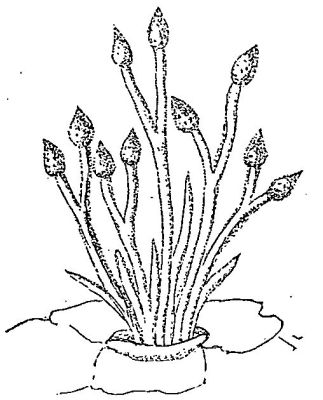
Fig. 2.—POTATO FUNGUS.
It is very different with beer. Pasteur gave a great deal of time and attention to finding out why so many millions of gallons of beer were every year spoiled in the making. The brewers could not tell why. They prepared their wort in just the same way, and planted just the same amount of yeast into the good beer as they did in what turned out to be bad. He brought that wonderful microscope of his to bear upon the subject. He found that whenever the wort was planted with yeast which had certain curious little glassy rods mixed through it, the beer turned sour. The brewer, when he put such yeast as this into his wort, was planting, along with the seeds of the yeast plant, seeds of a troublesome weed. The sour beer was really only a very queer kind of a liquid garden, growing more weeds than useful plants.
Vinegar is another thing made by these little fairy fungi. The cider out of which it is made is set away in a cask to ferment. The spores that work the change in this case are floating in the air, and manage somehow to get into the open cask. Did you never notice the flakes of muddy-looking substance at the bottom of a vinegar cruet? That is the mother, the little plant that has made the cider into vinegar.
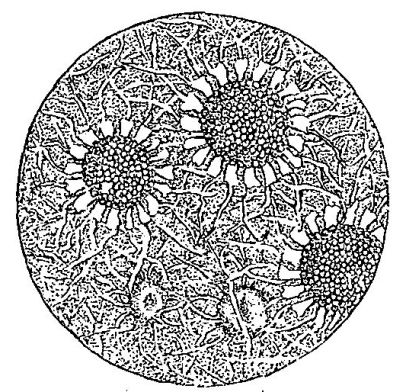
Fig. 3—LEAF MILDEW.
These are some of the useful things that are done by the fungi, and they are certainly very valuable services. We owe to them our bread, and wine, and beer, and vinegar. But they are not always benevolent fairies by any means. Sometimes we are inclined to think that they are at the bottom of pretty much all the mischief in the world. If they were not sailing about in every breath of wind, getting into all sorts of places where they are not wanted, we probably would never have any chills and fever or diphtheria, and the yellow fever would not sweep off its thousands and tens of thousands. If these little floating spores did not get into every crack and cranny, wounds would not fester, damp linen would not mildew, preserves and pickles would not mould, milk would not sour, nothing would spoil or ferment or decay. There is an old proverb that "the mother of mischief is no bigger than a midge's wing." I sometimes wonder if the old-time people that made the proverbs did not know something of these tiny mischiefs that only seem to be waiting the chance to work their naughty will.
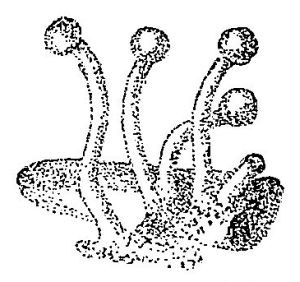
Fig. 4.—RYE SMUT.
There is one case where this change takes place which you have probably often seen. When I was a child I used to be very fond of getting from the woods close to the house, or from the wood-pile, bits of shining wood and bark, which we called "fox fire." The wood was always old and decaying, and we thought it was shining because it was dying. But really the perishing wood was covered all over with tiny mushrooms, which shone with a light something like the glimmer of a fire-fly. In some countries this brightness is very wonderful. In Australia people have been able to read by the light of a shining stump overgrown with luminous fungi.
Fig. 5.—MILDEW ON VIRGINIA CREEPER.
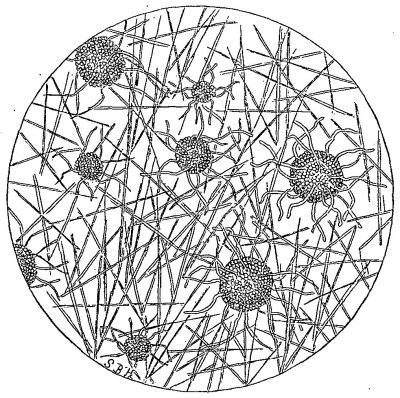
Some of the fungi have not even the manners to wait until their victims are dead. They take possession of living plants and animals, and never rest until they have destroyed them. The disease among potatoes called the potato blight (Fig. 2), of which we hear so much, is caused by the growth of a little fungous plant in the mouths, or breathing holes, on the skin of the potato, and the blight and mildew (Fig. 3) and smut of wheat and corn and rye (Fig. 4) are all due to the same cause. The mouldy look upon vine leaves is nothing else. I put a leaf of Virginia creeper which looked whitish and ugly under the microscope one day, and found the whole surface covered with a net-work of silvery threads, with a wonderful, fruit growing upon it. The fruits looked like peeled oranges surrounded with threads of spun sugar, or occasionally like a gigantic blackberry sparkling with crystals. This was only a common mildew, but under the magnifier it seemed a wonderful garden, growing conserves and fairy fruits, and was beautiful, beyond description. (Fig. 5.)
Fig. 6.—SILK-WORM FUNGUS.
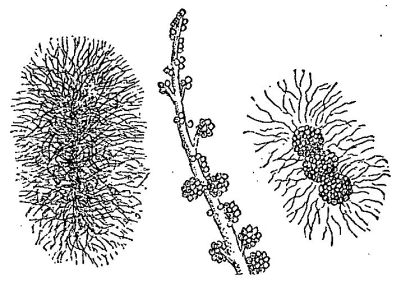
The silk-worm is attacked by a fungous plant (Fig. 6). It takes possession of the worm just before it begins to spin its cocoon, and some years ago it destroyed such multitudes that the French silk trade was seriously threatened. The microscope was again brought into use, and the cause of the trouble discovered, and the cure effected.
The untiring Pasteur studied up this and other diseases of the silk-worm as he did those of wine and beer, and helped the silk-worm growers to stamp out the disease when it appeared. It perhaps seems a small thing for a man of genius like Pasteur to give his whole life to studying these little plants through the microscope, but never was a life more helpfully and patriotically spent. Hundreds of thousands of the French peasants depended for daily food and shelter upon what they earned in the wine and beer and silk trades, and these trades Pasteur's work has saved from destruction or great loss. It has been said that his work with the microscope has saved to France more than the awful French Revolution cost her.