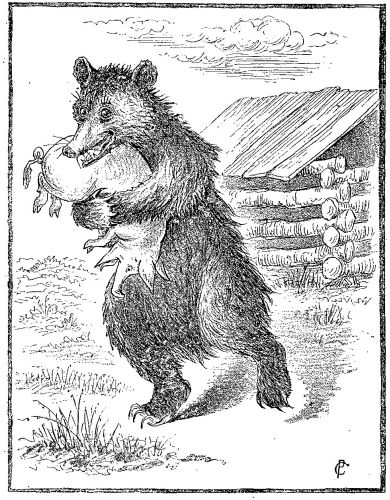
DOBBIN'S PERVERSITY.
Reading edition
"What can we do on this bright summer's day, And what may our frolic be? Shall we play at wild outlaws by Robin Hood led, Just baby, and Bertie, and me?"
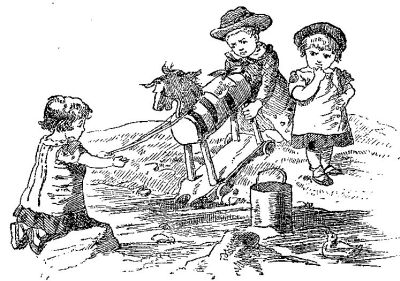
"Or stay, here's old Dobbin—why, children, you know We must gallop him off to the pond below. Poor Dobbin is thirsty—we nearly forgot; He's done lots of work, and he's tired and hot." Rattle and scamper—hurrah for the fun!— Three merry youngsters, see how they run! Fast go their heels, round go the wheels. Old Dobbin says nothing of all that he feels. Yet in his one eye lurks a mischievous wink, And brought to the water, old Dobbin won't drink. Sir Toadie lies low by yon mossy gray stone— A worshipful toad is he!— A toad with a wise and wonderful mien, Solemnly wearing his coat of green,
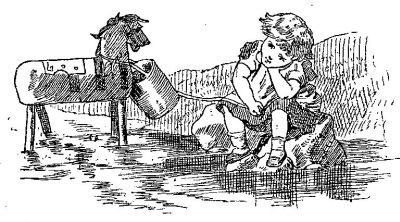
Of what does this knowing Sir Toadie dream? Hark! he croaks to a passing bee Watching the scene—the scolding and petting A very queer steed on the bank is getting, Now ordered, now asked, now begged, "just one drop," Next pushed all a-hurry, it tumbles in—flop!
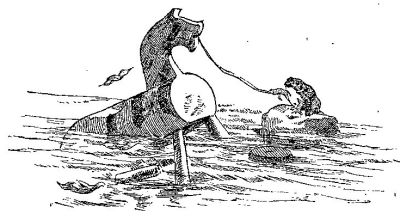
Nidding and nodding his wise old head, These are the words that the toad has said, "Many may lead to the fair river's brink, But a horse must will, ere they make him drink."
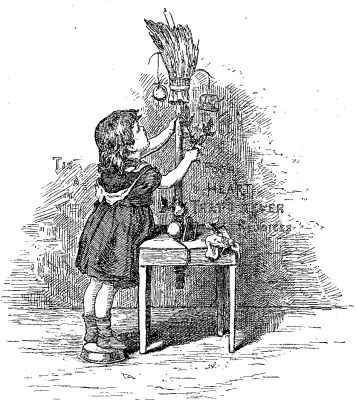
Jes you stan' up, you queer old broom. And be as good as you can be; You see to-night is Christmas-eve, And you must be my Christmas-tree.
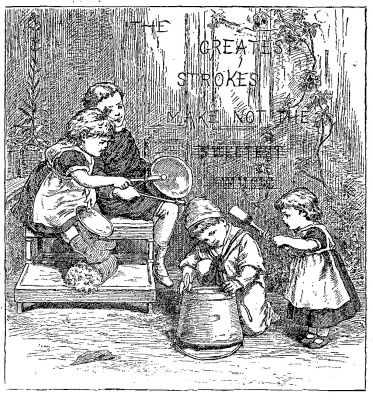
Rub-a-dub-dub on kettle and pan, Rub-a-dub-dub, make music who can. Our gay little party all sing out of tune; Tom of Puss in the Corner, and Ned of sweet June. While on the pail drumming Joe strikes with a will, Loud chanting the story of Jack and of Jill. Music you call it! I hear but a noise; But noise is sweet music to small girls and boys. Patience, grown people, remember the day When you were but children and rattled away, With a rub-a-dub-dub on kettle and pan, Rub-a-dub-dub, making music who can.

In this number of Harper's Young People we have given our readers a good foretaste of Christmas, just by way of preparation for all the delightful things coming in the next. On December 20 we shall publish our regular Christmas number, which will be entirely given up to matter suitable to the joyous Christmas-tide. The C. Y. P. R. U. will not have its attention drawn, as usual, to articles with sound facts for a basis; the Postmistress will not have a word to say; there will be no Exchanges; even the serial story will be dropped for a week. Our Christmas number will thus be complete in itself, for Young People, like its little patrons, has no room for other thoughts during one week in the year than those which are connected with the day which celebrates the birth of the Saviour of the world. The leading features will be a charming fairy story, entitled "Shamruck; or, the Christmas Panniers," by Mr. Frank R. Stockton, illustrated by Mr. Alfred Fredericks; another admirable story, entitled "A Perfect Christmas," by W. O. Stoddard, with illustrations by Mr. Howard Pyle; and a most amusing pantomime, entitled "The Magic Clock," by Mr. G. B. Bartlett, with an illustration by Mr. F. S. Church. There will be a number of minor attractions, which we will leave our readers to discover for themselves, and the whole will be inclosed in an entirely novel and unique cover, ornamented by one of Mr. Nast's most capital drawings.
Calumet, Michigan.
We have had snow three times this winter, and it has gone off twice, but the weather is very stormy now, and I guess it will stay this time.
I go to school. We have quite a large school-house, it being 190 feet long, 100 feet wide, and 100 feet in height, from the ground to the top of the belfry. The foundation is sandstone, which extends for about eight feet above the ground. There are eighteen rooms in use as school-rooms. I am in the next room below the High School. I am ten years old, and study reading, writing, spelling, arithmetic, drawing, higher geography, and grammar.
There are many curious things about the mines here. One shaft is 2400 feet deep. I have not been through the mines since the new machinery was put in, but I have been told that it is a great deal stronger and larger than the old. They have built two new engine-houses, and rebuilt two old ones, and put new machinery in all. One of the boilers at the Hecla is thirty feet long, and there are two of that size at the Calumet.
Percy P.
Michigan City, Indiana.
I am a little girl eleven years old. I have a pet dog which is part blood-hound, and was named after a famous fox-hound in Pennsylvania. I have ten dolls. Some are pretty old, and have retired from active life. My aunt Mate made most of their clothes. One is quite plain, and I call her the old maid. The beauty of my family I call Daisy. My mamma has been sick four years. I have a brother Charley, four years old last June. We have a bird whose name is Major. We call it that after papa; his friends always called him the Major. Then there is John, the cat, who is four years and a half old; he belonged to my sister, who died four years ago.
This is a great locality for sand. We have a number of high hills; one called Hoosier Slide, covered with white sand, is over a hundred feet high. We have a nice harbor, which has been improved every year since we came here. We don't like it here as well as we did in Michigan. We sent a box of clothing to a little girl there who needed it very much.
Maud S.
College Grove, Tennessee.
I am a little girl who has owned a great many cats. I lost the oldest one last November. His name was Mark Gray. He was fourteen years and eight months old. The first word I ever said was to call him "Tit-tat." Many persons said to me, "Anna, why don't you let that poor old cat be shot?" But I could not let him meet that fate. He had lost all his teeth, and I fed him on milk and biscuit till he died. I have had a great many dolls, but my favorite is a large one that Santa Claus brought me when I was three years old. I could not then lift her. She has a china head, a cloth body, and red kid gloves. I named her Lizzie M., for one of my young lady cousins, and when she married I changed the doll's name to Mrs. B. I raised twenty-four turkeys last year, and I take Harper's Young People with part of my turkey money. I have twenty-three this year, nearly all white. I like white turkeys best, because I can see them better than those of any other color when they wander off to make a nest. I have no brothers and sisters, but we have a little black girl who plays with me and helps me to drive up my turkeys. They got wet twice, and I thought they were dead, but we put them under the stove, and they revived. I have a garden and a little pit. I have five rose-bushes; one has blossoms no larger than my finger-nail. I have a bed of sweet violets; they begin to bloom in February. I have a lovely species of white asclepias that grows wild here; it looks like wax. Mamma says if it had come from the Cape of Good Hope, people would go wild about it. My pit is three feet square and one and a half feet deep. I plant in it verbenas, feverfews, Japan pinks, and rose cuttings. I cover it with boards, and when it is very cold I put a rug on top. I kept my flowers safely last winter, although it was so cold. This is November 7, and we have not yet had any frost. The roses are as pretty as in spring-time, and the garden is gay with zinnias and chrysanthemums.
Anna Miner R.
We ask attention to the letter from two little girls which follows this paragraph. We have sent them a bound volume of Young People for 1881, which we hope will help them in making the Christmas season a glad one to their little friends the "Innocents."
Dear Girls and Boys,—Christmas is drawing near now, and you are all preparing for the Christmas tree, and lots of you are making pretty presents for your friends. We wish to ask you a favor, so now please give attention.... The pastor of the Trinity Episcopalian Church established a "Home for the Innocents." All poor little waifs are taken to this Home, and little ones are left whose mothers work out by the day. They have a nice time playing together, and some kind Sisters watch these little ones. But the church caught fire and burned down, and now the members (who are mostly poor people) are saving their money so we can build the church up again, and we are sadly afraid the little ones will lose their Christmas fun. The Sunday-school scholars have given up the tree, so they could help the church, but the "Innocents" will have nothing. Now won't you all send us some toys, or brightly colored picture-books, or Christmas-tree ornaments. Rummage your closet shelves, and see if there are not broken toys or dolls you don't care about any more, and send them to us. Some of you write and tell of so many things you have; can't you spare one for these children? Please do, and after Christmas we will write again all about them.
Lydia Belle Hargreaves, Lulu G. Ruckstuhl, 508 Wenzel St., Louisville, Ky.
Be particular, children, to send your gifts directly to Lydia or Lulu, and not to Harper & Brothers.
Lawrence, Kansas.
I am a little Kansas boy who reads your paper regularly. I am very much interested in the Wiggle department of the Young People. I sent a wiggle for No. 95 and No. 104, and it made me very happy to see them in the paper. I shall send some more. I am eleven years old, and have been going to school four years, and am in the sixth grade. I live in Lawrence, and the University of Kansas is here. When I become old enough I will go there. I want to get a good education. Then, when I become a man, perhaps I may be an editor, or write story-books. West of Lawrence a few hundred miles are the great plains. The Indians used to live there, and hunt buffaloes. The Indians have gone now, and so, I suppose, have the buffaloes.
Kansas is a good place for little boys. I used to live in Washington. D. C. But there the houses are too thick to fly a kite. Here on the prairies we boys often fly our kites to the height of two balls of twine. We have lots of room to run. Father has promised me a pony on my next birthday. He says thousands of people come to Kansas every year from the Eastern States. I wish lots of little boys from the East would come to Lawrence to live. I am very anxious to hear about Mr. Stubbs's brother.
Sidney C. P.
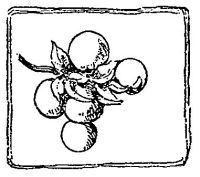
This little picture, represents a branch of oranges sent to the office of Harper's Young People. It was cut by Mr. James Otis from an orange-tree in Duval County, Florida, which this season has borne over 2000 oranges. We thank Mr. Otis for his kind remembrance.
McKeesfort, Pennsylvania.
I am six years old, and have a little brother John sixteen months old. He came Sunday night, July 4, and he bothers me a heap—wants all my playthings, and when he gets them, breaks them all up. At night, when I want papa to read me the stories in Young People, he screams and screams to see the pictures, and I have to wait for the stories till he goes to bed. I am going to start to school this week, and I will study hard and learn to read, so I can read the stories myself. My grandpa lives on a farm, and I go to see him nearly every day to get rides on the horses, and drive the cows, and to see the men working at the water-works basin which the town is building to get water from the Youghiogheny River. The only pet I have is an Alderney heifer named Bessie, which my grandma gave me. She is so quiet I can put my arms round her neck, and hold her by the horns.
Tommy E.
West New Brighton, New York.
I am eight years old. I have a white cat with one blue and one green eye. We have a dog called Grip, a bull-terrier. He is very gentle and playful. I lost my dog called Pickles. My father is going to get me another. I go to school at New Brighton, and take French lessons, spelling, reading, and geography. I have a little brother nearly a month old, and two others. Perhaps I have said enough.
Davy B.
It is quite proper for little correspondents who have not yet learned to write to do so by proxy; by which we mean to get their fathers or mothers to write for them while they dictate the letters. Such letters are always welcome. Master Davy B. signed his name very boldly to the letter his father wrote for him, and probably Tommy E. will soon be able to do the same.
I am a little boy seven years old last Valentine's Day. I have been taking Harper's Young People from No. 1 to the present time. I have had two volumes bound, and am saving up for the third volume. I have two numbers (duplicates), 20 and 76. I will give them to any of the little readers that will send me his or her address. I have eight cats and three kittens, also an English pug-dog. Pug does not like the cats, but the kittens eat out of his dish with him. One Sunday Pug went to Sunday-school, and sat on the bench beside my sister Helen. I am so interested in the story, "The Talking Leaves."
Louis N. W., Jun., Beverly, N. J.
Harry Van N.—Your description of the industries of Minneapolis is very interesting. A city where there is so much manufacturing, so much enterprise, is a good place for an intelligent lad to live in.
Six little girls at Pulaski, Tennessee, were directed by their teacher to write letters to Our Post-office Box, and bring them to her instead of their usual weekly compositions. The letters signed by S. K. A., Maggie J. A., F. W., A. B. A., M. R., and Julia R. have been sent to us, and are very creditable to the little writers. Our thanks are due to their kind teacher for her appreciation of our efforts in behalf of young people.
Alice McL.—For a boy of twelve who is fond of reading we know of no more enchanting book than What Mr. Darwin Saw in his Voyage Round the World in the Ship Beagle. This is a beautifully illustrated volume, and its price is $3. The Boys of '76, at the same price, is a fascinating book which tells young Americans about the stirring scenes of the Revolutionary war. There are three volumes of Travel in the Far East, by Colonel Knox, each of which boys pronounce splendid. They relate the adventures of youthful travellers in a journey to Japan and China, to Siam and Java, and to Ceylon and India, and the books, which may be purchased separately or together, cost $3 a volume. These books are all published by Harper & Brothers. Hector, by Flora L. Shaw, published by Roberts Brothers, and Boys at Chequassett, by Mrs. A. D. T. Whitney, published by Houghton, Mifflin, & Co., are very charming books, smaller than those we have placed first on the list.
A bright boy who already has a sled, skates, etc., might be pleased with a well-furnished tool-chest or a printing-press. At twelve, boys no longer care for toys which are merely playthings.
In addition to the pretty things you already have, make little mice and pigs of white Canton flannel for your Christmas tree. If you can procure some cotton as it grows, crystallize it with alum, and dispose clusters of it here and there. There are bright little balls of different colors which may be purchased for a few cents, and used to festoon the tree, and if put away carefully they may be used for successive years. Have plenty of little wax tapers, and your tree will repay your trouble.
We desire to call the attention of exchangers to the notice which is printed at the head of the Exchange list. Please make it a rule to follow this in every instance. When a boy has five or six coins, two or three hundred postmarks, or a few relics or curiosities, and calls attention to them in these columns, many thousands of readers see the notice, and he finds himself confronted with so many replies that his embarrassment is very great. In the mere matter of postage he may find himself burdened with considerable expense, perhaps more than his pocket-money will pay, or than his parents will allow him to spend. This inconvenience, and the further peril of being thought dishonorable, may be avoided by having a correspondence by postal cards before sending any precious things away.
It is not possible for us to rectify mistakes, nor to compel delinquent exchangers to make proper returns. We prefer to think that all who avail themselves of this privilege are worthy of it. We desire and hope that every girl and boy who is numbered among our young people shall be true, courteous, prompt, and obliging. Without the exercise of these qualities, neither exchanging nor any other business can be satisfactorily carried on.
Those who have saved their back numbers, as we think all ought to do, will find a paragraph on this matter in the Post-office Box of Vol. II., No. 80. To this we refer the attention of Willie B. G., who writes to us complaining of an apparently dishonest correspondent. We can not settle difficulties which arise among exchangers, but we think careful attention to preliminary correspondence, and to the full payment of postage, would prevent much confusion.
Until after the Christmas number the pressure upon our columns will prevent us from publishing all of the large accumulation of Exchanges we have received, but we will print them as rapidly as we can when the holidays are over.
C. Y. P. R. U.
Paper.—How many varieties of paper do you think they manufacture in Japan? Over sixty kinds are made from the fibres of various grasses and plants. "Paper," says Miss Bird, in her interesting record of travel in Japan, "is used for walls, windows, cups, pocket-handkerchiefs, lanterns, string, wrappers, cloaks, hats, and baggage covers, and is used domestically and professionally for all purposes for which we use lint, bandages, and cloths. It is so tenacious as to be nearly untearable, and even the finest kind, an exquisite and nearly diaphanous fabric, soft like the most delicate silk crepe, in which fine gold lacquer is usually wrapped, can only be torn with difficulty."
The same writer tells about the fine varnish or lacquer which we see on the beautiful Japanese trays and bowls. It is a natural varnish, the product of a tree, from which the sap is taken in the early spring. When it comes from the tree it is of the color and thickness of cream, but it darkens when exposed to the air. Lacquer is used for all kinds of purposes, from the golden shrines in the temples to the rice bowl in which the humblest cooly takes his meal.
WORK FOR LITTLE FINGERS.
Is it not wonderful, when you think of it, that with four little fingers and a thumb, two bright eyes, and the exercise of a subtle quality called taste, so much may be done to make home attractive? The young folks who have been asking the Postmistress what they should make for Christmas gifts no doubt read Aunt Marjorie Precept's "Bits of Advice" on the subject last week. But perhaps they will like to hear about some of the pretty things the Postmistress saw when, one very stormy day, she took a walk through some of the New York stores and bazars on their account. She looked specially for easy and pretty things which could be made by small but skillful fingers. A holder for the whisk-broom pleased her fancy. A frame of willow was covered with maroon silk, over which bands of black velvet were crossed, and embroidered with daisies. The willow frame may be purchased, or an ingenious boy could easily make one for his sister. A lining of old gold with bands of scarlet, or of pale blue with garnet bands, would be very striking and harmonious, and such a broom-holder is really artistic.
A graceful present for a young lady is a hair-pin box, mounted—of all things in the world!—on a wheelbarrow. Here comes in the boy's bracket-saw, to construct the barrow, into which the box must be very neatly fitted. The box must be stuffed with sawdust, and tufted closely with worsted, either by knitting-needles or with the crochet-hook, as you please. The wheelbarrow may be made of any common wood, and gilded, or it may be of black walnut, or basswood, without any other ornament than its carving.
Very elegant wall-pockets are made of old hats. Indeed, the possibilities of old or new straw hats are endless. You take a roughly braided bathing-hat which you wore last summer at the beach, line it with azure satin, twist it into any graceful shape you please, on the upper surface of the flaring brim paint or embroider a group of flowers, and to the lower attach a large bow of ribbon with broad loops, and you have an ornament which sets off the wall splendidly. The deep crown forms the pocket, and the brim makes the picturesque part, and you would hardly suppose that with so little you could do so much toward the brightening of a dull room. Father's summer straw hat (which you hid away in the attic, so that he should be compelled to buy a new one) will lend itself to your ideas of the beautiful very readily. Line it with crimson flannel, fasten a cluster of wheat, a bunch of summer grasses, or a few spears of oats to one side, and tack one bit of the brim down with a bow, and there you are with the scrap-basket, which is just what you need in the sitting-room or library.
Nothing provokes the neat housekeeper's anger like the scratching of matches on the walls, and it is very hard to teach some people never to deface the house in this way. Any little eight-year-old girl or boy can make a splendid match-scratcher by taking a round piece of wood, covering it with velvet, silk, morocco, or Java canvas, on which a little pattern has been worked, and then gluing on its reverse side a piece of sand-paper. Finish it with a loop of ribbon, and present to Uncle John or Cousin Ralph, and while they may appreciate its delicate hint, they will not resent it as personal.
A dozen sheets of blotting-paper, fastened together with a bow, and bearing on the outside a dainty little pencil drawing, either a cute little Kate Greenaway sort of picture, or a landscape, or a few wild roses and ferns, with a motto, is an acceptable gift to either a lady or a gentleman. Still prettier is this gift when a little panel picture, wood or card-board covered with satin, and then painted, is laid on the upper surface of the packet.
People who board are often quite bothered to find a good method of keeping account of the weekly wash. A laundry-cushion, which is simply a pincushion with the words shirts, collars, cuffs, handkerchiefs, etc., in a row down one side, with the numbers from one to a dozen corresponding to the articles, is a very convenient device for them. They need only stick a pin into the number of each article they have sent away, and count the things when they are returned. The writing on this cushion can be done with indelible ink.
A shaving-case, made of two pieces of pasteboard cut into the shape of a mug, covered with silk, and filled with tissue-paper, a little pasteboard handle at one side, is easily made, and will be acceptable to almost any gentleman.
The pretty articles here described were seen at the Exchange for Women's Work, No. 4 East Twentieth Street, New York city.
Katharine R. McD.—Thanks for your kindness in copying for us the metrical table of the Kings and Queens of England. It will be better, however, for the boys and girls to go to the history of England; and follow the line of the royal succession for themselves. We prize most what costs us most labor.
Beacon Beach, Oneida Lake, New York.
Dear Postmistress,—I am in the woods now, but am soon going up town to my home. I was ten years old a few weeks ago, and my papa has given me Harper's Young People for a birthday present ever since it began. The other day my mamma and I took a walk in the woods, and found two kinds of fungus—one was the "earth star" (a good description of which is in Appleton's Cyclopædia), the other was tiny toadstools growing on oak leaves in the sand, with slender, shining stems, black as ebony, and whitish tops, which look as if designed for fairy parasols. Would you please tell me the name?
I have a puzzle for the C. Y. P. R. U.'s that I found in a newspaper: "I went out in the woods and got it; after I got it, I looked for it; the more I looked for it the less I liked it; I brought it home in my hand because I couldn't find it."
Irma C. F.
Who can guess the answer to Irma's puzzle? I will give you three weeks to think it over, and will tell you the answer in No. 114. I am sorry that it is not possible from the description to identify the particular kind of fungus which Irma has found. There are more than two hundred fungi which infest the living oak, and myriads more which grow on dead leaves. Even were the fairy parasol sent, it would probably be withered by the time it reached this Post-office Box.
I am very much obliged to dear Irma for writing plainly on purpose to save my eyes. The eyes of a busy Postmistress like myself have to work pretty steadily, and they always feel thankful to such thoughtful little girls. But you ought to see how indignantly they snap when some of the pencilled letters arrive, almost faded out before the Postmistress gets hold of them.
The members of the C. Y. P. R. U. will find in this number, under the title of "The Fairy Fungi," by Mrs. S. B. Herrick, a most interesting account of the good and mischief worked by these strange little inmates of the vegetable world. The article on "Children of the Pantomime," by Mrs. Helen S. Conant, gives a striking and pathetic picture of the lives led by the children who are employed by London managers in getting up these entertainments. "A Novel Present" will help some of the girl readers who are undecided what to make for some little friend for Christmas.
PUZZLES FROM YOUNG CONTRIBUTORS.
No. 1.
DOUBLE SQUARE.
Across.—1. Play. 2. A knot. 3. A place of public contest. 4. Reposes. 5. A ringlet.
Down.—1. The handle of a plough. 2. More perfect. 3. Fleshy. 4. Schisms. 5. A volcanic earth.
Miltiades.
No. 2.
EASY ENIGMA.
In eel, not in fish. In urn, not in dish. In gun, not in shot. In rope, not in knot. In cent, not in dollar. In necklace, not in collar. Look not in this for wealth or fame, But seek and find the writer's name. E.
No. 3.
TWO EASY DIAMONDS.
1.—1. A letter. 2. To jump. 3. A salutation. 4. A mark made by pressure. 5. An insect. 6. A letter. Centrals read down and across—Something which never comes after noon.
Blanche S.
2.—1. A letter. 2. Evil. 3. A part of the body. 4. Something that is never old. 5. A letter.
Edwin and Marie S.
No. 4.
NUMERICAL ENIGMA.
I am slow and easy-going, and never was known to hurry;
You couldn't, if you should try your best, put me into a flurry.
My 4, 5, 8, 7 is part of the human frame.
My 7, 2, 3, 1 is what scholars a species name.
And by 8 little letters I'll be handed down to fame.
Will A. Mette.
ANSWERS TO PUZZLES IN No. 108.
No. 1.
Magna-Charta.
No. 2.
C
BOWS
BOWIEATE
COWPENSSTARS
WIERDERA
ENDS
S
No. 3.
Ton, Eaton, Canton, pistol.
Constantinople.
Correct answers to puzzles have been received from May Ridgway, May Terry, Maggie J. Laurie, "Brooklyn Reader," Grace C. Hayes, Helen S. Woodworth, Blanche Spinning, Jesse S. Godine, Frankie Wadsworth, Gracie S., Grant K., Mabel Strickland.
The answer to "What am I?" published in No. 109, is Bark; and to the Enigma, Napkin.
[For Exchanges, see third page of cover.]
PREPARING FOR CHRISTMAS.