RUSTIC ADORNMENTS FOR LAWN AND GARDEN.
Reading edition
BY A. W. ROBERTS.
Small fingers always want to be kept busy. No matter how warm the weather is, they can not lie comfortably quiet, but must be doing something. Why not try a little rustic-work, setting up a good-natured rivalry with florists and landscape gardeners? It will require the boys and girls both—the boys to do the heavy work, and the girls to supply the grace and minor ornamentation.
Rustic-work is a term that by general consent is now applied to all structures of wood the forms and surfaces of which are left in their natural shape, or covered with material such as bark, cones, fungi, etc.
Fig. 1.
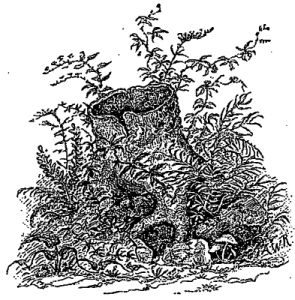
Fig. 1 is an excellent example of nature's rustic-work. How kindly the golden-rod, blackberry, Virginia creeper, and ferns have ranged themselves about the old stump to increase the picturesque beauty of its decay!
Now imagine this stump transplanted to a lawn or garden with its wealth of wild plants and shrubs, while in strong contrast to these are planted in the hollow of the stump a variegated mass of drooping vines, and the most beautifully marked and colored of the so-called "foliage" plants. Truly no imported and expensive jardinet (small garden) of highest artistic workmanship was ever made that could compare with this of nature's wild and cultivated beauty.
There are thousands and thousands of just such stumps that with a little care and trouble might easily be converted into beautiful lawn and garden adornments.
When digging out such a stump, the ground must be well excavated from about and under the main roots, which are sawn (not chopped) off about one foot below the surface of the ground. In replanting the stump, try to imitate all the natural features of the ground surrounding it, even to rocks and toad-stools. The latter are not poisonous unless eaten, and are very picturesque.
The best soil for filling in the spaces about the roots and the bottom of the stump is the black and rich "vegetable mould" found in all old woods. Next to this comes peat, which can be obtained from dried-up ponds and ditches, only care must be taken to crush it fine, and mix with it about one-third of ordinary garden soil; otherwise it will be apt to cake after rains.
When setting up a stump jardinet it is the easiest thing in the world to establish at the same time a small menagerie. Tree-toads, common garden-toads, all varieties of land-snails, field-mice, chipmunks, can be induced to make their homes in and about your stump if they are well treated and cared for.
Fig. 2.
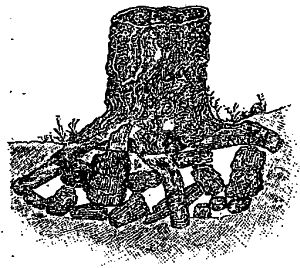
To set up a successful stump menagerie, little nooks must be formed under the roots by means of stones so placed together as to leave open spaces of various sizes. These must connect with one another, as shown in Fig. 2. When covered with earth, these chambers are entered by means of runs which connect with the under-ground chambers. All creatures that set up a home in these chambers will have a good time if you do not dig them out every other day, "just to see, you know, how they are getting along."
But now let us imagine that no such rotted-out and picturesque stump is to be obtained. There is still quite an easy way to make a jardinet.
Fig. 3.
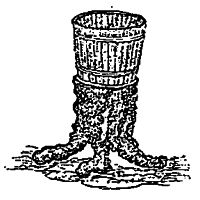
First obtain from a grocer a half butter-keg, which will cost about twenty cents. Wash it out thoroughly with hot water to cleanse it of all salt, that might prove injurious to growing plants. In the bottom bore a number of small holes, and place a layer of broken flower-pots or pieces of charcoal two inches in depth. The holes are for the purpose of draining off all surplus water. The layer of charcoal is to prevent the soil at the bottom of the tub from being carried away through the draining holes. If these precautions are not taken, the earth in the tub will "sour," and the roots of the plants will rot. Next obtain a log of wood of rough exterior, and also some rough bark. The tub must be fastened to the top of the log, as shown in Fig. 3, and the latter firmly planted in the desired spot. The bark must be nailed to the tub so as to join and match the bark on the stump.
Fig. 4.
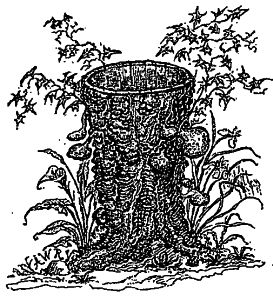
On dead and decaying white-birch-trees many kinds of fungi are to be obtained, and at the bases of very old trees many varieties of lichens. These, when fastened to the jardinet as shown in Fig. 4, produce a very natural and picturesque effect. About the base of the jardinet rude-shaped stones are piled up. The spaces of earth between the rocks are dug out to the depth of from one-half to three-quarters of a foot. These are technically known as "pockets," and are for the reception of vegetable mould. The rookery is now in condition for planting with cultivated and wild ferns, and also low-growing varieties of plants. The tub is also filled with mould, and planted with "foliage" plants and vines.
Fig. 5.
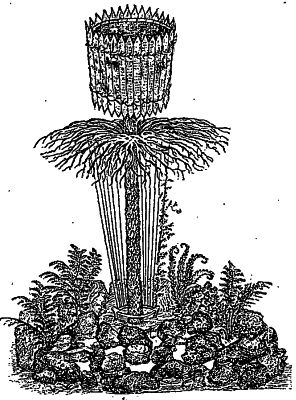
Fig. 5 is a jardinet, vinery, and fernery combined. The upright post is of red cedar or locust, with the bark on. A square piece of board two inches in thickness is nailed on top of the post, and on this is placed a half butter-tub, on which pointed slats half an inch thick and two inches wide are nailed. These slats are painted green, and a light and graceful trimming of rustic vinery is tacked on near the top and bottom of the slat-work. Instead of slats, straight rustic branches split in half and pointed at both ends can be used.
The branch-work consists of a circle of branches of drooping habit, the ends or stocks of which are both nailed and bound with wire or stout twine, so as to support the weight of vines when they reach it from the tub above and the trellis below. The twine-work for the vines consists of gray or green twine. There is a twine sold by florists by the name of "invisible twine," which is of a light green color, and is used for training vines; this is far superior to the white cotton cord generally used, which always looks cheap and inartistic, and in course of time frays out and breaks. But this cheap cord can be made very durable and pleasing in color by running it through hot yellow bees-wax in which has been mixed any of the cheap chrome greens.
A small wooden hoop is securely fastened to the bottom of the post close to the ground by means of four wooden hooks; to this hoop the lower ends of the twine are securely fastened; the upper ends are tied to the branch-work, which helps to retain them in a drooping position. To obtain the best results and light and graceful effects, always plant Madeira or cypress vines; avoid the fancy gourds and other heavy climbers, as they are apt to break down the twine-work during heavy storms. At the base of the structure a heavy rockery is massed, containing numerous pockets. In these, ferns and the English ivy and the so-called German ivy are planted.
All rustic-work should present the appearance of solidity and durability, and must be strongly put together. Never use in any way marine forms or material in conjunction with rustic-work or rockery. They are entirely out of keeping and harmony with nature, and indicate a great want of taste. Nothing can exceed the ugliness of a bordering of clam or oyster shells, or Florida conch shells; they are worse than calcimined or white-washed rocks.