MILLIE'S NILE-BIRD HAT.
Reading edition
BY ARTHUR LINDSLEY.
"Why, Millie, where did you get that bird-skin which you wear in your hat?"
"I am sure I do not know, papa. But it is very seldom you take notice of my hats, and I am very glad that for once I am wearing one which interests you. Mamma bought the bird somewhere down town; I did not ask her where. I think he is just lovely; don't you?" and off came Millie's hat for the Professor's inspection. "Only see his breast, so bright that it almost looks to be on fire, and just above it his throat as white as a patch of snow! Isn't he perfectly splendid?"
Her father had taken the hat in his hand, and was examining the bird with an expression of face that showed he was thinking of something more than what was before him. He stood so long without speaking that Millie broke out in her usual lively manner:
"Why, papa, I never saw you look at a girl's hat so closely before—mine or any one's else. I have had handsomer hats than that, and you did not say a word about them. The bird is very beautiful, I know, but what do you see so wonderful in him?"
"I was wondering how he could come here, my child. You do not know where your mother bought the skin, but do you know where the bird lives?"
"No, sir, not at all. I have no doubt you do, but I never thought of it. Did you ever see them in their native country?"
"Yes, Millie, I have seen them often. The species is African; I saw them very often in South Africa—once, I recollect, at Zanzibar, and on the West Coast I have seen them in Senegambia and at the mouth of the Gaboon. Shall I tell you where I first saw the bird?—for I can never forget it, and the sight of this skin brought back that day to me so forcibly, that for a moment I forgot where I was."
"Oh! do, papa, do. You know how I rejoice in the stories. What a favorite hat this will be!"
"Let us go into the library, then, where I can show you an engraving that I have. Please hand me the russet-leather portfolio from that lower drawer. See, I have opened at once to the very one I wished to find. It will give you an excellent idea of the two bright little kingfishers that I saw that day on the west bank of the Nile."
"The Nile, papa! I wonder if mine came from the Nile? Only think of my Nile-bird hat!"
"That I can not tell, Millie. But before I go on with my story it is well that you should know something about the family of birds to which this one belongs, for he has many relatives, and they are scattered in almost all countries, and one at least of them has been famous among poets for two thousand years. Did you ever hear or see the expression used of halcyon days, meaning days of great prosperity and happiness?"
"Yes, sir, I recollect it was in one of the pieces of poetry we read only last week in school, and I wondered at the time what it meant, and I intended to ask you."
AFRICAN KINGFISHERS.
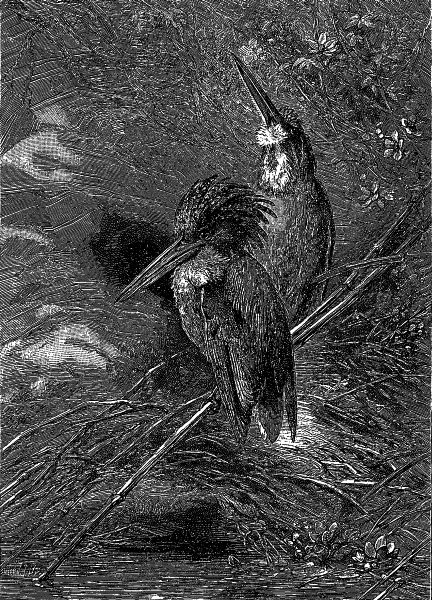
"I will tell you. This little bird of the drawing and of your hat is a kingfisher, and the kingfishers are found, as I explained, in almost all parts of the world. We have one species, not at all uncommon, throughout the United States, which is known in the books as the belted kingfisher. Our little African here, you see, is not larger than a sparrow, but his belted brother is almost as large as a common pigeon, and well do I recollect what a time a lot of us had, when I was a boy about twelve years old, in trying to get at the nest of a pair of them. Kingfishers the world over build their nests in deep burrows which they make in river-banks and similar places. Eight of us gathered one Saturday, with Tom Perkins—a stout boy of fifteen—for a sort of Captain, and Charlie Mason for Lieutenant. We worked all that day, and then nearly until night, of the following Saturday, before we found the end of the burrow. Tom said he really thought we should dig across Deacon Moseley's farm and out into Widow Whitman's pasture lot. It was sixteen feet and a half that the birds had burrowed into a very hard bank of clay.
"This was our American species, whose name is Ceryle alcyon; but all about the shores of the Mediterranean a similar smaller species is found which by the old Latins was called Alcyon or Halcyon, though in ornithological works, now it is named Alcedo hispida. Most absurd stories have always been told concerning it. It was said to have the power of preventing storms, of keeping the sea perfectly quiet, so that while the female was sitting on her eggs the weather was always calm and peaceful, and you see readily how the word halcyon came therefore to have in poetry the meaning to which I have referred. Of course this was all foolishness, but it was only one of many tales which have been told about that very bird, and some of which I have no doubt are believed by ignorant people to this day."
"Is he a handsome bird, papa, like this one in my hat?"
"Oh no; on the contrary, he is of quite plain plumage. You must not fancy that our species or the European possess any such brightness of color. Now look at the picture again. You see both the male and the female. Notice, by-the-way, that they are sitting near the mouth of their burrow. Look at those long crest feathers. They are shining blue, almost like the sky, with light ashy green spots, while the jet-black ones fairly sparkle on their blue background. And then his blazing red lower surface, with his white throat and that enormous bill of bright vermilion, makes such an assemblage of brilliant color as you seldom see."
"Let me get the map, papa, and then please show me just where you found my little bird."
"That is right, Millie; you will be more interested the more definitely you fix the knowledge. How well I remember that day. It seems as though it had been but yesterday. Among all the rivers of the world, there is not one which can be compared with the Nile. It does not seem like any other water. There's a sort of magic about it. All the time that I spent there I felt myself living in dreamland rather than in anything that belonged to this life and this world. It is not the river itself, for I have seen a number of much finer and grander streams of water in other countries. The Danube or the Ganges can either of them surpass it, while here in America I could select half a dozen which are more than its rivals. But any one of them I always felt that I could understand. They were beautiful, they were grand, with charming banks and forests and fields and cities, but there was nothing strange about them. They seemed like other parts of the world. But the Nile is not like them; it never looked to me like a reality. Everything about it was so mixed with mystery that if I had waked any morning and found that there was no Nile to be seen where I saw it the night before, I should have thought it was all right.
"All around me were monuments and temples and houses so old that those who built them had died and been forgotten hundreds and perhaps thousands of years before the earliest history of which we have any knowledge commenced. Who were those people? I could tell how they looked, for there were their figures and faces carved on the stones, but—who were they? Where did they come from? Negroes, Asiatics, Egyptians, such as were about me every day; there they were carved, and sometimes painted, on the ruins, and I used to wander around and wonder, and dream, and wonder, and it was in the midst of just such wondering as that that a little kingfisher flashed upon me, and it is not strange that I remember him. Do you see the First Cataract, Millie, on the river?"
"Yes, here it is. P-h-i-l-a-e, Philæ; is that it?"
"That is the name of an island there with some extremely beautiful ruins upon it. Few travellers ascend the river further; they stop there and return; but I did not; I continued on to the south a long distance. One day, just before I reached the Second Cataract, I had stopped on the west bank of the river to rest my men for an hour or two. It was a burning hot afternoon, perfectly calm, with the sun blazing down on the white sand of the desert and on the glass-like water of the river, until it was enough to almost fry one's brain. Three or four palm-trees grew at this point, and it was their shade which had induced me to stop; but I found to my great delight that what was probably a temple had formerly stood there, and some of the fragments still remained. One of these fragments represented a human figure seated. The head was gone, and one arm; the other arm was perfect, with the hand lying on the knee, and I began to make a drawing of the whole.
"Just as in my drawing I reached the hand, and was sketching its shape on the paper, a little blue and red bird passed me, with a cry somewhat like the one you may hear any morning from our American species, and swinging up he perched himself on the very hand which I was drawing at the moment. It was a lovely little kingfisher. He sat there but a moment, and then darted to a hole in the river-bank, which he entered, and which I knew must contain his nest. It was such a burrow as our American species makes, and forthwith came back to my mind the time when I was a boy, and when Tom and Charlie and the rest of us worked so hard at digging toward Deacon Moseley's lot.
"I watched till the little fellow came out. Then he flew away, and I soon lost sight of him. His name is Corythornis cyanostigma, and the sight of another here in your hat carried me away so completely that for the moment I almost fancied I was on the Nile again, the association was so powerful."
"Well, papa, I am very glad of it. I will wear him only a day or two, and then I will take him out and give him to you, and get mamma to put something else in his place. You may be sure I shall never forget my Nile-bird hat. But did you not say that there are kingfishers found in other countries? I suppose they must be like this, even if they are not so beautiful."
"Yes, there are; and I must tell you of one most remarkable species, Millie—remarkable for his voice, though not for any beauty of color. We will call him Dacelo gigas—gigas meaning very large, for he is a great clumsy bird. He lives in Australia. The first night I ever spent there 'in the bush'—which means out in the wild country—I was waked just before daylight by a most outrageous racket in the thicket close to me. I started up in some fright, and roused a man near me. 'Oh, go to sleep; that is nothing but a jackass.' But as we were where a donkey would not be likely to come, I could not tell what to make of it, and I did not go to sleep, and by-and-by I heard him again and again, but my comrades paid no attention to the sound, and so I said nothing further.
"After breakfast I took my gun, and started out to look for birds. Among others I shot a great coarse-looking kingfisher, larger than a crow; and when I returned to camp, the man whom I had roused in the morning remarked, as I laid out my game: 'There, you have got him. That is the very fellow that you heard this morning. We always call him the laughing jackass.' And often after that I heard their harsh cry, like laughing and braying together."