RACKETS.
Reading edition
BY B. HARDWICK.
Did you ever play rackets? If not, come and have a game with me. But first we must understand the court and the implements.
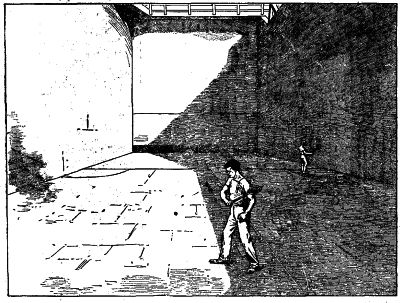
Here we have a picture of the racket-court on the corner of Twenty-sixth Street and Sixth Avenue, New York city. The figures are those of the two markers, whose business it is to keep the score. The court is eighty feet long by forty feet wide. The front wall is thirty feet high, and the back twelve. Over this wall there are galleries for the spectators. These you can not see in the picture, as they form the point of sight. The floor of the court is divided by a line from side to side, and where this line meets the side walls there are quarter-circles marked. These are called the service courts; there is also another line dividing the nearer half of the court. The spaces on either side of this line are called the right and left courts. The front wall to the height of twenty-six inches is covered by a wooden board. And seven feet from the floor there runs a line, over which every served ball must be struck. The walls and sides of the court are of brick and plaster, hard and smooth.
The rackets, or bats, have handles about two feet long, and their frames are strung with catgut. They are much smaller than tennis bats. The balls are of white leather, very hard, and tightly sewn, and little more than an inch in diameter. The game is played by either two or four persons. If by four, two play on a side. Let us have a single-handed game, you and I, so that we may understand it more easily. I will begin.
I go to the right-hand service court, and throwing up the ball, I strike it with the racket so that it bounds back into the left-hand court, in which you stand ready to receive it. If I fail to strike over the line, or play the ball so that it does not bound back into the left court, it is a fault. Two faults would put me out. But now, see, I give my racket a sweep, cutting the ball rather than striking it. The effect of this is that when the ball strikes the wall it does not rise, but returns at a low angle. Now it has bounded, and you strike it back, before its second bound, on to the front wall. After the service you are not bound to strike any higher than the twenty-six inches of wood. If you strike the wood, the ace counts to me, or if you fail to return the ball on to the front wall, it counts to me, and I score one. Then I go over to the other service court, and serve again, so that the ball returns into the right-hand court, and so on, until one of us fails. If you fail to return the ball properly, it counts another ace to me; but if I fail, it does not count one to you, but simply puts me out, and you go in and serve. Only the server can add to his score. The one who first scores fifteen aces, or points, wins the game.
This seems very easy, does it not? But if you take the racket you will find it is not so easy as it looks. There are several tricks in the game, the object of which is to make your opponent's return difficult if not impossible. Thus, sometimes a player will volley a ball—that is, strike it before it has bounded—and, playing it downward just a few inches above the wood, it will bound downward, and touch the floor where it can not be reached, or a player will strike very low, so as to produce the same effect. I should have mentioned that you are not bound to strike the front wall first. You may play off the side walls, and sometimes by this play make it very difficult indeed for your adversary to return the ball. Thus, if you play on to the side wall at an angle of anything like forty-five degrees, the ball will take a similar angle off the front and side walls, and never come down to the end of the court where the players stand at all.
There is another point to be learned—the science of twist. If you strike the ball very low, cutting it with the racket held with the face slanting, it will give a twisting movement to the ball, so that the return will not come off at the usual angle, but in a very unexpected manner. This makes it very difficult for the other player to know where to place himself to receive the stroke. The French, who are great racket-players, have a saying, "La balle cherche le bon joueur" (the ball seeks the good player). In point of fact, the really good player, the moment a ball is struck, places himself so that the ball comes to him. Nothing marks more clearly the difference between good and bad players than ability in this respect.
When four players play together, they play, as I have said, two on a side. Each side goes in alternately. One player on one side serves until he is put out, and then his partner serves until he is put out. Then the other side goes in, and so on. The non-strikers are bound to get out of the way. If they in any way embarrass a striker, it is called a "let," and counts for nothing.
The Spring Handicap Championship games were lately held at the Racket Club. There were thirty-eight entries, divided into first and second class, with a prize for each class. In order to make the chances of the good and the bad players as nearly equal as possible, the good ones gave odds to the bad ones. Thus Mr. Allen, who is one of the best players in the club, was put down as "scratch," that is, he received no odds. Mr. Leavitt and another gentleman were in the same position. After these, all the other players received odds—one or more aces, for instance, or an "extra hand."
There is scarcely any game in which difference of skill is so apparent as in rackets. Luck or chance has but little to do with it. The great art is, the moment a ball is struck on to the front wall, to judge exactly where it will return, and to get in that particular spot.
Quickness in getting over the court is another great point. Short, quick steps are better than a run, as they are more easily checked. With good players in the court, the game is almost as exciting to witness as to play. The constant movement, the volleys, the rallies, the drops, twists, and cuts, succeeding one another rapidly, require all the observer's attention. For affording the greatest amount of exercise in the shortest time there is no game like rackets.