FLOWERS IN FANCY DRESS.
Reading edition
BY MRS. SOPHIE B. HERRICK.
I remember as well as though it were yesterday how, years and years ago, when I was a very little girl, I once went roaming through the beautiful woods of Southern Ohio, hunting for a certain wild flower.
The object of my search was a flower not often found, which we children called the Indian moccasin. It did look like a moccasin, indeed, with its round blunt toe and yellow, leathery, shoe-shaped pouch. I wonder if any prospector ever looked for signs of gold with more intense excitement than I felt when searching for my little golden shoe? Everywhere I turned, in my breathless haste, yellow moccasins seemed dancing before my eyes, and I hardly knew, till my eager hands had grasped the stem, whether it was a real flower I had found or not. I hardly think I could have valued it more if I had known what I have since learned about the wonderful ways of the orchids, to which family my moccasin belonged.
Fig. 1.—Lady's-Slipper.
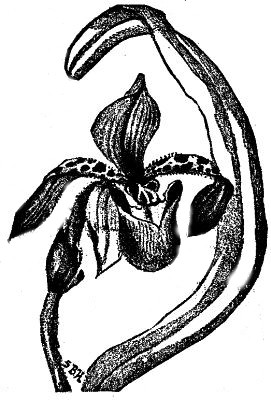
You may never have found this particular plant in your rambles, and yet may know some other of the orchid tribe which grows wild in our woods. The common names are so different in different places that it is hard to tell you how to know them when you see them. The putty-root, and the lady's-slipper like that in Fig. 1, are some of them. Not the touch-me-not, a plant whose seed-pods snap and curl up if you touch them, and which is sometimes called lady's-slipper.
The orchids are an eccentric family. There is scarcely one of them which is not "queer" in some way or other. They seem always to be trying to look or to act like something besides flowers. They imitate all sorts of things besides little Indian shoes. I wish I could take you into an orchid greenhouse and let you look around. You would think you had been invited to a fancy-dress party of the flowers.
There is one that looks for all the world like a swan, with its long curved neck; there is a beautiful butterfly with spotted golden wings; over yonder stands a scarlet flamingo, in a meditative attitude, on one red leg. Bees and spiders, done in brown and yellow, or perhaps more gorgeous colors, are all around. Here is a long spike of waxen flowers, and in the cup of each nestles a pure white dove with outspreading wings. The Spaniards have given it a name which means the flower of the Holy Ghost, from its resemblance to a dove.
These strange likenesses to other things are, however, the least wonderful thing about orchids. They differ from ordinary plants in many singular ways. Many of them, instead of growing in the ground, and drawing from it their food and drink, grow in the air, and take nourishment from it by means of their naked dangling roots. It seems sometimes as if living as they do high up on the bark of trees had put the notion into their heads of trying to look like birds and butterflies and bees.
The air manages to supply them with food, but they have to depend upon getting drink in some other way. Plants are a good deal like people in that respect; they can manage to get along somehow with very little food, but they soon die of thirst if deprived of water.
Fig. 2.—Young Plant growing on Flower Stem.
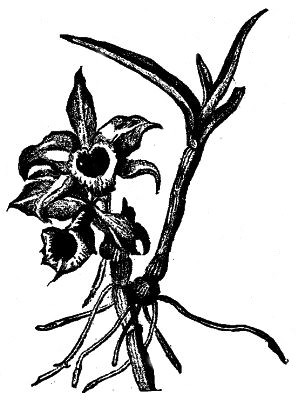
In a wild state, the air-plants grow on the bark of trees or on other substances, but they send their little roots into the moist bark or moss to get water. They do not feed on the juices of the trees, as parasites like the mistletoe do; they only want a standing-place, something to push against as they grow, and water. In the greenhouse they are usually planted in pots filled with bits of stone and damp moss, or they grow attached to the parent plant, as you may see in Fig. 2, and send their roots out into the air for food. A few of them—the Indian moccasin, for instance—grow like common plants in the ground.
It would almost seem as if the orchids had an eye to business in their imitation of insects. At any rate, there seems to be a very good understanding between them, and constant business relations are kept up. The flowers always have a little pouch somewhere about them in which they keep a stock of honey on hand. Their beautiful colors and delicious smell attract, by day and night, bees, butterflies, and moths. In return for the "treat" which the flowers give, the insects render a valuable service to the plants.
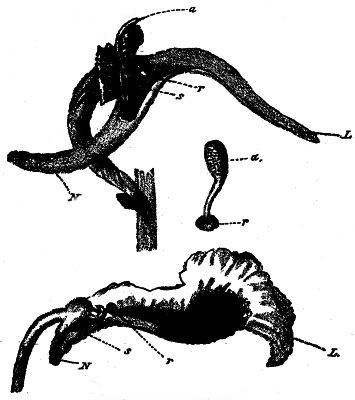
Fig. 3.—Honey Pouch and Pollen Pods.
I must remind you of something we have looked into before in "Picciola" (February 14, 1882), and that is that every perfect seed is the result of a partnership entered into by the pollen grains and the ovules of a flower. The pollen is the yellow dust which it is so easy to see on lilies and some other flowers; the ovules are little round bodies lying in the swollen part of a flower where it joins the stem. Above the ovules, and connected with them, is the pistil, sometimes standing up like the lily pistil of the geranium, sometimes only a sticky little pad, as it is in the orchids. Some plants get along perfectly well if this partnership is entirely a family affair, and the pollen of a flower falls on its own pistil, and makes a union with its own ovules, but this is not always the case. Certain plants require that the pollen shall be from another plant if the seed is to be sound and healthy. Orchids require this cross-fertilization, as it is called, and without the help of insects it could not be effected.
Bees and butterflies, it has been found out, always go in a single excursion from one flower of a kind to another of the same kind. They do not mix their drinks. This instinct not only serves to keep the honey stored by the bees pure, but it enables the insects to carry the pollen just where it will be useful. The pollen of a morning-glory would die if put on the rose pistil. It must be placed on a flower of the same family as the one it came from, or very nearly related to it, or it will do no good.
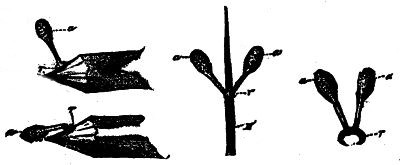
Fig. 4.—Pencil and Needle, with Pollen.
Now look at Fig. 2, and you will see that the flowers have a hollow tube in the centre, with a projecting lower lip. This tube is a single flower leaf curled over to make a tunnel, and through this tunnel is the only path to the honey pouch. When a butterfly feels like taking a drink, and one of these orchids is near, he lights on the lower lip of the tube, and pushing his long proboscis or trunk through it into the pouch, sucks up the honey. Now look at Fig. 3. This is a picture of the tube with its near wall cut away so that you can see the inside arrangement. As he works his proboscis down into the honey pouch, N, it is pressed against r, and touches a spring there; the little cap at r snaps open, and leaves a sticky ball resting on the proboscis. As the butterfly goes on sucking, this ball dries as if it were glued to his trunk. When he draws his head out, this proboscis is ornamented with one or two little tufts which look like the trees in a child's toy village, as you will see in the illustration.
Fig. 5.—Butterfly's Proboscis, with Pollen.
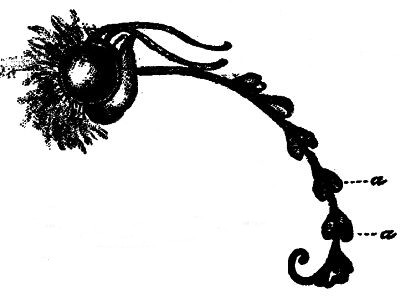
Now look at the fragment of a flower in the lower part of the same illustration. Suppose the pollen tuft to stay just where it is when the butterfly comes out of the flower. You can see by looking at the figure that it would strike r in the next flower it entered, and that would do no good; s is the place it should strike; s is the pistil. Now take an orchid flower, if you can get one; if not, look at Fig. 4, and see what will happen. I push into it a sharpened lead-pencil, and it comes out with the pollen tuft standing up as it does on the butterfly's trunk. Watch it a minute. As it dries, the stem of the tuft bends down, toward the point of the pencil. Now push it into another flower. Wait a little while—a minute perhaps—and take the pencil out. You will see that the pollen has been pulled out of its little case. If you tear open the flower, you will find the pollen sticking so tight on the pistil, s, that you can scarcely brush it off. In this upper flower the drawing is from Mr. Darwin's book; but the lower one is one of the flowers in Fig. 2, which I picked off the plant after drawing it, and tried with a pencil myself. r in the lower drawing looks like a little purple velvet pouch swung lightly on its stalk. The pencil came out, leaving the little bag empty, and the pollen glued fast to its side. But they were not glued so fast that they were not pulled off by the next flower that the pencil entered.
Some of the orchids have two pistils, one on each side. In these, if you push into the tube a bristle or needle, the two pollen cases come out as in Fig. 4; as they dry, they spread apart, and bend forward so that both pistils are struck at once as it is pushed into the next blossom. The contrivances by which each orchid receives on just the right spot exactly the right pollen are perfectly marvellous. I have only told you a very few of the simplest facts in regard to the help the insects give to the flowers. Many a poor butterfly goes through life having its proboscis loaded down with the glued-on pollen cases (Fig. 5). It is one of those business arrangements which does not work equally well for both parties. All this is beautiful for the flowers, but it seems rather hard on the butterflies.