PART I.
Reading edition
Once upon a time Puck and his little sister Blossom lived together in a great big egg.
"It's too close in here," said Puck: "let's go and see how it looks outside." Bang! went his head, right through the wall.
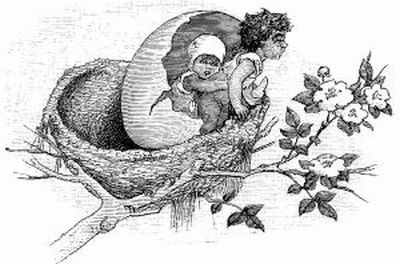
Outside it was raining, so he drew back his head in a hurry; but the rain came pattering in after him. "Oh, my doodness!" moaned Blossom, "is that how it is outside? Now we shall det wet to the skin."
"Come," said Puck, "let's go find us another house; it'll be better by-and-by."
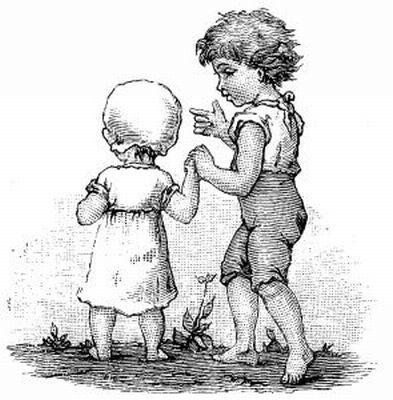
So they went, and they went, till they came to old Mother Bee, who lived with her children in the leafy house of the linden-tree.
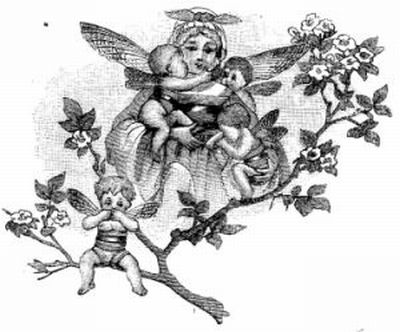
"Oh, come in," said she; "but you must sit quite still, or else my children will sting you. As for me, I must go and gather honey."
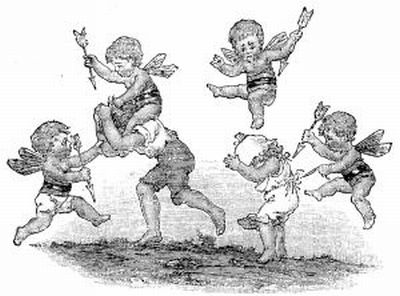
For a little while they sat quite still. "Sister Blossom," said Puck, "it's too close in here. I must go see where they keep the honey." He was starting off that very minute, but all the Bee children flew up in such a rage, and fastened themselves upon Puck and Blossom, that they got away, they hardly knew how.
"I didn't even det a taste of their old honey, and I'm all stung up," sobbed Blossom.
"Never mind," said Puck, comfortingly, "it'll be better by-and-by."
On the meadow whom should they meet but Master Stork. "Oh, take us with you up to your nest!" cried Puck. Master Longlegs, being quite willing, quickly snatched up the children in his long bill, and set them down in his nest.
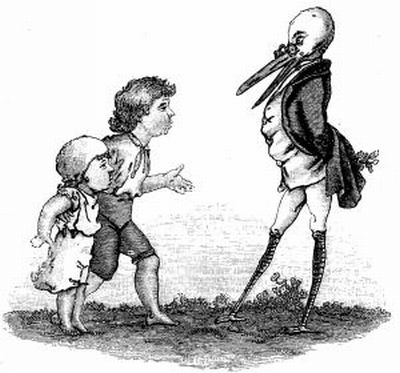
"Sit still," said he, "then you'll have plenty of room."
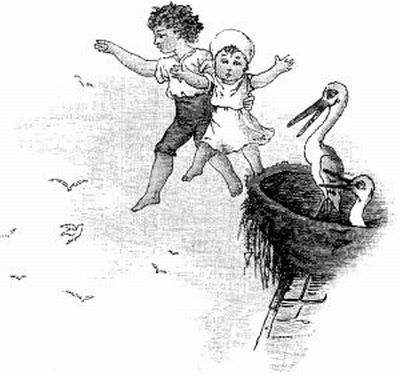
For a little while they sat quite still. "Sister Blossom," said Puck, "it's too close in here. I've seen young storks fly. I know how they do it; I can do it too. Come, now, you do just what I do." He spread his little arms, she spread her little arms, and—
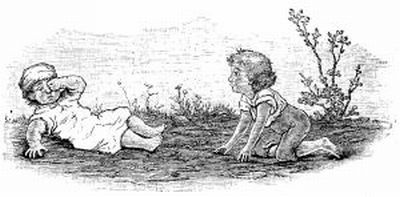
Thump!—they lay on the ground.
[to be continued.]

Milwaukee, Wisconsin.
I have subscribed for Young People for a year. When I have read it, I send it to my cousins in England. We are going there in June, to stay at my grandfather's house. I shall be eight years old on the 25th of March, and I have been across the ocean six times. I will write when I am in England, and tell you about the beautiful things I shall see there. Grandma has some rabbits waiting for me. There is a pond there, with ducks, and Chinese geese, and swans, and all kinds of fowls.
John MacC.
Muskogee, Indian Territory.
I am nine years old. We live on a hill. There are many hills here just like it, and the people here call them mounds. They are shaped very queer. They rise straight up on one side. There are rocks on some, and on others trees. We have two ponies, and when we go hunting, they let me ride on one of them. When they shoot anything, I go and bring it back to the buggy.
Eva S. T.
Jefferson Barracks, Maine.
I am a poor boy. I lived with an officer here, and I was so fond of reading the daily papers and other things that his wife kindly subscribed for Young People for me, and I like it very much. I live in the woods, and I caught nineteen wild rabbits this winter in traps. I tried to tame some of them, but I could not. I wish you would tell me how to tame them.
Joseph D.
Have any of our correspondents had experience in taming wild rabbits?
Grahamville, Oklawaha River, Florida.
I am a little boy eight years old, and a subscriber to Young People. I made the money myself that paid for the subscription. I live away down in Florida, and during the winter months I sell flowers and curiosities to the Northern visitors. I have made twenty dollars this season. I don't go to school now, but my mamma and papa teach me at home. I have a handsome scroll-saw, and can make nice brackets. I had a shepherd dog, but it died. I want to take Young People till I am a grown-up man.
Turner E.
Davenport, Iowa.
I want to tell you something about myself. My papa was an American. When he was young, he went to Florence, Italy. There he met my mamma, who was an Italian lady, and married her. I was born in Florence. When I was five years old we moved to Spain. Then I learned the Spanish language. Papa taught me to speak English. We staid in Spain one year, and then moved to America, and came out here. We had not been here long when mamma—poor dear mamma!—died. Then papa went back to Italy, and left me with Aunt Esther. He died while he was there, and now I am an orphan. I am eleven years old, and I can speak and write Italian, French, Spanish, and English, and I am studying German now. I want to be an artist some day, and go back to Italy, and make my name renowned. A friend here gives me Young People, and I like it so much! Please put some nice pictures in it for me to draw.
Aurora.
Danville, Illinois.
Some little girls—my cousins Nellie and Fannie, Clara Hessey, Nellie Woods, and Kittie Short—are going to have a cooking club, and I wish some other little girls would send some receipts. My cousin Nellie sends you a letter too.
Puss H.
Here is a receipt for sugar-candy that some little girl may like to try: Two table-spoonfuls vinegar; four table-spoonfuls water; six table-spoonfuls sugar (brown is best). Boil twenty minutes, and pour into a buttered plate. I think the Spanish Dancer was very pretty.
Nellie H.
Fort Smith, Arkansas.
I am a reader of Young People. I live on the border of the Indian country, and I see plenty of Indians when they come to town to trade. I went to the United States jail not long ago, and I saw about fifty prisoners. Some of them were white, some Indians, and some negroes. They were all together. I felt so sorry for them. I am ten years old, and I go to school.
Carl C. M.
Fort Plain, New York.
My uncle has come home from India, and brought my brother and myself a beautiful bow, quiver, and arrows. The bow and arrows are made of black cocoa-nut wood, and have ivory tips. The arrows have pointed ends, and colored feathers on the head. The target is three feet high, and has an ivory heart in the middle. In the centre of the heart there is a hole. We have a club of girls and boys, and the one that shoots his arrow in the hole gets a prize. The next prize to be given is an upright writing-case. We only shoot once a week for the prize, but we can shoot other times as much as we wish. Charlie Clark got the prize a month ago. It was a pair of skates. We live in Chicago, and are going home in May. We are visiting my grandma now.
Pearl F. S.
Fort Warren, Boston.
I have a pet Newfoundland dog about three months old. I am teaching him to "fetch and carry." He is very intelligent, and learns very quickly. Every morning he waits at the door of our quarters for my papa, and when papa goes to his office he carries his papers for him. He looks so much like a young bear that we call him Oso, which is Spanish for bear. I am ten years old, and I live on an island in Boston Harbor.
Mary B. R.
Syracuse, New York.
I want to tell you about a baby bear I saw yesterday. A man had it in a store. He brought it from the North Woods. It was so gentle that mamma held it in her hands, and I took hold of its little paw. We have two canaries, named Dick and Daisy. Daisy has made her nest, and there are two pretty little blue eggs in it. If we should have any little birds by-and-by, I will write and tell you about them.
Ethel M. L. (6 years).
San Francisco, California.
I am nine years old. I found the answer to the Geographical Double Acrostic in No. 18. "Sadie," the little girl who made it, is three years older than I am, but I have studied geography the last two years, and I think I can find out any geographical puzzle she can make. Ask her to try again, please.
Maud T. K.
Munich, Germany.
I am a little girl six years old, and my name is Meta, but my sisters call me Peter. My thirteen dolls have all funny names. My rubber boy doll is Moses in the Bulrushes. My big rubber doll is Pharaoh's Daughter. I live in Germany, and am learning German. I hope next year to go back to America, and I shall be glad to see all my friends again. I have two gold-fishes, and I feed them with fish food. Papa bought me a microscope to look at bugs with. I am tired, so I will stop.
Meta F.
Salem, Massachusetts, March 25, 1880.
I wrote you last November, and told you I was lame, and confined to the house. I am in the house still, but better. I have a gentleman friend who comes to see me every other day, and last week he brought me a plant which he got in the woods, called hepatica, and it is now on my window, in bloom. It is sometimes called liverwort. [Hepatica is a Latin word, and signifies pertaining to the liver.] The willow "pussies" have been out here two weeks. As I can not go out and enjoy sports like other boys, I amuse myself by reading, and I enjoy Harper's Young People and Weekly very much. I fare pretty well for a sick boy, for I take five different periodicals.
Horace F. H.
Orange, New Jersey.
I thought some of the young readers might like to hear about our alligator. It is about nine inches long, from its tail to its nose. It came from Florida last month. We keep it in a tub. It would not eat much, but we feed it by tapping it on the nose, and putting a small piece of meat on its tongue with a stick.
J. O. U., Jun.
You would better give your alligator a piece of board to crawl up on, for it will die if compelled to remain constantly in the water.
Melrose, Massachusetts.
I found a caterpillar when I was going to school one morning last fall. When I came back, I brought it home with me. I put it under a glass globe, and fed it with milkweed leaves for about a week, and then it changed into a large brown butterfly, with black and white spots on its wings. We put it on a piece of Brazilian wood, such as naturalists use, which a lady gave me. The time to find the caterpillars is in July and August. I am trying to keep a cabinet. I found willow "pussies" last January. I put the twigs in a vase of water, and now they have leaves on them about an inch long.
Arthur L. H.
Your caterpillar must have passed some time in the chrysalis state before it became a butterfly. It is very interesting to watch the process of transformation from a caterpillar to a chrysalis, and nothing is prettier than the butterfly or moth creeping out of its cell, and expanding its wings for the first time.
Chester, New Jersey.
I like Young People very much. Although I am only eight years old, I can read it all except the hard names you call some of the animals and plants. But papa explains them to me. I have a Maltese kitty. A short time ago we moved, and I was afraid I would lose it. A lady told me to take it to the new house, and rub butter on its paws. I did so, and kitty spent hours licking off the butter. It kept it busy until it became used to its new home, and contented to stay.
Mamie B. L.
Concord, New Hampshire, March 22, 1880.
We are four children, two boys and two girls, living in rather a lonely place, and Young People gives us a great deal of pleasure. In warm weather we hunt wild flowers and go fishing. There is a brook near here, where I have caught a good many nice pickerel. My sister has found trailing arbutus buds, which have blossomed in the house.
B. M.
New Haven, Vermont.
I shall be eight years old next August. I have a cat named Pet. I have a little saw-horse and a little saw, and I saw kindling wood for Grandpa Kent.
Kent K.
Deer River, New York.
I have four brothers, and we have lots of fun. We have three lambs, seven rabbits, a pair of peacocks, and guinea-hens, geese, doves, ducks, and eleven little pigs. My brother Bert is eleven years old, and I am nine.
De Vere V.
C. V. Hess, No. 440 North Seventh Street, Philadelphia, writes that L. H. N., of Lockport, Illinois, can obtain collections of minerals by addressing him as above.
Jersey City, New Jersey.
I take your paper, and nobody is more happy than I when papa brings it home. Just as soon as my sister comes back, we are going to get up a sewing society. Do you think it is a good idea?
"Blue Light."
If you intend to devote your time to making clothes for poor little girls like Biddy O'Dolan, your sewing society is an excellent idea, and we hope you will carry it out. If you stop to look about you, there are many poor children within your reach whose lives you can make brighter and more comfortable. You can not realize the good you can do until you begin, and see the effects of your work.
Millie B. S.—The fact that you take Young People through a news agent makes no difference whatever. "Wiggles," puzzles, and other favors from our young readers all receive the same attention, and are equally welcome.
C. H. W.—Ceres, called Demeter by the Greeks, was the goddess of agriculture. She was pictured by the ancients holding a torch and sheaf of corn, a basket filled with flowers at her side, and a garland of wheat ears interwoven in her hair. Her festival fell on the 19th of April, the beginning of seed-time. There is a pretty legend that Persephone, the daughter of Ceres, was stolen by Pluto, who allowed her to leave his subterranean kingdom only during the period between spring-time and autumn, and that Ceres, enraged at the theft of her daughter, refused to bless the earth with fruits and flowers during those months when she was deprived of Persephone. The name Ceres is derived from the Sanskrit, and signifies to create. Vulcan, whose Greek name was Hephæstus, was the son of Jupiter and Juno, and the god of fire. He was lame and ugly, but was worshipped as the patron of all craftsmen who worked at the forge. He is represented by ancient artists as a powerful, bearded man clad in a workman's cap and short blouse, surrounded by smith's tools. His festival fell on the 23d of August, when the young men of Athens ran torch races in his honor. You can obtain answers to your other question by inquiring at the rooms of the Society, corner of Court and Joralemon streets, Brooklyn.
Harry Van N.—Wheeling is the capital of West Virginia. The New Hampshire Gazette, published at Portsmouth, New Hampshire, is the oldest paper in the Union which has been continued without interruption or change of name. It was established by Daniel Fowle in 1756. The Worcester Spy, still in existence, was established in 1770, and there are several other papers of equal age. The New York Commercial Advertiser is one of the oldest dailies. It was established in 1793 as the Minerva, but soon assumed its present name. The New York Evening Post first appeared in November, 1801. You will find a complete history of American newspapers in Frederic Hudson's Journalism in the United States, published by Harper & Brothers.
Willie S. W.—There are no rules by which you can train cats. They are not so easily taught as dogs and birds; still, with patience and kindness, you may accomplish your purpose.
"North Star."—Your puzzle is very neatly and correctly made; but we can not use it, as we have recently published one with the same solution. Do not be discouraged, but try again. The book you inquire for is published by Henry Holt & Co., and is a very useful little volume.
C. W. Lisk.—The dauw (Equus burchellii) is a South African quadruped, intermediate between the zebra and the quagga. It is found in numerous herds in the wide plains north of the Orange River. It is somewhat larger than the zebra, but more easily domesticated.
Willie B. A.—Read the paper on "Gold-Fish" in Young People No. 6.
PUZZLES FROM YOUNG CONTRIBUTORS.
No. 1.
EASY NUMERICAL ENIGMA.
The combined numerals in the following sentence form the name of a great poet, which is composed of 11 letters. A little girl sat in the garden watching some 6-2-5-8-7 frolicking on the grass. The gardener was at work with a 10-9-4-11, and he gave her a 7-5-3-10 to eat. Then a poor Italian came up the road with a 2-9-10-7, and she ran to 9-1-4 her mother if 6-9-10-3-2 might give him a piece of bread.
Polly.
No. 2.
DROP-LETTER PUZZLE.
Each dash represents a letter. The whole is a familiar proverb:
B—r—s—f—f—a—h—r—l—c—t—g—t—e—.
A. T.
No. 3.
ENIGMA.
My first is in battle, but not in fight. My second is in darkness, but not in night. My third is in brighten, but not in cheer. My fourth is in antler, but not in deer. My fifth is in knot, but not in tie. My sixth is in near, but not in nigh. My whole is a tropical fruit. Effie Violet (12 years).
No. 4.
DOUBLE ACROSTIC.
A vegetable. A puzzle. A gem. A buffoon. A bird. Labor. A roll of coin. An affirmation. Answer—Two branches of an important study.
C. P. T.
No. 5.
WORD SQUARE.
First, a governor. Second, to join. Third, flexible. Fourth, a girl's name. Fifth, attachments to fishing-rods.
E. M.
No. 6.
ENIGMA.
My first is in made, but not in done. My second is in work, but not in fun. My third is in knit, and also in spun. My fourth is in take, but not in won. My fifth is in chase, but not in run. My sixth is in cake, but not in bun. My seventh is in left, but not in begun. My eighth is in mortar, but not in gun. My whole was a noted French general. C. W. L.
ANSWERS TO PUZZLES IN NO. 21.
No. 1.
Violet.
No. 2.
Story of Robinson Crusoe.
No. 3.
Athens, Orleans, Oporto, Dover, Granada, Naples, Madrid, Paris, Basle, Berlin, Lyons.
No. 4.
Candy.
No. 5.
HebreW
UmbrellA
DumB
SiberiA
OatS
NeigH
Hudson, Wabash.
No. 6.
Wellington.
Favors are acknowledged from Lula Barlow, May Thornton, William N., Carrie G. Hard, Laura Wharry, C. N. MacClure, H. T., Lura W., William H. M., Frank Haid, Jennie Clark, L. A. G., J. E. Conger, Clarence L. M., Jennie Graves, Robert Hoyt, Amy R. Du Bois, N. Rust Gilbert, M. H. and M. B., G. C. M., R. V. Thomas, Munn Trowbridge, Walter B. and Clara M., Jeanie Curtis, Marion Comer, Nellie Douglas, E. G. L., Lillian Murdoch, Annie Wright, "Frank," Susie Benedict, Florrie Cox, C. B. Albree, M. Isaacs, Lillian Morton, Fanny Pierce, Deffie MacKellar.
Correct answers to puzzles are received from Maud Knowlton, C. H. MacB., George W. Raymond, F. Schakers, Fred and Mary Pitney, Susie Randall, Willie Atkinson, Grace J. Richards, Lottie G., Herbert N. T., Edward Chamberlin, Hugh Burns, Arthur Brigham, George B. Wendell, Fannie and Florence M., Rose C., May Fields, Agnes Witzel, Lily and Carrie Levéy, Huntington Merchant, Etta Rice, Walter Dodge, V. L. Kellogg, Dora Jelliff, W. S. Wenship, Fannie Rockwell, Pierre Jay, "George," C. H. Conner, J. E. Marshall, Clara Jaquith, Willie Morris, Jessie G., Katie and F. Lawlor.