Chapter VI
Reading edition
AN OCEAN PRAIRIE.
Frank found his new work tolerably easy, though it required constant attention, for every joint of the machinery had to be watched, and oiled afresh the moment it began to get dry and hot. There being two other oilers, he now stood his regular watch of three hours at a time, having the rest of the day to himself. Most of this leisure time was spent in talking with Herrick, or studying the ins and outs of the machinery; and Frank soon learned to "take a card" as well as any man on board. This is done as follows: a slip of paper is rolled round a brass tube attached to the valve of the engine cylinder, and a pencil fixed so as to trace certain curved lines on the paper as it turns, the shape of which shows the exact working condition of the engine.
On the fourth afternoon of his new duties Austin heard himself hailed from the upper deck by a familiar voice:
"Hello, Frank, my boy! come up and have a look at Daddy Neptune's pasture-ground."
Up went Frank with all speed; but his first glance around made him start. Instead of the deep blue water that had surrounded her a few hours before, the ship was now in the midst of a smooth green plain, extending as far as the eye could reach, and covered, to all appearance, with coarse grass and broad-leaved plants. Nothing was wanting, in fact, to complete the picture except a few sheep and cattle.
IN THE SARGASSO SEA.
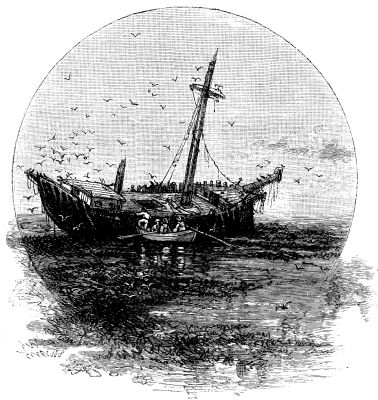
For a moment our hero really thought he must be dreaming; and then he suddenly recollected his school-book pictures and stories of the famous Sargasso Sea, where, for thousands of acres together, the water is quite hidden by a thick growth of "Gulf weed," and knew at once that this must be it.
And certainly this ocean prairie was a wonderful sight. As the steamer ploughed its way through the matted weeds, Frank could see in the narrow openings their trailing roots hanging far down into the clear cool depths below. Above these open spaces thousands of sea-birds were hovering with shrill cries, while ever and anon one of them would swoop down into the water, re-appearing instantly with a fish wriggling in its beak.
In the purple shadow of the weed beds bright-colored fish were moving lazily to and fro, but these darted swiftly away at the approach of the steamer. On every side queer little crabs and turtles were plumping into the water, scared by the plashing wheels, while, stranger still, birds' nests and eggs were seen here and there amid the huge broad leaves of the stronger plants, to the great delight of Frank, who thought the idea of birds nesting in the middle of the Atlantic the finest joke he had ever heard.
A mass of the tangle was hauled on board, and the men amused themselves by stamping on the hollow air-cells which give the weed its buoyancy, producing a series of cracks like the explosion of fire-crackers.
"I've heerd tell, though I can't say I've seen it myself," observed a sailor, "as there's places whar them weeds are so thick and strong that a man can walk on 'em all the same as dry land."
"Well, they can stop a ship, anyhow, whether they can carry a man or not. A chum of mine as v'y'ged here in a Portigee steamer told me that she once got reg'lar jammed among the weed, and only 'scaped by reversin' her engines."
"Well, it's a fact that some whar in these seas there's a place they call the Lumber Yard, 'cause of all the driftwood and floatin' spars and bits o' wreck and sich gittin' jumbled up together; for all the currents sort o' meet there, like them puzzles whar every road leads in and none out. If a ship once gits in there, good-by to her; for there ain't no wind, nor tide, nor nothin', and you jist stick there till you rot."
Here old Herrick muttered, dreamily, as if speaking to himself, "I've seen that, and I sha'n't forget it in a hurry."
The men nudged each other, and there was a general silence; for it was but seldom that Herrick could be got to spin a yarn, and he was now evidently about to "get off" one of his best.
"I was cruising in these waters," he went on, "'bout twenty years ago, when one afternoon we sighted a sort o' mound in among the thickest of the weed, with somethin' like a ship's mast standin' up from it. The 'old man' came out to look at it, and then gave orders to lower the boat, and we pulled for the wreck with a will. But as we neared her, the very look of her seemed to strike cold upon us all. Her hull had such an old-fashioned build that it might ha' been afloat for a hundred years and more; and all up the sides and over the deck great slimy coils of weed had trailed, like them eight-armed squids that clutch men and drag 'em down. As we came nigher, the very sun clouded over, and all was chill, and gray, and dismal, and the wreck itself looked so unearthly, with no sign or sound of life about it, that I guess I wasn't the only one who felt queer when we ran alongside at last.
"Up we scrambled, our very tread soundin' hollow and uncanny in that awful silence. Not a livin' thing was there aboard, not even a mouse. The mainmast was gone, all but a stump, and the moulderin' tackle lay on the deck all of a heap. The plankin' was rotten and fallin' to bits, and the place on the starn where her name had been was clean mouldered away. All at once our coxswain, Bill Grimes, gives a jump and a holler as if he'd trod on a rattlesnake; and when we ran for'ard, what should we see, half hid among the weeds, but the skeleton of a man, fastened to the bulwarks by a rusty chain!"
The speaker ceased, and looked round the attentive circle with the air of a man who feels that he has made a hit.
"A slaver, I reckon," said one, at length.
"Or a pirate."
"Or some craft that had got starved out."
"Ay; but how cum that skeleton there? Did you never find out nothin' 'bout her, old hoss?"
"Never," said the old man, solemnly. "That's how many a gallant ship has ended—just a mark of 'missing' opposite her name in the owner's list, and a few poor souls watchin' and waitin' for them that'll never come back. Ay, boys; for as bright and pretty as these waters look, there's many a black story hid aneath 'em as'll never be known till the day when the sea shall give up its dead."
They were now east of the Azores, and within four days' run of Gibraltar, which was their first halting-place. So the men were set to work to scrub the deck, polish the rails, new paint the boats, mend such of the signal flags as were torn, and "smarten" up the vessel generally; for a sea-captain is as proud of his ship as a lands-man of his wife, and likes to bring her into port as trim as possible.
Frank, always ready to be of use, took his share of the work, though he had plenty to occupy him without it. He was never tired of watching the sun make rainbows in the spray of the bow, and the pretty little sea-fairies, called by sailors "Portuguese men-of-war," float past with their tinted shells and outspread feelers; while at night the moon was so gloriously brilliant, and the sea so clear and smooth, that he often staid on deck till midnight to enjoy the spectacle. But another sight was in store for him, even more to his taste than these.
One evening, just before sunset, two sail (the first for several days) were descried by the look-out, quite close to each other. Herrick, after eying them keenly for a moment, pronounced them to be a British steamer and a full-rigged American clipper ship.
"How on earth can you tell that?" asked the wondering Frank, who could see nothing of the strangers but their topmasts.
"Easy enough. That un's a steamer, by her smoke; and she's a Britisher, by the look o' the smoke, for they mostly burn soft coal. T'other's a clipper, by her rig, and the lot o' handkerchiefs [studding sails] she has aloft; and she's a 'Merican, for nothin' else could hold its own with a steamer. But what can they be doin' so close together? Ah! I've got it—they're a-racin'."
AN OCEAN RACE.
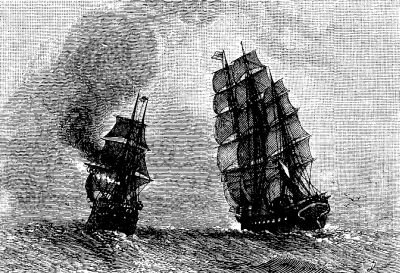
When the two vessels came near enough to be signaled, and to reply, Herrick was found to be right in every particular, and the excitement aboard the Arizona rose to a height. The captain himself came out to watch the race, and every man who was not on duty below hastened on deck.
"See how Johnny Bull's a-pilin' the coal on!" cried old Herrick, pointing to the eddying smoke, which grew blacker every minute. "But he don't whip that craft—not much! Canvas agin tea-kettles any day! Hooray!"
"Right you air, old hoss! Guess some o' them clippers can show as good a record as any steamer afloat. Why, didn't the old Nabob run 7389 miles in thirty days out thar in the Indian Ocean?—and that's 246 miles a day for a whole month, anyhow."
The two racers were now crossing the Arizona's bows, and every one crowded forward to look at them. The steamer's passengers were seen clustered along the side like bees, while the crew were bustling to and fro, setting every sail that would draw. But still on the starboard quarter hung the beautiful clipper, gliding along smoothly and easily, one great pyramid of snow-white canvas from gunwale to truck, while the look-out and the two men at the wheel (the only persons visible on board) grinned from ear to ear at the "Britisher's" vain efforts. Just as the clipper passed, the Stars and Stripes fluttered out jauntily at her peak.
"Come, boys!" cried Herrick; "let's give the old 'gridiron' a cheer."
Mingling with the hearty shout that followed (in which Frank joined with a will) came three sharp blasts from the Arizona's steam-whistle, by way of salute. Instantly the clipper's crew sprang up from behind the bulwarks, and, waving their caps, sent back a rousing cheer, answered by the Englishman with a short whistle of defiance as he swept by.
Little by little the racers, still close together, melted into the fast-falling shadows of night; but there were not a few who declared that, when last seen, the clipper was getting the best of it, and their belief in the superiority of wind over steam was greatly strengthened thereby.