THE WATERMELON TIDE.
Reading edition
BY EARLE TRACY.
The great still tide that comes from the Gulf when no one is expecting it reached up through the marshes one summer night, and spread itself over the banks of the bayou, and found numberless things in places of safety, and when it was ready to go out again it took them along.
Among its discoveries was a schooner-load of watermelons, about which Captain Lazare and the boss of the big farm had disagreed so radically that the melons had been left in a pile on the landing to wait for other transport. The tide charged itself with them, and when morning broke they were on their way to New Orleans.
Bascom had been tossing in his sleep as the little Mystery did when the tide went in one direction along Potosi Channel and the wind went in the other. With the first glimmer of light he was up and down at the beach.
"Me, but it's been high," he gasped, coming up from his first plunge and leaning back in the water as if it were a steamer-chair. "It would be beautiful to run out with in the Mystery—an' me goin' to pick figs all day in them dumb ole trees! I wish the canning factory would bust!"
Bascom was ready for the hardest kind of work at sea, but things on shore were unutterably lifeless to him, and how Captain Tony could have contracted to sell his figs instead of letting the birds take care of them was past Bascom's understanding.
While he was floating and thinking mournfully of the figs, one of the watermelons struck him softly on the cheek. He bounded clear out of the water with fright, and as he made for shore another melon came up under him and sent him pelting through the shoals. He was not followed, and when he felt grass under his feet, and realized that he had fled shoreward for safety and that he had not been hurt at all, he felt very queer.
"If they was popusses they'd be a-splashin'," he reasoned; "an' if they was sharks they'd have eaten me—least-ways they wouldn't have been so polite about lettin' me excuse myse'f. I wonder what they is?"
He moved gingerly into the deep water again, and at last swam out to investigate. He could see two or three dark round surfaces letting the tide sway them easily away from shore. At his approach they neither dived nor turned to attack him. "They mighty tame," said Bascom, laying his hand on one. "They—they's watermelons!"
"Where did you come from?" he asked, taking the nearest in his arms. "What po' dumb idiot let you get away like this? Did you ax permission to come here visitin' me? I'm mighty glad to see you, anyways. You's jus' who I was a-thinkin' of."
He capered round them for a while, then gathered them all in a line within his arm. They were too many for him, but the wrestle to keep them from bobbing over or under and getting away was sheer delight. "Three melons!" he repeated; "cooled in this high tide! Three of 'em! What'll Captain Tony say?"
He was so interested in thinking of Captain Tony's surprise that the outside melon escaped from him, and he could not get it again without losing the other two.
"I'll come back for you," he promised; "you can't go far 'thouten your fins grow." He took the other two and put them under a clump of palmettoes, where they would make no new acquaintances while he was gone. "Don't know as anybody else is up," he said; "but they might be. It was a terrible hot night."
As he waded out again over the sharp oyster-shells the sky had grown blue instead of gray, and a brightness sprang across the water, touching hundreds and hundreds of glistening green watermelons undulating with the falling tide.
Bascom's heart stood still. He stopped right where he was, and his brown face grew tense with round-eyed wonder. The water lapped against his breast. He almost let it take him off his feet. "I knowed they was called watermelons," he said, slowly, "but I never caught 'em growing in the water by night before. How's we goin' to get 'em in.'"
He looked from the melons toward the shore, where Captain Tony's long seine hung on the poles beside the submerged pier. "Usses can haul 'em in," he said.
Although it was exceedingly early there was no time to lose. It would take two good hours to get the melons in, and the people on the bay would be only too glad to help in the rescuing as soon as they woke up. "Folkses is always so interested in what I find," Bascom grumbled; but for once no one troubled him. He roused Captain Tony, and they hitched the net between two boats and, rowing apart, circled around the melons with it, gathering them in, until they were fairly rafting them before it toward the shore. The net bulged in a great crescent, and Bascom could hardly keep his boat abreast of the Captain's. The weight they were towing made it seem as if his oars were pulling through stiff clay. No net on all the coast had ever had such a full haul before. Bascom and the Captain exulted in it, even while their faces grew scarlet.
"We can'd take in anoder one," the Captain declared; "de net can'd stan' de strain." And closing together as much as the mass between them would permit, they pulled ashore and rolled the melons out in a line upon the beach. The tide was going out so fast that each haul made a separate rank farther and farther out from the high drift-mark in the grass.
It was glorious hard work, and before it was finished the sun had turned the water violet, then red, then gold and blue, and yet no one had come to take a share in the salvage, and no one had come to claim the melons. "I tell you," said Bascom, as he wheeled the last barrow-load up from the beach—"I tell you they's mascots, and they's come right in from the deep sea. Do you reckon they's too many of 'em for usses to eat?"
The Captain straightened himself, and measured the heap of cracked melons, which he had left out as he piled the good ones symmetrically under one of the live-oaks. "Yo' boy," he said, "if yo' jus' made way wid de busted ones I'd be paintin' a black ring roun' de mas' of de little Mystery 'fo' sunset, an' w'ad would I do 'boud pickin' de figs faw de cannin' factory?"
"O-h-h," groaned Bascom, "I'd forgot about the figs. Can't they wait till we take these melons off in the Mystery and sell 'em?"
"De melons can wait, ya-as, now we got dem all safe," said the Captain. "De cracked ones will not keep noway, an' de good ones will las' bettah dan de figs. An' w'ad is mo' to de point, dere is de ownah of de melons to consult."
"But he isn't here," Bascom said, "an' we don't know where he is. They didn't bring his address with 'em when they come in on the tide."
"I reckon I know his address," the Captain answered, "an' maybe yo' would, also, if yo' let yo'se'f t'ink 'boud id. De big tide washed dem off de landin' up de bayou. Lazare was a-tellin' me yestahday dat he an' de boss ad de big fahm had a quahl boud de price o' melons, an' Lazare, who was to have take dem in de Alphonsine, he go off mad, an' de melons dey stay in a pile on de landin', an' I was t'inkin' boud goin' up to see de boss me aftah de figs was pick'. I reckon now de bes' way is faw me to go ad once while yo' pick de figs."
"But we ought to start right now while the tide is goin' out," objected Bascom.
"Dere will be oder tides, an' dey is waitin' faw de figs ad de factory," said the Captain, "so I fink yo' bettah go to pickin', boy"; and without stopping for further persuasion from Bascom he got into his skiff and headed toward the mouth of Bayou Porto.
As Bascom carried the last of the melons to add to the heap it slipped from his hands accidentally, and split into rich red pieces on the sand. "U-m," he said; "lucky it was a cracked one." He took it up to eat it in the shade of the live-oak. "Too bad," he added, "after you was so enterprisin' to start out by yourse'f that me an' Captain Tony couldn't agree to take you right along. Queer how folkses can't agree 'bout you. If it wasn't for them dumb ole figs! S'pose when I'm done eatin' I got to go up an' go to pickin'. Seems like such a sailor as Captain Tony hadn't ought to fuss with things on shore."
His arms were aching from the heavy pull, and they did not feel drawn toward the sticky figs, and mud daubers were sure to be in the trees ready to sting interfering people, and he had not finished with the melon when Peter Pierre, or Peter Peer, as the Creoles pronounce it, came hopping leisurely along the beach, with one leg wrapped around the other like a stork's. He was a neighbor's boy, and had been sent to borrow Captain Tony's axe. There would be no morning coffee at his house until Captain Tony's axe had chopped wood enough to build a fire.
"H-o!" said Peter Peer.
"H-o!" replied Bascom.
"Whose is dose melons?" cried Peter Peer. "Wheah did dey come from?"
"Came down the bayou," said Bascom. "They's mine. Mine an' Captain Tony's."
"Gimme one?"
"Nop," said Bascom.
"Sell one?"
"N-nop, I reckon not. They ain't so many as they look."
"Heap o' cracked ones," said Peter Peer. "I'll trade yo' my play boat faw one."
"Eatin' the cracked ones," said Bascom, taking another mouthful; "they's mighty sweet."
"Yo' can'd eat dem all!" cried Peter Peer, his eyes rolling hungrily from side to side.
"Look a-here, kid," said Bascom; "if you want one so bad I'll tell you what I'll do. I'll let you pick figs for 'em. I was wantin' to pick 'em myse'f, but it looks like I got to stay and take charge of these. I'll give you a cracked melon for every basket of figs you pick."
"All right," said Peter Peer; "gimme de basket."
Bascom gave him a corner of melon to seal the bargain and keep the basket from looking too large, and Peter Peer was soon whistling in the trees behind the Captain's house. Bascom had scarcely settled himself under the live-oak when Sonny Ladnier and his younger brother came in sight with their red-sailed cat-boat, bent on an early trip to Potosi. They saw the pile of melons, and it drew them like an undertow.
"Wheah yo' ged all dem melons?" they shouted.
"Growed 'em," replied Bascom; "do you want some?"
"Yo' bet yo'!" cried Sonny, tying up the boat. "Hand one ovah."
"What for?"
"W'at faw? W'y, to eat."
"I mean, what will you give me?" Bascom explained.
"Two bits faw two."
Bascom shook his head. There was only one way in which those melons could be had. After some argument Sonny and his little brother repaired to the fig-trees, each with a chunk of melon in one hand and a basket in the other. Sonny Ladnier was big enough to have tried to bully Bascom, but the people on the bay had a respectable fondness for him, not to mention his partner.
During the hour, Narcisse Fontaine, big Noel Roget, Rubier Peer, who came to look for Peter, and Patrice Rodriguez, with his pointed beard and his reputation for duelling, added themselves to Bascom's force behind the Captain's house, and the figs were fairly charmed from the trees. Bascom did not think it safe to leave the melon pile for more than a moment at a time, and he was sitting alone beside it, and had just cleaved open the crack of a long striped "rattlesnake," when a strange schooner passed by a length or two, then came about, and anchored off the point. She was the Luna May, from Pass Christian, and he had never seen her before. As three men got down in her tender he could hear their voices as plainly as if they were talking to him.
"'Cose dey sell dem. Wat dey have dem faw?"
"Bud we got no money. We spen' it all las' night."
"We can trade 'im out of some. I give my knife faw one o' dem big ones. It's a terrib' hot day. Dat little chap be mighty easy to bargain wid. Yo' see."
"You see," echoed Bascom, chuckling, as they left their skiff, and came sauntering up to him. "Somethin' I can do for you gentlemans to-day?" he inquired.
"Whose is dese melons?" asked the first schooner-man.
"Mine, jus' now," said Bascom.
"Aw, get away."
"Well, they is."
"Den I reckon yo' lookin' faw a chance to get rid o' some o' dem."
"Not as I knows on," Bascom said.
"Wat?" cried the second schooner-man. "I'll give yo' dis." He took out a big Spanish pocket-knife that opened with a spring. "Yo' can have it faw t'ree of dem."
"I don't reckon I need any knife," Bascom said.
"Aw," said the third schooner-man, impatiently, "a lot of dem is good faw not'ing. He got to give us some. If he ain't got de sense to trade faw dem we take dem."
He spread Bascom out swiftly with his hands, and sat down on him, directing his mates to pile melons in their skiff. After the first instant Bascom did not offer the slightest resistance. He lay gathering breath against the weight of the man on his chest, and when he was quite sure of himself he lit it out again in a terrific howl for help. The man clapped a hand on his mouth, but Bascom had no need to speak again. A posse of men and boys came dashing round the house, some of them putting down the baskets, and others brandishing sticks as they ran.
The schooner-men jumped into their skiff, but Patrice and Rubier and Noel and Sonny Ladnier rushed into the water after them, and brought them back. A dozen hands rescued the stolen melons, while with Irish expletives and Creole fierceness Patrice pounded the biggest man as a preparation to bidding them good-by. The crowd was following his example, and it would have gone hard with the strangers if Bascom had not had a different mind.
"MAKE 'EM PICK YOUR FIGS!" HE SHOUTED, "MAKE EM PICK YOUR FIGS!"
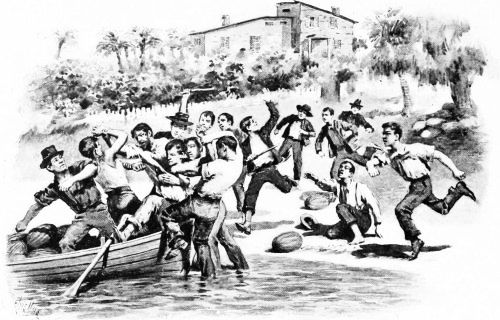
"Make 'em pick your figs!" he shouted. "Make 'em pick your figs! They'll look handsome in the trees! Make 'em pick for you!"
The cry found favor, and the verdict became, "If yo' want to go free yo' got to pick de figs!"
When Captain Tony and the boss of the big farm approached the point, and saw a strange schooner anchored there, the Captain felt anxious. "I hope de boys not havin' troubl'," he said. "I don' see w'at dat boat wan' stop dere faw."
As they landed, Bascom met them and explained. "I've got the crew of that schooner pickin' figs for me, an' some of the boys from round here is watchin' that they do it lively. They was honin' for some cracked watermelons, an' I thought they'd better do a little work, seein' as they got out of temper."
The boss was a Northern man. He looked at Bascom's agile weather-beaten figure, and they all went round to see the force of overseers and the three men in the trees. "That's about the way I have to work it," he said. "More overseers than men; but how do yours manage to make the men work so lively?"
"Ho!" said Bascom, "easy enough. They're workin' by the job. Can't go till they're done."
But it was not until Patrice told why the strangers sat so glum and warm and active in the trees that the Captain and the boss understood.
"Yo' boy," said the Captain, as they went back to the melon-pile, "an' yo' nevah picked a fig yo'se'f?"
"Not a one," said Bascom, candidly. "The boys came along at first an' wanted to pick for cracked melons, an' then 'bout the time they was gettin' tired this schooner hove in sight. After I begun to have comp'ny, looked like it was best for me to watch the melons."
"And before?" laughed the boss.
"I'd had the misfortune to drop one," Bascom said. "It busted, and I was lookin' after the pieces."
The boss clapped Bascom on the shoulder. "You're the man I've been hunting for down here," he declared. "Don't you want to come up and help me run the farm?"
Bascom looked over at the little Mystery, the deep blue of the bay, and the tree fringe on Deer Island, beyond which lay the Gulf.
"I reckon they'd have to be a mighty long calm," he answered; "wouldn't they, Cap'n Tony?"
"They suah would," the Captain agreed. "In sailin' weathah me an' Bascom mostly sails."
They counted the melons as they loaded them on board the Mystery, agreed on a rate of salvage and a price, and arranged for future dealings as the crop went on. The schooner-men finished their work, and Bascom paid off the overseers generously; then the Mystery raced the Luna May to the bridge, and passed through first.
"Well," sighed Bascom, when they had left the figs at the canning-factory, and their faces were turned toward the welcome reaches between Potosi and New Orleans, "if it hadn't a-been for that honey of a tide I'd be up in them dumb ole trees a-studyin' 'bout pickin' dem figs."