GREAT MEN'S SONS.
Reading edition
BY ELBRIDGE S. BROOKS.
THE SON OF CROMWELL.
In the famous old English village of St. Ives—famous because of a certain nursery rhyme concerning a man who, travelling toward the town, met seven wives with their cats and kits—there once lived a farmer who, later in his life, became more famous than St. Ives itself.
Out West they would have called him a ranchman. He was really a cattle farmer, with a big grazing farm that lay along the river Ouse, in what is termed "the fen country" of England. Here, where the Ouse slipped thickly and lazily through those low, green, boggy, marshy fields called the fens, this farmer raised his beef, his pork, and his mutton; and here lived his son Richard, as lazy and sluggish of nature as the river along whose banks he lounged or fished or wandered as a boy, until it was time to send him off to Felsted School, in Essex, where his brothers, before and after him, were placed for such education as those days provided.
A slow, good-natured, easy-going fellow was this boy Dick—"lazy Dick," his father often called him. He was neither as bright in mind or manner as his younger brother Harry, nor as promising a lad as his elder brother Robert. Robin was what this elder brother was called; he was the delight and hope of his fond father—then called by his neighbors "the Lord of the Fens," because of the stand he took against the King's threatened "improvement" of the marshy fen-lands. To-day the world honors and revels that sturdy farmer of the fens as Britain's mightiest man—Oliver Cromwell, Lord Protector of the Commonwealth of England.
We catch a few glimpses—not many, unfortunately—of the quiet home at St. Ives, in which the Cromwell boys and girls lived. It was a happy and united home, blessed with a mother whom her children revered, and having as its head a father they honored and never dared to disobey.
But fathers in those days—two hundred and fifty years and more ago—though stern in their ways with children, were as fond and as loving as are the fathers of to-day, and Cromwell the farmer, Cromwell the General, Cromwell the Lord Protector, loved his children dearly, and labored for their good alike in the great palace at Whitehall as in the low, timber-framed house upon the one street of St. Ives, where the willows shivered in the wind, and the cattle grazed and fattened upon the wide marshy meadows that lined the sluggish Ouse.
How little Dick Cromwell fared as a boy at St. Ives we have little means of knowing. When he was ten years old—in the year 1636—the Cromwells moved into a bigger house at Ely, fifteen miles away. It was called Ely from the eels that wriggled about in the muddy Ouse, and is that famous cathedral town of the fens where King Canute, who tried to order back the tide, once bade his rowers stop his boat that he might hear the monks of the cathedral sing.
Probably boy Dick thought more of bobbing for eels in the Ouse than of King Canute and the monks; for there were no monks singing in England when Richard Cromwell was a boy. There was soon to be no King in England, either, and in that great uprising against principalities and powers Dick Cromwell's father was to bear an important part.
We would like to know more of Richard Cromwell's boyhood. We would like to know how he lived and what he did as a small boy on that cattle farm among the fens at St. Ives, and at the more spacious homestead in the shadow of the great gray towers of Ely Cathedral. We would like to know whether he liked sport, as most boys do, or whether he was too lazy to exert himself at play. We would like to know how he studied, and what he learned at the Free Grammar School at Felsted, where, one after the other, four of the Cromwell boys were sent; whether he loved football as much as his father did, and became a champion full-back as his father did when he was a boy.
I am afraid Richard Cromwell was just as careless at his books as at the later duties that came to him; for, from things that have come down to us, we know how his busy father, who was as ambitious for his boys as all fathers are, had but little patience with lazybones anywhere, and reproved boy Dick for his carelessness as he found fault with young Mr. Dick, in later years, for his shiftless ways.
Troublesome times came to England. The people rose in defence of their rights. The King fell. The throne and crown were abolished. The Parliament bent before the iron will of the people's champion, and from the Captain of a troop and the General of an army the determined farmer of the fens took the helm and steered his country through reefs and breakers, until, under the leadership of Oliver Cromwell, the commonwealth of England became the first power in Europe, unconquerable on the land, invincible on the sea.
Step by step Cromwell rose to power. Against his own desire he rose, the one strong man in England. And, as he advanced, his family rose with him into notice and position. One by one the older boys died. Robert, a promising lad of seventeen, died at Felsted School; Oliver, the second son, named for his father and a Captain in the cavalry, died just before the great victory of Marston Moor, and Richard Cromwell thus became the eldest living son, heir to the estates, successor in power, but never heir to the fame that his mighty father attained.
For there was in "lazy Dick" nothing of his father's masterful manner or genius in leadership, nothing of the display and vast hospitality that made famous his ancestor, known as "the Golden Knight of Hinchinbrook," nothing of the dash and daring that marked his more remote ancestor, "Diamond Dick," who unhorsed all his rivals at a tournament, and so defended the king's colors that the pleased monarch, bluff King Henry the Eighth, called the victorious champion his "diamond."
We are not even certain that Richard Cromwell fought in the wars against the King, as did his brother Oliver and Henry. We cannot find that he desired either the position or prominence that his father's rise to greatness gave him. Richard Cromwell cared only to live and die a quiet, inoffensive, lazy country squire. At any other time in the history of the world he might easily have lived unknown, unhonored, and unsung. It was his father's fame that brought him into notice; it was because he had neither the will, the inclination, nor the ability to take up his father's work, and carry it forward for the greatness and glory of England, that to-day the world holds in such slight esteem this quiet son of Cromwell.
We should not blame people for not doing what they cannot do. It may be, indeed, that "lazy Dick" was not shiftless, though he was lazy, nor a numbskull simply because he was not great. Richard Cromwell liked to take things easy; he hated to be bothered; he liked to keep out of trouble, and was willing to let the world wag as it would so long as he had a comfortable home and nothing particular to do.
There is nothing really bad in this; but boys and men of that stamp, you know, never help the world along. And I am afraid that "lazy Dick," notwithstanding all his opportunities and the high position to which he was finally advanced, never did anything to help the world along. If a good thing came in his way he took it, enjoyed it if he could, and got out of it if it proved troublesome and laborious.
When he was twenty his father tried to make him a lawyer; but he soon dropped that profession. He offered him a command in the army, but Dick seems never to have accepted it. When he was twenty-three he married a nice girl in Hampshire. Oliver Cromwell loved her dearly, but he and her father had their hands full trying to make Dick "toe the mark."
RICHARD PREFERRED HUNTING TO POLITICS.
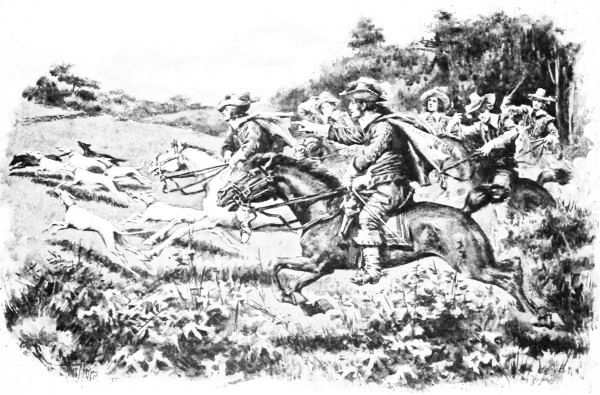
Whenever he could, Richard Cromwell would slip away from the work his father wished him to do and go out hunting, or have a good time with other rich do-nothings at his Hampshire farm. He disliked the almost kingly court of his father at Whitehall Palace, and though sent to Parliament, he did little and said less. And when he was made one of his father's chief advisers—a privy councillor—his counsels amounted to nothing, and his position was simply what politicians call a sinecure.
When, at last, his great father's life went out, and England was left without a head, Richard Cromwell was named as his successor, and made Lord Protector. Lazy Dick became King of England, without the title, but with more of power than many a King before and after him possessed.
But he had neither the skill nor the sense to hold what the people had given him. I doubt if he cared either for the place or the power. And they were his but a short time. Dissatisfaction broke into revolt. The nation was divided. The King came to his own again. Charles the Second was placed upon the throne from which his father had been hurled, and Richard Cromwell, without a word of protest, without striking a blow for his power, stepped quietly down from the Lord Protector's chair his father had set up, and slipped back into private life, too weak to be defended by his friends, too insignificant to be persecuted by his foes.
He lived to be an old, old man, and died at eighty-six amid his rose-gardens at Cheshunt, near London, unhonored and disregarded by the England his father had liberated, but which the son was too weak to uphold as a free commonwealth.
We must not be too bard on "lazy Dick." He had not a spark of greatness in him, and should not be blamed for failing to maintain his father's glory. It is a hard thing for a small son to live up to the fame of a great father. And yet the world does not take lack of ability into account. Richard Cromwell to-day has no place in the world's esteem. His name lives because he was his father's son; because he was a failure where his father had been a success; and because his life was so sad and stupid a sequel to the people's stand for liberty in the days made glorious in English history by the might and power, the grandeur and manliness, the strength and patriotism of England's greatest man—Oliver Cromwell, great father of a small son.