Part 2 — EARN A BICYCLE!
Reading edition
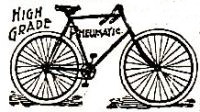
We wish to introduce our Teas, Spices, and Baking Powder. Sell 75 lbs. to earn a Bicycle; 50 lbs. for a Waltham Gold Watch and Chain; 25 lbs. for a Solid Silver Watch and Chain; 10 lbs. for a beautiful Gold Ring; 50 lbs. for a Decorated Dinner Set. Express prepaid if cash is sent with order. Send your full address on postal for Catalogue and Order Blank to Dept. I
W. G. BAKER, Springfield, Mass.

Giving a Nut Social.
Autumn approaches, and evening entertainments in-doors will soon be in order. Besides, the chestnut burs are getting large, and almost before we are aware of it they will be opening. A nut social is a novel thing, and it can be made as amusing, mysterious, or instructive as you wish, with genuine nuts and metaphorical nuts—geographical, historical, literary, or social.
Issue your invitations in a form to stimulate curiosity. You might put "Nut-cracking," "Nut Social," or "Mixed Nuts" as a title on the outside, with a big interrogation mark filling the centre, and the words "Contributions requested" below, with date and place of entertainment in the lower left-hand corner. Or better still, perhaps, paint a large nut, or a group of small ones, with nut-crackers and picks, if you choose, in the upper left-hand corner, and the words "To crack" in the centre, followed by place and date as before.
Your invitations may simply ask the pleasure of Miss Bessie M.'s or Miss Flora T.'s company. Engage several of your bright young friends to give a little description of some nut, impersonating it as far as possible, telling where found, its habits, manner of growth, uses, and any other interesting facts regarding it, concealing its name, and weaving as much mystery about it as possible. Have these descriptions only two or three minutes long, but as bright, catchy, and witty as may be. Then, after each nut is described, give a chance for quizzes and guesses regarding it. Intersperse the chat with an occasional strain of familiar music, which, in accordance with the nut cracking scheme, may be identified and the composer guessed. Brought in at unexpected intervals, it will require quick wits to name them readily.
To give variety to the entertainment, noted personages, books, characters in fiction, or works of art may be represented by the different guests, or an art gallery may be improvised by the hostess. The greater the variety of puzzling things, the greater will be the interest and the more enjoyable the entertainment. Everything, as far as possible, must be in the nature of a nut—to be cracked.
The refreshments should be of nuts, or something having nuts as an ingredient, as nut-cakes, nut-candies, etc. Have a nut salad if you like—a dish of nuts decorated with autumn leaves, intermingled with slips of paper containing conundrums, enigmas, puzzling Questions, etc., to be guessed by the recipients; or you may have nut bonbons of this same kind. Or, after carefully cracking English walnuts, substitute for the meats your paper nuts, unite the two half shells with a drop or two of mucilage, and serve with each plate of refreshments. Provide every guest with paper and pencil to record his guesses as he makes them, and give a prize for the greatest number of correct answers, and a booby-prize for the least. A silver nut-cracker or a set of nut-picks would be appropriate for the former, and a hammer for the latter. Try it, and you will like it.
Kinks.
No. 33.—A Combination Kink.
My first is in zinc, but not in lead;
My second in rose, but not in red;
My third is in disc, but not in tray;
My fourth is in black, but not in bay;
My fifth is in paid, but not in lynx;
My sixth in dilates, but not in blinks;
My seventh in martlet, but not in crow;
My eighth is in cut, but not in mow;
My ninth is in shrine, but not in fane;
My tenth is in walnut, but not in plane;
My eleventh in alley, but not in lane;
My whole is a nickname bestowed on the capital of Virginia.
The solution to the above cross-word enigma forms the central column (reading downward) of the following acrostic, the initials of which are the same throughout:
Crosswords.—1. Invigorating. 2. Thought long and anxiously. 3. A cloth ornamented with raised work. 4. Devoted to books. 5. Dimmed as to sight. 6. A heraldic term denoting a strip surrounding the field. 7. Indian sage—thoroughwort. 8. Relating to the Fagus. 9. A fourteenth-century helmet, basin-shaped. 10. Jeers. 11. In falconry, pieces of leather used to bind up the hawk's wing.
Ab Sinthay.
No. 34.—Charade.—A Triple Character.
I sang my most melodious song, My sweetest roundelay, In vain, to win a wanderer's love; Then threw my life away. And now in distant Indian seas, Beneath the wild waves' roar, I sit, a prisoner in a cell, And sing of love no more. Afar within the realms of space, Where planets hold their sway, I shine to guide the wanderer's feet Along the homeward way.
No. 35.—A Fleet of Ships.
My fleet of ships went over the sea, Bound for a distant shore. One day, they all came back to me, And marvellous freight they bore. The first brought home a cargo of love, The second, labor and toil; A title the third on me bestowed; The fourth gave claim to the soil; The fifth my knees bent low in prayer; The sixth gave control of men; The seventh another put under my care; The eighth in my hand laid a pen; The ninth sent me far away from my home; The tenth gave me limitless power; The eleventh put me in charge of a court; The twelfth made learning its dower; Number thirteen brought me a steed; Fourteen forth sent me to preach; Fifteen gave charge of other men's goods; Sixteen brought duty to teach; Seventeen to another bound me for years; Eighteen left no leisure from writing; Nineteen supplied me aid in my work; While twenty gave position for fighting.
No. 36.—Two Good Anagrams.
1. A police captain's order:
"Examine hat and roll."
A well-known American statesman.
2. "Ever turn, stout Louisa."
A famous negro patriot.
Answers to Kinks.
No. 30.
Central letters, right-hand hour-glass, Apelles; central letters, left-hand hour-glass, Phidias.
1.—1. D. 2. Sen. 3. Selah. 4. Deluder. 5. Nadir. 6. Her. 7. R.
2.—1. R. 2. Sad. 3. Spire. 4. Railing. 5. Dried. 6. End. 7. G.
3.—1. Dappled. 2. Habas. 3. Bit. 4. D. 5. Die. 6. Chart. 7. Plaster.
4.—1. Rotates. 2. Paper. 3. Bed. 4. L. 5. Ale. 6. Tread. T. Glisten.
No. 31.
1. Apple. 2. Salt. 3. "Butter" (goat). 4. Mace. 5. "Nutmeg" (Connecticut). 6. Flounder, 7. Quince (in Midsummer-Night's Dream). 8. Pepper (K.N.—Cayenne). 9. Eggs. 10. Flower (flour).
No. 32.
1. Grapes, rapes, apes, pes. 2. Sago, ago, go. 3. Acorn, corn, orn. 4. Flax, lax, ax.
Does Progress Lie this Way?
My father is a teacher in a missionary school here, and on Sundays he assists in the mission services. I assist, too, playing an American cabinet organ and helping with the singing. The other evening a gentleman called at our house for a chat. He is a Japanese of perhaps forty, and he spent ten years in Europe and America. He speaks Spanish, French, English, German, and Chinese, besides his own tongue, in the latter of which he is perfectly versed. He has visited every city of importance in the western world, and is therefore a judge of customs. Suddenly he said to my father, "What an inconvenient man you are!"
Father looked up in astonishment, and inquired why.
"Why? Because you require, like all western people, so much to make you comfortable. And out of all you have you get no more comfort than do we Japanese from our little. No, not so much comfort by half. For instance, you pay to live here—how much?"
"Two dollars per day," replied my father.
"Ah," said our Japanese acquaintance, "I pay seventy-five sen, or about forty cents of your money. And I am just as happy and as comfortable as you are. To be sure, you have tables, and chairs, and bedsteads, and dressing-cases, wash-bowls, pitchers, mirrors, and goodness knows what in your rooms. I have nothing of the sort. They are too much trouble to care for. A nice cool mat and quilt form a good enough sleeping outfit for me. And you make yourself so much work at your meals, using all those pitchers and plates, goblets, spoons, pepper-pots, and the rest. Then, when you eat, you crowd yourselves into one room. I eat alone. My meals are served on a tray by a pretty maid, who kneels before me as I eat, chatting and making herself interesting.
"When you travel you take with you, either to tote about, or hire some one to carry for you, a great amount of luggage. As for me, the hotel furnishes me a dressing-gown and a night-robe, and I buy a fresh tooth-brush each morning for a sen. No; say what you please, you western folk are inconvenient people. You do not follow the line of the least resistance. You make too much effort to live, and the cost is too great in nerves, brains, flesh, blood, and worry."
G. Kyoto, Japan.
Questions and Answers.
Helen Disosway asks whence comes the caper of which the caper sauce is made. It is a small bud that grows in very hot climates, especially in the East Indies. It is gathered before the petals have unfolded. The work of collecting these buds is very slow, hence the expensiveness of the sauce of commerce. The seed-pod of the caper is also used. It makes a delicious pickle. The caper plant is perennial, but dies down and seemingly disappears in the autumn. It grows best on dry and hot stony ground. It is sometimes used in the East to surmount rockeries, because it lives on little soil, while its foliage is delicate and its silvery flowers are ornamental.
Charles R. Botsford: Articles descriptive of magic have appeared in the following recent numbers of Harper's Round Table: 844, 852, 862, 866, 869, and 873. The numbers may be had by applying to the publishers. Eleanor Little, aged twelve, Marblehead, Mass., collects bicycle buttons. Perhaps you do too. If so, you will be glad to have Miss Eleanor's address. Earl L. Hendricks, Box 626, Savannah, Ill., collects fossils and mineral specimens and wants correspondents. So does Edith S. Lewis, 1418 Eighth Avenue, Kearney, Neb., who also writes verses and stories. She is fourteen. James Fahlberg, 520 Barbey Street, Brooklyn, wants to join the staff of an amateur paper in Brooklyn. We are not advised of any Brooklyn amateur paper that wishes to increase its staff, but suggest that Sir James apply to Beverly S. King, 1625 Atlantic Avenue.
"E. W. S." is fifteen and wants to enter the United States navy. He must apply to the member of Congress from his district. Had he given his address we could have told him the name and address of his member. Any local politician can tell him. So can his postmaster. Appointments are made only as vacancies occur at Annapolis. If you fail to hear from your Congressman, write to the Secretary of the Navy, Washington, D. C., asking when a vacancy will occur in your district. Hon. Hilary A. Herbert is the secretary's name. You will receive a prompt reply. Applicants must pass rigid physical and mental examinations, but the latter covers the common branches only. No, fifteen is not too old to enter. David B. Hendricks: "University Extension" means an extension of university teaching to men and women too old and perhaps too poor to attend universities—that is, carrying university lectures to those who cannot come for them. It was inaugurated by the universities of Oxford and Cambridge, in England, but soon copied by Columbia, Pennsylvania, and Chicago in this country. There is also an American Society for the Extension of University Teaching that is unconnected with any university, and sends out lecturers from Princeton, Columbia, Chicago, and other leading universities, and even business men and principals of high-schools. The course includes art, astronomy, biology, chemistry, civics, forestry, travel, history, literature, mathematics, music, philosophy, sanitation, and sociology. Lectures in courses may be had on any or all of these subjects. There are examinations and diplomas. The usual plan is for local societies, either existing ones or those formed for the purpose, to select their subjects and apply to the Extension Society for lecturers. The cost, when divided among a society, is moderate, and many courses are given in villages as small as Moodus.
Making and Flying Tail-less Kites.
"E.W.D." asks, "Will you kindly tell me how to make and fly tail-less kites?" These kites are common in Holland, and are therefore called Holland kites. They are easily made, and there is no bother about getting exactly the right amount of ballast for them. A good size is 4 feet for the main upright stick. For cross-stick use ash or hickory, and have it exactly 3 feet long. Attach strings to each end and tie it at the back, curving the cross-stick into the form of a bow. This curve must be varied with the strength of the wind. If the wind is strong, tighten the bow cord, and give the bow more curve. The bow is fastened to the upright 1 foot below the upper end of the latter. Attach a belly-band at the contact of the stick and the bow and at the bottom of the stick. To determine the length of the belly-band let its angle just reach the ends of the bow, at which angle the kite string is to be attached. These measurements may be larger or smaller, but if varied at all they must be varied alike. The proportions here given must be maintained, or the kite will not be a success. Each side of the kite must be of equal weight. Lift the kite by the belly-string, balancing lower end on a finger-point. If it tips to one side, paste bits of paper in the light side till both sides are equal. The stick, bow, and cords must be as light as their duties will warrant. Covering may be as in any other kite. If correctly made, kites of this pattern require no tails, and the gentlemen who furnishes the information says that the first one he made staied up all day the first time he flew it.
Mounting Bird Feathers.
Will some one tell me how to mount my bird-feather collections? I will be very thankful for any information on the subject.
Jay F. Hammond, R.T.K. Harford, N.Y.
We suppose these collections to be made of feathers that the birds have no longer any use for. No Knight or Lady would take what is another's, and the feathers are certainly the bird's so long as he has need for them. Let us know how to artistically mount feather collections—where said feathers are gathered after the bird has shed them. The Table will be glad to print the morsel or morsels on the subject.
Cure for His Breath.
Washington had for many years a famous caterer Mr. John Chamberlin. The other day Mr. Chamberlin died. Once a man, entering his restaurant, said in his hearing: "How I would like a fine steak smothered in onions! I'd have it, too, if it were not for the breath."
Chamberlin replied: "You needn't worry about onion breath. Order the steak, find when you get your bill I'll have it so large it'll take your breath away."

There are only a few brands of manufactured articles that are kept by all grocers. Ivory Soap is one of these.
The Procter & Gamble Co., Cin'ti.
