CANAL LOCKS FOR OCEAN STEAMERS.
Reading edition

t was at one time supposed that the railroads would be able to carry freight so much cheaper and quicker that the canals would gradually become useless, and only the heaviest and most unimportant class of goods would be sent from place to place over the all-water inland routes. One of the reasons for this was that the canals had not advanced in any way since they were first built—that is, the mechanism of locks had not been improved, and no other methods had been devised by which canal traffic might be made speedier. But about six years ago an American engineer, Mr. Chauncey N. Dutton, invented a lock which many experts think will probably revolutionize canal traffic, and make it possible to build a waterway from New York to the Great Lakes, following the line of the Hudson and using Lake Champlain and the St. Lawrence River.
DIAGRAM OF LOCKS.
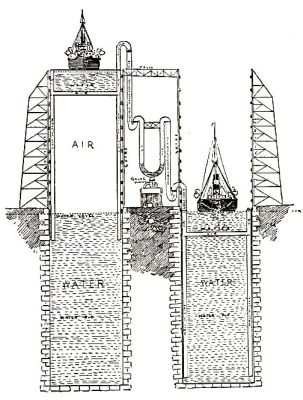
The lock invented by Mr. Dutton is founded upon the already well-known and widely utilized principle of compressed air, and although at first it looks complicated to the average person, it is said by mechanics and engineers to be a very simple affair. The lock is called a pneumatic balance lock. It is made up of two sections, each of which may very well be compared to elevators. These elevators are in reality huge tanks, each about 510 feet long, 65 feet wide, and capable of holding 26 feet of water. These tanks are placed in other steel tanks which correspond to the shafts of an elevator, and these shafts are placed alongside of one another. Of course the shafts of these great elevators are sunk as deeply into the earth as it is necessary to raise a ship into the air, or up to the higher level of the canal. The sunken portions of the shafts are filled with water, and the tanks, or elevators, are arranged so that they work up and down like balanced scales—that is, when one is at the higher level the other is at the lower level. Compressed air does all the work. Perhaps by looking at the diagram this may be more clearly made apparent.
The two tanks are connected by a great pipe 21 feet in diameter. Where it connects immediately with the locks this pipe is flexible and moves up and down with the tanks, and looks very much like a huge elephant's trunk. Through it the compressed air shifts, at the will of the operator, from one shaft to the other.
Therefore, supposing one of the tanks is at the highest point of one of the shafts, the other will naturally be at the lowest level of the other shaft. The upper tank is supported by compressed air resting on a body of water which fills the lower portion of the shaft—that is, the part sunken down into the earth. All that it is necessary to do now in order to bring the upper tank or elevator down to the level of the lower tank is to open a valve, and allow the compressed air to run out of one shaft into the other, which it will do at a velocity twenty-eight times that of water. The weight of the descending tank, of course, is the power which forces the air through the pipe from one shaft into the other, and as soon as the two tanks reach the balancing-point they will stop. In order to get the elevator down to the bottom level, therefore, it is necessary to allow water to run into that compartment which needs to be made the heavier and to allow water to run out of the other. It is plain to be seen, therefore, that this invention is bound to crowd out the old-fashioned stationary canal lock if it can be constructed cheaply enough.
PNEUMATIC LOCKS IN OPERATION.
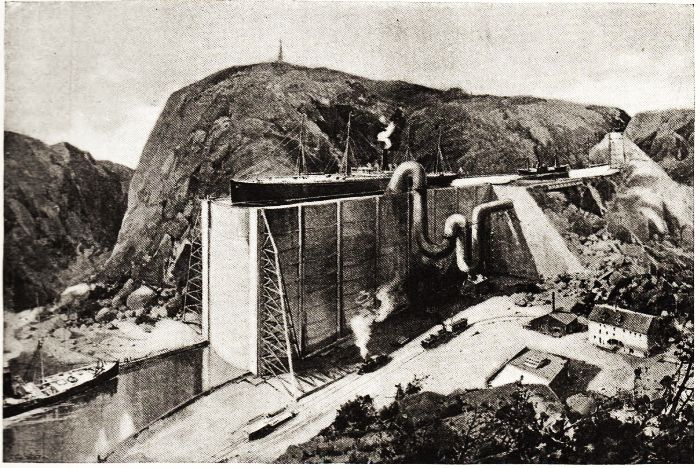
The canal lock of to-day is a very slow working affair, as we all know, and is such a clumsy piece of mechanism that only ships of a limited tonnage can pass through it. When a canal-boat comes along it is let into the first lock, and if that is on the higher level the gates are closed, and the water is allowed to run out until the boat is floating on a level equal to that in the other portion of the lock. Then the gates are opened, and the boat passes on. If it is necessary, on the other hand, to raise the vessel from the lower to the higher level, much more time has to be consumed in order to pump the lock full of water.
By Mr. Dutton's method, however, the vessel comes along the canal, and it may be as large a ship as an ocean freighter, and it may carry as great a cargo as 12,000 tons, and yet it can slip into one of the great steel tanks 510 feet long, and a boy can open the compressed-air valve, and let the great ship travel gently down the elevator shaft until it reaches the lower level of the canal. The operation requires perhaps fifteen minutes, instead of hours; and no more time is necessary for ships of equal tonnage going in the other direction, since a much greater weight of water can be run into the upper tank from the higher level of the canal than could be counterbalanced by any kind of steamship that would need to be lifted from the lower level.
A company has been organized to build a canal from the Atlantic to the Great Lakes, and it is its intention to use Mr. Dutton's locks along the way; not more than two or three will be necessary. But as it will cost about one hundred million dollars to carry out the enterprise, it may be some years before they will be able actually to begin work.
It is the belief of those interested in the construction of this great canal that there is no economy in cheap construction. Good results may only be obtained by good work. The Suez Canal, for example, is cheaply constructed; it is only 72 feet wide at the bottom, and large ships may pass one another only when one goes into a sort of siding, where it usually runs aground. The expense of getting ships out of the sand, since the traffic was first opened through the canal, has far surpassed the sum for which the canal could have been constructed so as to avoid such delays and accidents. Therefore it is proposed that any maritime canal to be built should be fully 250 feet wide, and 30 feet deep at least.
One of the great undertakings which would be connected with the construction of such a canal would be the reversion of the current of Lake Champlain, in order to deepen the water in the upper Hudson. This would be done by diverting a portion of the waters of the St. Lawrence River into Lake Champlain, and such a condition of affairs would develop at Waterford an immense water-power, nearly equal to one-third that of Niagara Falls. This water-power could be used for developing electric-power, and the canal could be illuminated with electric-light at night so as to make traffic almost as easy in the dark hours as in the daytime.
The effects of such an enterprise would be far-reaching. An open-water route from the Atlantic to Buffalo, Cleveland, Detroit, Chicago, and Milwaukee would make those great inland cities practically seaports, and therefore the people who live in those cities would be able to purchase all sorts of commodities more cheaply than they can now, because the charges of transportation by water directly from foreign countries would be much cheaper than it is now, when there has to be a transshipment of the goods on the coast, and transportation by rail, which is expensive. On the other hand, the people of those other cities would also be able to sell more of their own products, and to greater advantage to themselves, because they could deliver them in foreign countries more cheaply than they can now.