CARRIER-PIGEONS.
Reading edition
BY ANNE HELME.
In the middle of the square around which the Herald building is built in New York city is a carrier-pigeon house on a level with the roof. It is a square house, large enough for a good-sized play-house, and has a piazza, a porch fenced in with wire, where the birds can exercise until they have learned enough to be allowed to fly around the city, for pigeons require a great deal of exercise not only in flying, but in walking. Just notice the next time you see a flock of pigeons when they light on the ground, or on the roofs of buildings, how they walk up and down for a long time.
Great care is taken with the pigeons. Their pedigree is kept and they are all named. Then, too, a mark is stamped on their under wings, so there shall be no mistake, and by this means they have often been recovered and sent home when they have lost their bearings or have been stolen. The man whose duty it is to attend to them takes a personal interest in each and every bird.
THE INTERIOR OF THE PIGEONS' HOME.
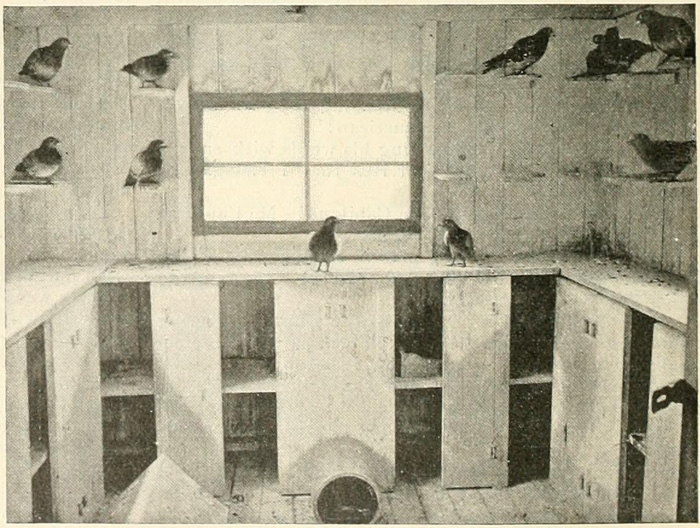
At night, when they come home, he looks to see that all are there, and to prevent any strangers from mixing with his own particular flock. Pigeons are very homelike in their tastes, and rarely does a day pass that several strange birds do not join them. They are fed chiefly on cracked corn, but they require more water than food—and water is absolutely necessary to their health and happiness. The amount they consume is almost incredible—more than double that of other birds.
Their home instinct, which is, of course, their distinguishing characteristic, is very marvellous. So strongly developed is it that it is impossible to keep the older birds away, and the gift of a pair of old birds is a very thankless one, as they will inevitably fly home the moment they are liberated, although they may be carried miles and miles away, and in a covered basket. The birds chosen to carry the messages from the yachts or steamers are sent down the Bay for several days, so that they may prove how swiftly they can fly back, and each day are liberated, and a record kept of the time they make in getting back to the office.
When a newspaper tug starts down the bay for the yacht-races which are taking place just now, one of the principal articles taken aboard is the big basket filled with carrier-pigeons, and each bird has a brass band on its foot. At different times during the race messages are written on the thinnest of paper and made into small parcels. These are attached to the band, and the birds thrown up into the air. A pair are usually sent off together, as they fly better, it is thought, in that way.
For a moment they wheel about apparently dazed, poise themselves for perhaps a second, and then fly straight for home.
On one of these races from half an hour to thirty-five minutes was the longest time taken from the moment they were thrown into the air until they arrived at their destination, and the messages were taken from their feet. It was a beautiful sight, and a wondrous one, to see these birds arrive. Curiously enough, in some instances they brought back with them strange pigeons who had joined them on the trip, evidently much interested to know the outcome of the yacht-race. The strange birds did not stay at the cote after nightfall, and apparently felt themselves quite out of place with pigeons of such intelligence.
It is now well proved that carrier-pigeons can be used to good purpose, for the news of the yachts was by their aid conveyed much sooner to headquarters than otherwise would have been possible, and the question is now being discussed as to whether it will not be advisable for all ocean steamships to carry them, so that if any vessel were disabled at sea, and, as has often happened, met with no other steamer, by their means word might be sent back to shore. An interesting article on this very subject was published recently in one of the daily papers, giving an account of an experiment that was tried and with great success. Five thousand pigeons were put on board the Manoubia, sailing from Saint Nazaire, and at distances varying from one hundred to five hundred miles were liberated.
CARRIER-PIGEONS COMING TO THEIR COTE.
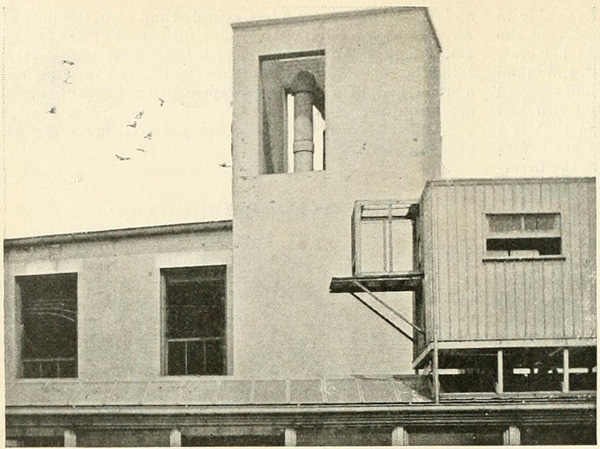
The results were beyond the most sanguine hopes, for within a shorter time than had been deemed possible they had all, almost without exception, returned to their pigeon-houses.
It would not mean a great addition, either in money or care, to have these birds on every ship that left the port, and certainly great good might be done and endless anxiety saved in many instances, if intelligence as to a disabled ship's whereabouts could reach her owners.
In order to make carrier-pigeons at home in any place they must be taken there very young. Even birds six weeks old will make their way back to the nest, the instant they are liberated, as distance is as nothing to them. One pair sent out to Wilmington, Delaware, were kept shut up for six weeks, fed and watered with the utmost care and regularity. The seventh week they were set free, and at once disappeared. Their owner telegraphed to their old home, and received an answer that the birds had arrived there before his telegram was received.
One pair of the pigeons, which were named Annie Rooney and McGinty, were given to a boy of eleven who lives in New York city. They were very young when they were given to him, and he determined to train them so that they would always make their home at his house. For six weeks he kept them in his room in a mocking-bird cage, and was very careful about the food and water. In the day-time he put the cage outside the window, and when it rained covered it with a cloth, for pigeons, while they use a great deal of water both to bathe in and to drink, do not like to be out in the rain.
When six weeks were passed he opened the cage door and fastened it so that the birds could go out. At first they were contented to poke their heads out of the open door, but finally, after a great deal of conversation (pigeons are great conversationalists), out they flew. They seemed hardly to know the use of their wings at first, and circled around in a dazed way, alighting on the top of a neighboring roof, where they apparently had again a great deal to say to each other. For twenty minutes they talked, then seemed to have made up their minds to try a long flight, for with one graceful swoop into the air, off they flew. Hours went by, and they did not return, and when it was nearly dark all hope was abandoned; but suddenly there was a whir of wings, and Annie Rooney came home. McGinty still was absent. Annie Rooney perched herself on her roost, every feather rumpled up most disconsolately, while the boy who owned them went to bed very low in his mind. At daylight next morning he was awakened by such a cooing as he had never heard before. Rushing to the window, there he saw McGinty, in the wildest excitement, and with his head almost buried in the little dish which held the drinking water.
McGINTY, ANNIE ROONEY, AND A GUEST.
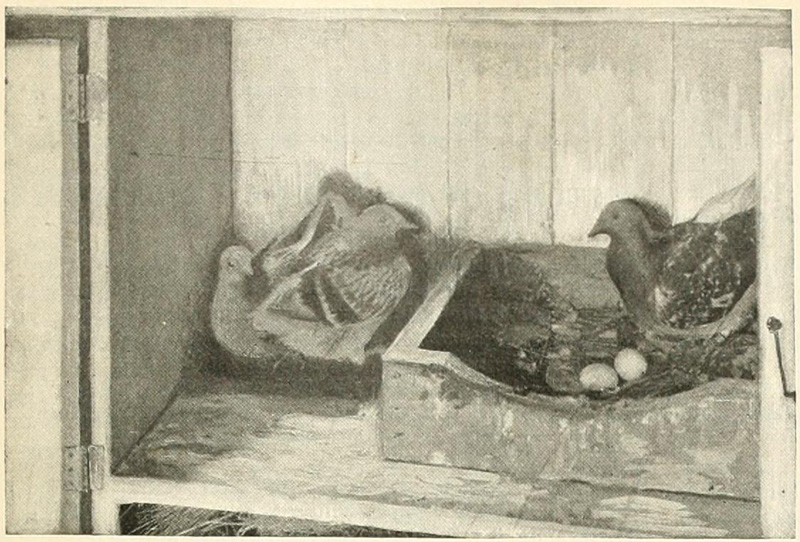
From that day the cage was left outside, and the door taken off, so that the birds might come and go as they chose.
Then, alas! began their troubles. So pleased were they with their little journey into the world that they at once set out to explore the houses near by, and every day a note was sent in from some neighbor to the effect: "Extremely sorry, but your pigeons fly into my bedroom and knock down all the ornaments." "Your birds insist upon walking up and down under my bed, making most unearthly sounds; I am afraid of birds and cannot stand having them in my house." "Again your birds have flown into my windows, and are in the children's doll-house. They refuse to come out, and make such a hideous noise as to alarm the children."
These three notes were only samples of others, and after a family conclave it was decided the pigeons must be sent away. Summer was coming on, and it was finally concluded the country was the best place for them.
Their owner took them in a covered basket to a farm on Long Island, where they were put into a pigeon-house, and provided with water and food. The next day they were apparently happy, so with many regrets they were told good-by, and the boy returned to town.
It was a long journey—some hours—and it was rather a sad-faced youth who mounted the steps and told his mother he had left his birds in the country. It was then six o'clock in the evening. At ten minutes past six there was a great fluttering of wings, and lo and behold, Annie Rooney and McGinty had returned, and prouder and happier pigeons never were seen.