Chapter X
Reading edition
Tommy stared for some minutes at the antics of the Ibexes, and then turned to the ex-Pirate.
"How very odd!" he remarked.
"Very," assented the other. "Aren't you beginning to feel sort of queer?"
"I don't notice any motion at all," replied Tommy.
"I don't mean that," said the ex-Pirate, looking reproachfully at the little boy. "But, personally, I am beginning to become affected by all these animals. I almost feel as though I could become a second Abou-Ben-Din."
"A second Abou-Ben-Din?"
"Yes," continued the ex-Pirate, scarcely noticing the interruption. "But I hardly think it would pay. I doubt if there are any other craft hereabouts."
"What are you mumbling about, anyway?" asked Tommy.
"I was not mumbling at all. I was thinking of Abou-Ben-Din. There was a pirate for you!"
"I never heard of Abou-Ben-Din," said Tommy. "I've read about Captain Kidd and the Dey of Algiers, and lots of others—but that's all."
"Well, if you had allowed me to read the first sixteen chapters of my autobiography," exclaimed the ex-Pirate, becoming somewhat excited, as he always did when the subject of his autobiography came up, "you would have known all about Abou-Ben-Din by this time. He was a Hindoo."
"But can't you tell me about him now, just as well?" pleaded the little boy, anxious to get another pirate story.
"I might," answered the ex-Pirate, meditatively. "I might. It is a favorite story of mine, but I don't think this is very good company to tell it in."
"Why is not it?"
But before the ex-Pirate could answer, the Lion arose and roared so fiercely that the rafters shook, and many of the birds fell from their perches.
"What does this mean?" he growled. "What does all this skylarking signify?"
"I'm not doing anything," put in the Skylark.
"Shut up," continued the Lion, even more fiercely. "This banquet has not been adjourned yet. Why are so many of you standing and running about? Everybody sit down! I want you to understand that this is a continuous performance—booked for forty days and forty nights—and if some one does not perform pretty soon, I'll take a hand in the entertainment myself!"
Everybody knew what that meant. There was only one kind of entertainment that the Lion knew anything about, and that was eating. He was very good at that, and he cast his eyes about on the smaller animals gathered at the board. But the warning was sufficient; there was a grand rush for seats again, and a general inclination to be entertaining was displayed by all. Tommy and his companions got their old places, but the Gopher was so frightened that he retained his seat with difficulty, and he trembled so that he was unable to keep his sun-bonnet on straight.
In the mean time the Lion was scowling and waiting for some one to volunteer. His eyes fell on the shaking Gopher, and he said, grimly,
"Don't you know another joke?"
The poor little animal almost fainted with fright, and for lack of a better inspiration he pointed at the ex-Pirate and gasped,
"He knows lots of things!"
And so the King of Beasts, who was rapidly losing patience, glared at the ex-Pirate and roared,
"Do something!"
The ex-Pirate hesitated; but Tommy, who was not feeling at all comfortable, whispered:
"Give them Abou-Ben-Din!"
"That's a pretty risky thing to do," answered his neighbor; "but I guess I shall have to. I can't think of anything else." And so he arose in his customary way, and bowing to all, announced that he would recite another selection from his autobiography entitled,
THE BALLAD OF ABOU-BEN-DIN.
Oh, there's many a tale that I like to tell, And many a yarn to spin, But there's none I love one-half so well As the story of Abou-Ben-Din. For Abou-Ben-Din was a terrible man, A blood-thirsty wretch through and through; A pirate on quite an original plan, And he captained a terrible crew. Not a man did he have on his swift-sailing craft, But a hundred and ten wild beasts, That snarled on the deck while Abou stood aft, And steered them toward movable feasts. For all day the brutes, with eyes opened wide, Would eagerly watch for a sail, And as soon as their vessel was brought alongside They would swarm like rats o'er the rail. Then after the lions and tigers had dined, Old Abou would visit the ship. To collect all the booty and goods he could find Then drive his beasts back with a whip. Thus it soon came to pass that the sailors were few Who would sail in the India Seas, Where Abou-Ben-Din and his man eating crew Were eager and ready to seize. But I was no coward, and none of my crew Had ever been known to show fear; So I said, "We will capture this nautical Zoo; Toward Abou-Ben-Din let us steer!" The men all agreed, and we started that day With cheering and waving of caps; And down in the hold I had hidden away A hundred and fifty steel traps. These were brought up on deck as soon as we spied Old Abou-Ben-Din and his ship, And were set and all covered with sawdust to hide The teeth that were ready to grip. Then the men went below and closed down the hatch, While I clambered up on the mast, Where, safe from the lions, 'twas easy to watch What happened from first to the last. Well, the pirate approached. He came alongside. And the beasts all scrambled aboard; And I never have heard such cries as they cried, Or such terrible roars as they roared. Each lion was caught, and he couldn't get free, Each trap held an animal fast; And the way that they struggled was fearful to see— And I saw it all from the mast. But Abou-Ben-Din merely gazed in dismay, And when he knew what had occurred, He plunged in the sea, and sank straightaway, Without ever speaking a word. Ay, there's many a tale that I like to tell, And many a yarn to spin, But there's none I love one-half so well As the story of Abou-Ben-Din!
There was a dead silence when the ex-Pirate finished his recital, and Tommy noticed that the lions and tigers were shifting about restlessly in their chairs. He turned quickly to the Gopher, and said in low tones,
"They don't seem to like it."
"I'm afraid it was a trifle personal," answered the Gopher.
"Perhaps we had better retire," suggested the ex-Pirate, prudently.
"Where can we go?" asked Tommy.
"You can go to the dogs," said the Gopher.
"You must not talk like that," observed Tommy, sharply. He had heard his Uncle Dick use that expression before, and it shocked him a little.
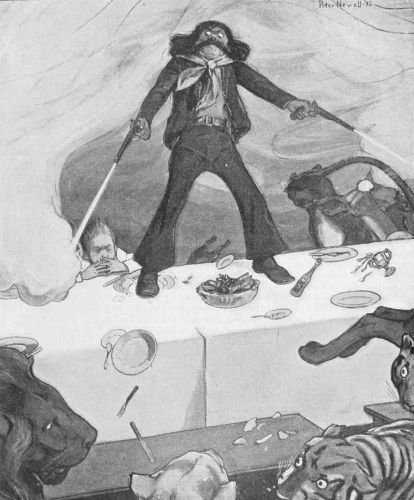
THE EX-PIRATE JUMPED UPON THE TABLE AND FIRED.
"Why not?" exclaimed the Gopher. "The dogs are all right, even if they are down below. They might be of some assistance to us if the lions get ugly."
"Oh!" exclaimed the little boy, but before he could say any more the Lion coughed very fiercely, and spoke to the ex-Pirate.
"How many lions and tigers did you say there were on board of that ship?"
"About a hundred and ten, I reckon," answered the ex-Pirate.
"One hundred and ten," repeated the Lion, slowly. "And you gathered them all in?"
"We did. Every single one." The ex-Pirate's recklessness staggered Tommy and the Gopher. Then the Lion growled:
"That being the case, I think I shall have to gather you in." And he arose, followed by the tigers, and began to approach the ex-Pirate and the little boy. The Gopher became so alarmed that he dropped under the table and was never seen again. Tommy was so scared that he could not move. But the ex-Pirate jumped upon the table, and drawing both his pistols from his belt, aimed them at the approaching beasts and fired.
The flash, the bang, and the smoke caused Tommy to close his eyes tightly for a second, and he felt as though his heart had leaped into his throat.
When he opened them again he was sitting on the window-seat in his own room, and his mother was standing in the doorway.
"You must not leave the door and the windows open at the same time, Tommy," she was saying. "That causes a draught and makes the door slam. Get ready for supper; it is nearly tea-time."
THE END.

The first meeting of the New York Interscholastic Athletic Association this fall will be held this afternoon at Wilson and Kellogg's School. Of the many questions that are to come up for discussion and settlement few can be of greater importance than that of the formation of a National Interscholastic Amateur Athletic Association, and I sincerely hope that a committee will be appointed to consider the best ways and means for carrying out the idea. I have already said all I can in favor of the scheme, and can only repeat now, at the last moment, that the formation of such an association will be of the greatest benefit to scholastic track and field sports, and that if the New York association fails to seize the opportunity it now has for making history, in its own sphere, such a chance may never present itself again. In fact, I hear on excellent authority that the New England League, upon the advice of a number of Harvard graduates who still retain a lively interest in school sports, is seriously considering the advisability of having the initial move in the formation of a National Interscholastic League emanate from Boston.
At the meeting of the High-School Athletic Association in Worcester a week ago the important question as to whether the Worcester High-School should secede from the New England I.S.A.A. was not settled owing to lack of time for a proper debate on the subject. It will probably come before the newly elected board of directors for consideration, although many think a question of so much importance should be brought before the entire association. There seems to be considerable feeling over the matter, but such a serious step should by no means be taken unless the W.H.-S. athletes are absolutely persuaded that it is for their own best interests, and for the best interest of interscholastic sport.
The point at issue is this: Last winter an attempt was made to have the New England I.S.A.A. vote to divide the two schools, and split up the points won at the recent games, on the ground that they were two schools, and should be considered such by the I.S.A.A. The W.H.-S. athletes naturally combated the suggestion (which they are persuaded emanated from their rival, the Worcester Academy), and presented some strong arguments in defence of their position. The principal reasons advanced for opposing the plan were that the two schools had but one alumni association, one football and baseball team, and in their field day competed class against class rather than school against school. The students made such a good fight, that when the N.E.I.S.A.A. finally met the motion to consider the Worcester High-Schools as two institutions, and to divide the points accordingly, was lost.
But, following upon this decision, the W.H.-S. team went down to Cambridge in June, and not only won the championship at the Interscholastics, but scored twice as many points as any two other schools in the association put together. As a result of this the pro-division feeling at other schools increased, and the W.H.-S. students now fear the association may vote a separation of athletic interests. Fearing this, there is a strong sentiment in favor of withdrawing from the association before any such action can be taken. This seems unwise, for there is no strong reason to believe that the I.S.A.A. will take any such action.
The secession of the Worcester H.-S. would be a serious loss to the league, for it is one of its largest members and one of the strongest in athletics. Another reason why W.H.-S. ought not to withdraw is the possibility of Andover and Worcester Academy making an arrangement for annual dual games—such as they held last year—and leaving the N.E.I.S.A.A. for that reason. This would not be sufficient cause for so doing, but there is talk of it both at Andover and in the Academy. With the loss of these three schools the association would not be so representative of the New England schools as it is now, and the cause of scholastic athletics could not fail to be injured. I hope there is more smoke than fire here.
It is good news from California that the bicyclists of the Academic Athletic League are working for the formation of an association separate from track and field interests. If the move is successful it will rid the latter sports of an event that never really belonged among them, and, in addition, it will undoubtedly be of benefit to bicycle-racing, which, if reasonably and properly conducted, should be encouraged. The Oakland High-School already has what they call a "cycling annex" to their regular athletic association—a branch of the latter for the promotion of bicycling, and for the management of bicycle races. This annex has proved an excellent institution, and has served to develop remarkable speed in some of its members, as these records will show:
Distance.Time.Holder.
1/8 mile, flying start, unpaced13-3/4sec.Colby.
1/4 mile, flying start, unpaced30-1/5sec.Gooch.
1/4 mile, standing start, unpaced34-3/4sec.Childs.
1/2 mile, standing start, unpaced1min.7sec.Gooch.
1 mile, standing start, competition2min.18-1/2sec.Gooch.
2 miles, standing start, paced5min.12sec.Kenna.
5 miles, standing start, competition, road race13min.20sec.Gooch.
5 miles, standing start, paced14min.19sec.Kurtz.
At the meeting of the Reliance Athletic Club, September 7th, Gooch rode third in the mile, Class A. The winning time was 2 min. 18 sec, and the O.H.-S. rider was only the length of his bicycle behind. On September 9th he rode third to 2 min. 14-1/2 sec. in the Class A mile at San José. The winner of both these races was an A.A.L. rider—Squires of the Berkeley Gymnasium, who was second in the half, Class A, at San José, when a world's record was made. The records of the O.H.-S., as given above, were made on the Oakland Race Track, which is 100 yards short of a mile in circuit, and has a straightaway quarter.
Football in the New York schools is slow in getting a start this fall. Almost every other scholastic league is hard at work in the field, but as yet scarcely any of the school teams hereabouts have done any work. On Long Island a little more activity is being shown, but not much. The slight start they have over the New-Yorkers, however, will be of benefit to them, and it is not rash to prophesy, even at such an early date, that the Inter-City championship in football will go across the river, as the baseball championship did this spring, unless the Manhattanites display an unusual degree of energy between now and November.
Reference to the Inter-City game suggests that in view of the three sets of football rules in vogue this fall, it will be advisable for committees from the N.Y.I.S.F.B.A. and from the L.I.I.S.F.B.A., to meet at as early a date as possible to determine which set of regulations these two leagues will adopt. For it stands to reason that if they are to play a match in November they must sooner or later come to an understanding on the subject of the laws that are to govern the contest. There ought to be no difficulty about this, the only important point being that the decision should be reached at once so that every school eleven may get into practice, and learn to play the game that is to be required of them later.
The absurdity of having three different sets of rules has already manifested itself among the colleges. Before the game between Harvard and Dartmouth, which was played ten days ago, the Captains of the respective teams had to meet and powwow over what methods should hold good in the contest. Of course, Captain Brewer wanted to play according to the Harvard-Cornell-Pennsylvania scheme, but Dartmouth, having a Yale coach, preferred the Yale-Princeton system. This difficulty will doubtless crop up previous to every game played by one of the five law-making colleges with the other colleges who had no say about the revision. It is impossible, of course, for all the scholastic leagues of this section of the United States to get together and agree on uniformity of rules, and this is unnecessary; but I strongly urge neighboring schools to reach some sort of an understanding, or there will be no end of squabbles as the season advances.
Of early games in New England, Exeter was badly defeated by Dartmouth College, Andover succumbed to the Boston Latin School, and a few days afterward the B.L.S. players disposed of the Charlestown High-School to the tune of 16-4. B.L.S. has a strong team this year, beyond question. The Charlestown players were confident of winning before the contest began, but at no stage of the game did they stand the slightest chance of success. Captain Maguire, of B.L.S., did excellent work all through the two halves. He made several long runs by good dodging and fast sprinting, punted finely, and tackled hard. Teevens found the centre weak, and banged away at it for a number of good gains. Lowe and Nagle, too, showed up well by breaking through on the runner repeatedly, and making holes large enough for the entire team to get through. Ramsey was easily the best man on the Charlestown High, making all the large gains, and being pushed over the line for the only touch-down. Curley put up a good game at quarter, making some fine tackles, and running the team in good shape. Better arrangements should be made in the future to keep enthusiastic spectators off the field. This is an old-time fault of games between schools. The management of the home team should always consider itself responsible for the policing of the field.
The most important game of the New England series, next to the final championship contest, was played at Brookline, Friday, to determine whether Brookline High or Newtown High should be the sixth member of the Senior League. As was partially anticipated in these columns last week, victory went to Brookline; but Newton High's defeat was much worse than I had supposed it would be. The score was 22-0, and this showing was due much more to Brookline's steady preliminary work than to any great discrepancy in the make-up of the two elevens. As a spectacle the game was well worth watching, and the manager of the B.H.-S.F.B.A. saw to it that the field was kept clear.
The weakest point in the B.H.-S. line was at right guard, and the Newton Captain soon discovered this, and sent his men cavorting into Talbot with good effect. Almost all of Newton's gains were made through here. Brookline, on the other hand, did not play much for centre, but managed to get around the opposing ends pretty frequently, the last two touch-downs being made in this way. Good individual plays were made by Cook, Aechtier, Seaver, and Morse for B.H.-S., the first-named doing some especially brilliant punting. For Newton the best work was done by Cotting, Lee, and Forsen.
Newton fumbled a good deal during the game, and many of their losses were due to this inability to keep their hands on the ball. At times, however, Lee's men seemed to be able to brace, making strong resistance at critical moments. B.H.-S.'s second touch-down was only secured after a stubborn fight. The ball had been rushed down to Newton's five-yard line, when the N.H.-S men gathered themselves well together and held their opponents for four downs. But this did them small service eventually, because of their woeful fumbling. In the very first rush following the four downs the Newton runner dropped the ball, and Seaver fell on it. In a few moments the second touch-down was scored. If Newton had only persisted a little longer in bucking the centre during the second half, I feel confident they could have scored.
The Cambridge Manual Training-School defeated Somerville High again last week, and put up some good football. Somerville was unable to score, although they played hard at times, especially in the second half, when they got the ball within four yards of the opponents' goal. The best ground-gainer for Cambridge was White, who also did some hard tackling. Thompson got around the ends well and interfered effectively, and Captain Murphy did some excellent rush-line work, making most of the holes through which he shot his men. Sawin showed himself a level-headed quarter-back, and will doubtless fill that position for the rest of the year.
Somerville High's play was very loose at times, and the men seemed to choose the most critical moments of the game to do their fumbling. There was a noticeable lack of team play, which must be remedied at once if Somerville hopes to do anything in the championship series later on. The backs did not interfere for each other, except on rare occasions, and the C.M.T.-S. forwards had an easy time of it bringing down the runner. It looks to me as if there was too much of a desire on the part of these Somerville backs to shine by brilliant, individual work. That is a fatal ambition, and if it exists should be killed by the captain at once. Football to-day is a game for team-work, and the star player is a very rare bird indeed. In the first half S.H.-S. had the ball only at the kick-off and after touch-downs. They did not seem able to hold it. In the second half they did better, and, as I said, at one time were within threatening proximity to the C.M.T.-S. line; but there is much room for improvement with the Somerville men. Good coaching is what they need.
It was a hot game that was played September 28th between Groton and the Boston English High-School. For the first time in the history of the sport, Groton met defeat at the hands of a Boston Preparatory School. The Boston team played a great game throughout, and won by their strength of line, which was impregnable for the Groton backs. In the first half E.H.-S. had the ball most of the time. Groton got it but twice, only to lose it immediately on downs. The E.H.-S. players were lighter, but their team-work was much superior to that of Groton. Callahan, Whittemore, Ellsworth, Higgins, and Murphy played an extremely hard game, and the others' work was very steady. The touch-down was made in the first half. In the second E.H.-S. had the ball most of the time, but could not score.
The championship schedule for the Senior League of the New England Interscholastic Football Association was made out last week at a meeting of the Captains held at the B.A.A., and the games will be played as follows:
English High—Oct. 29, Brookline High at South End grounds; Nov. 12, Hopkinson at South End grounds; Nov. 15, Cambridge High and Latin at South End; Nov. 22, C.M.T.-S. (grounds undecided); Nov. 28, Boston Latin at South End.
Brookline High—Oct. 29, English High at South End: Nov. 4, Cambridge High and Latin at Brookline Common: Nov. 8, Cambridge Manual at Soldiers' Field; Nov. 22, Boston Latin at Brookline Common; Nov. 27, Hopkinson at Brookline Common.
Hopkinson—Nov. 1, Cambridge Manual at Soldiers' Field: Nov. 8, Cambridge High and Latin at Soldiers' Field; Nov. 12, English High at South End; Nov. 18, Boston Latin at Soldiers' Field; Nov. 27, Brookline High at Brookline Common.
Cambridge High and Latin—Oct. 20, Cambridge Manual at Soldiers' Field; Nov. 4, Brookline High at Brookline Common; Nov. 8, Hopkinson at Soldiers' Field; Nov. 12, Boston Latin (grounds undecided); Nov. 15, English High at South End.
Cambridge Manual—Oct. 29, Cambridge High and Latin at Soldiers' Field; Nov. 1, Hopkinson at Soldiers' Field; Nov. 8, Brookline High at Soldiers' Field; Nov. 15, Boston Latin at Soldiers' Field; Nov. 22, English High (grounds undecided).
Boston Latin—Nov. 12, Cambridge High and Latin at South End grounds; Nov. 15, Cambridge Manual at Soldiers' Field; Nov. 18, Hopkinson at South End grounds; Nov. 22, Brookline at Brookline Common; Nov. 28, English High at South End grounds.
The Junior League schedule was not made up, because of absentees among the representatives, but it has doubtless been arranged by this time. The number of games will be greater this year than before, and as a matter of interesting record this table of matches played since the organization of the League is here given:
T
o
u
GcS
oha
adf
loe
swtT
GniTo
foseot
rasta
olfal
msabl
iyP
TflPoG
oriooiGa
uonpinam
cmgpntme
hotses
dfGnss
oioell
weanwowo
nlltosos
Teams.sdssntnt
1888.
Cambridge H. and L.20..4..136...60
Boston Latin12..17..1401551
Roxbury Latin10..11665642
English High2..2..207823
Stone, Nichols, and Hales4..51465213
Hopkinsons1..3..1812615
Nobles..11..910805
1889.
Cambridge H. and L.1136..1051630
English High3..7..463221
Boston Latin7..4..582022
Roxbury Latin4......246822
Hopkinsons1......610304
1890.
Cambridge H. and L.10..8..913551
English High10..7..882641
Hopkinsons7..8..745232
Manual Training614..57481[1]3
Roxbury Latin5..51528014
Boston Latin..........12204[2]
1891.
Hopkinsons17..7..130440
Manual Training915..795622
English High2..12..604822
Boston Latin4..2..325822
Cambridge H. and L...........13504
1892.
Hopkinsons12..4..88840
Manual Training2..3..243411[3]
English High5..4..465221[4]
Cambridge H. and L.1..1..103412[5]
Boston Latin2..1..165604
1893.
Manual Training19..5..134284[8]1
Boston Latin3..3..306823
Newton High10..3..728823
Cambridge H. and L.5..1..347812[9]
Hopkinsons5..6..545404[10]
1894.
Manual Training9..5..74..40
English High11..2..682632
Cambridge H. and L.2..1..169823
Hopkinsons5..3..421623
Boston Latin3..1..223223
Newton High1..2..145813
St. Mark's has six of last year's men back in school, and a number of promising candidates. Several minor games have been played, but the chief matches will be with Andover next week, and with Groton, November 9th. At the present writing Groton has the better eleven, but the St. Mark's players are working hard under good coaching and will improve.
The Graduate.