BATTLE OF LAKE CHAMPLAIN.
Reading edition
BY JAMES BARNES.
The first Thomas Macdonough was a Major in the Continental army, and his three sons also possessed desires for entering the service of their country. The oldest had been a midshipman under Commodore Truxton, but being wounded in the action between the Constellation and L'Insurgent, he had to retire from the navy, owing to the amputation of his leg. But his younger brother, Thomas Macdonough, Jun., succeeded him, and he has rendered his name and that of Lake Champlain inseparable; but his fearlessness and bravery were shown on many occasions long before he was ordered to the Lakes.
In 1806 he was First Lieutenant of the Siren, a little sloop-of-war in the Mediterranean service. On one occasion when Captain Smith, the commander of the Siren, had gone on shore, young Lieutenant Macdonough saw a boat from a British frigate lying in the harbor row up to an American brig a short distance off, and afterwards put out again with one more man in her than she had originally. This looked suspicious, and Macdonough sent to the brig to ascertain the reason, with the result that he found that an American had been impressed by the English Captain's orders. Macdonough quietly lowered his own boat, and put after the heavy cutter, which he soon overhauled. Although he had but four men with him, he took the man out of the cutter and brought him on board the Siren. When the English Captain heard, or rather saw, what had occurred—it was right under the bow of his frigate that the affair took place—he waxed wroth, and, calling away his gig, he rowed to the Siren to demand an explanation.
The following account of the incident is quoted from the life of Macdonough in Frost's Naval Biography:
"The Englishman desired to know how Macdonough dared to take a man from one of his Majesty's boats. The Lieutenant, with great politeness, asked him down into the cabin; this he refused, at the same time repeating the same demand, with abundance of threats. The Englishman threw out some threats that he would take the man by force, and said he would haul the frigate alongside the Siren for that purpose. To this Macdonough replied that he supposed his ship could sink the Siren, but as long as she could swim he should keep the man. The English Captain said to Macdonough:
"'You are a very young man, and a very indiscreet young man. Suppose I had been in the boat—what would you have done?'
"'I would have taken the man or lost my life.'
"'What, sir! would you attempt to stop me, if I were now to attempt to impress men from that brig?'
"'I would; and to convince yourself I would, you have only to make the attempt.'
"On this the Englishman went on board his ship, and shortly afterwards was seen bearing down in her in the direction of the American vessel. Macdonough ordered his boat manned and armed, got into her himself, and was in readiness for pursuit. The Englishman took a circuit around the American brig, and returned again to the frigate. When Captain Smith came on board he justified the conduct of Macdonough, and declared his intention to protect the American seaman."
Although Macdonough was very young, and his rank but that of a Lieutenant, people who knew him were not surprised to hear that he had been appointed to take command of the little squadron on Lake Champlain. These vessels were built of green pine, and almost without exception constructed in a hurried fashion. They had to be of light draught, and yet, odd to relate, their general model was the same as that of ships that were expected to meet storms and high seas.
Macdonough was just the man for the place; as in the case of Perry, he had a superb self-reliance, and was eager to meet the enemy.
Lake Champlain and the country that surrounds it were considered of great importance by the English, and, descending from Canada, large bodies of troops poured into New York State. But the American government had, long before the war was fairly started, recognized the advantage of keeping the water communications on the northern frontier. The English began to build vessels on the upper part of the lake, and the small force of ships belonging to the Americans was increased as fast as possible. It was a race to see which could prepare the better fleet in the shorter space of time.
In the fall of the year 1814 the English had one fair-sized frigate, the Confiance, mounting 39 guns; a brig, the Linnet; a sloop, Chubb, and the sloop Finch; besides which they possessed thirteen large galleys aggregating 18 guns. In all, therefore, the English fleet mounted 95 guns. The Americans had the Saratoga, sloop-of-war, 26 guns; the Eagle, 20; the Ticonderoga, 17; the Preble, 7; and ten galleys carrying 16 guns; their total armament was nine guns less than the British.
By the first week in September Sir George Prevost had organized his forces, and started at the head of fourteen thousand men to the southward. It was his intention to dislodge General Macomb, who was stationed at Plattsburg, where considerable fortifications had been erected. A great deal of the militia force had been drawn down the State to the city of New York, owing to the fears then entertained that the British intended to make an attack upon the city from their fleet. It was Sir George's plan to destroy forever the power of the Americans upon the lake, and for that reason it was necessary to capture the naval force which had been for some time under the command of Macdonough. The English leader arranged a plan with Captain Downie, who was at the head of the squadron, that simultaneous attacks should be made by water and land. At eight o'clock on the morning of September 11 news was brought to Lieutenant Macdonough that the enemy was approaching. As his own vessels were in a good position to repel the attack, he decided to remain at anchor, and await the onslaught in a line formation. In about an hour the enemy had come within gunshot distance, and formed a line of his own parallel with that of the Americans. There was little or no breeze, and consequently small chance for manœuvring. The Confiance evidently claimed the honor of exchanging broadsides with the Saratoga. The Linnet stopped opposite the Eagle, and the galleys rowed in and began to fire at the Ticonderoga and the Preble.
THE BATTLE OF LAKE CHAMPLAIN.—"SARATOGA" RAKING "CONFIANCE."
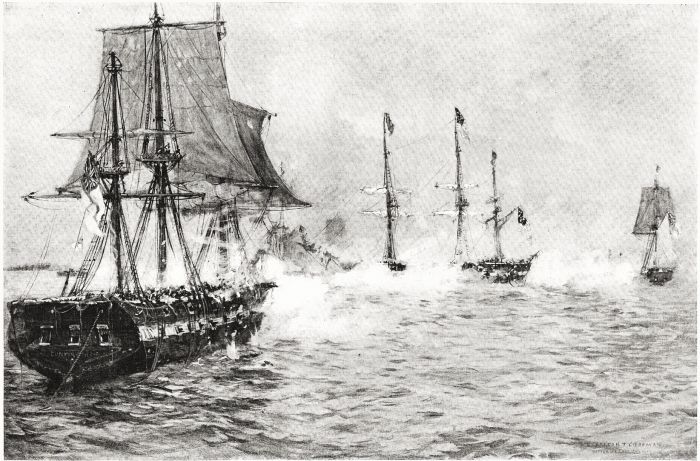
Macdonough wrote such a clear and concise account of the action that it is best to quote from it:
".... The whole force on both sides became engaged, the Saratoga suffering much from the heavy fire of the Confiance. I could perceive at the same time, however, that our fire was very destructive to her. The Ticonderoga, Lieutenant-Commandant Cassin, gallantly sustained her full share of the action. At half past ten the Eagle, not being able to bring her guns to bear, cut her cable, and anchored in a more eligible position, between my ship and the Ticonderoga, where she very much annoyed the enemy, but unfortunately leaving me exposed to a galling fire from the enemy's brig.
"Our guns on the starboard side being nearly all dismounted or unmanageable, a stern anchor was let go, the bower-cable cut, and the ship winded with a fresh broadside on the enemy's ship, which soon after surrendered. Our broadside was then sprung to bear on the brig, which struck about fifteen minutes afterwards. The sloop which was opposed to the Eagle had struck some time before, and drifted down the line. The sloop which was with their galleys had also struck. Three of their galleys are said to be sunk; the others pulled off. Our galleys were about obeying with alacrity the signal to follow them, when all the vessels were reported to me to be in a sinking state. It then became necessary to annul the signal to the galleys, and order their men to the pumps. I could only look at the enemy's galleys going off in a shattered condition; for there was not a mast in either squadron that could stand to make sail on. The lower rigging, being nearly all shot away, hung down as though it had just been placed over the mastheads.
"The Saratoga had fifty-nine round shot in her hull; the Confiance one hundred and five. The enemy's shot passed principally just over our heads, as there were not twenty whole hammocks in the nettings at the close of the action, which lasted, without intermission, two hours and twenty minutes.
"The absence and sickness of Lieutenant Raymond Perry left me without the assistance of that able officer. Much ought fairly to be attributed to him for his great care and attention in disciplining the ship's crew, as her First Lieutenant. His place was filled by a gallant young officer, Lieutenant Peter Gamble, who, I regret to inform you, was killed early in the action."
The English had begun the action as if they never doubted the result being to their advantage, and before taking up their positions in the line parallel to Macdonough's Downie had sailed upon the waiting fleet bows on; thus most of his vessels had been severely raked before they were able to return the fire. As soon as Sir George Prevost saw the results of the action out on the water, he gave up all idea of conquest, and began the retreat that left New York free to breathe again. The frontier was saved. The hills and the shores of the lake had been crowded with multitudes of farmers, and the two armies encamped on shore had stopped their own preparations and fighting to watch.
Sir George Prevost had bombarded the American forts from the opposite side of the river Saranac, and a brigade endeavored to ford the river with the intention of attacking the rear of General Macomb's position. However, they got lost in the woods, and were recalled by a mounted messenger just in time to hear the cheers and shouts of victory arise from all about them.
In the battle the Saratoga had twenty-eight men killed and twenty-nine wounded, more than a quarter of her entire crew; the Eagle lost thirteen killed and twenty wounded; the Ticonderoga, six killed and six wounded; the Preble, two killed; and the galleys, three killed and three wounded. The Saratoga was hulled fifty-five times, and had caught on fire twice from the hot shot fired by the Confiance. The latter vessel was reported to have lost forty-one killed outright and eighty-three wounded. In all, the British loss was eighty-four killed and one hundred and ten wounded.
Macdonough received substantial testimonials of gratitude from the country at large, the Legislature of New York giving him one thousand acres of land, and the State of Vermont two hundred. Besides this, the corporations of Albany and New York city made him the present of a valuable lot, and from his old command in the Mediterranean he received a handsome presentation sword.
An English journalist travelling through the United States relates a humorous incident in his experience out West. He was journeying overland on horseback, and one day, after a long spell of desolate travel, he espied a house on the prairie. He rode up to the doorway and accosted the only person around, a long gentleman in boots, these boots seemingly trying to reach the sky, they were perched so high above the owner's head. They came slowly down at the salutation.
"Howdy do, stranger? Glad ter see yer. This is Boonville," and with a sweeping gesture he compassed a landscape of grass and wooden stakes. "There's Broadway runnin' down 'tween them stakes, and there's Chicago Avenue, St. Louis Avenue, St. Paul Avenue, and all them are streets staked off'n it. On the lookout for a buildin' site?"
"No," replied the journalist; "I'm just travelling for pleasure, not for investment."
"That's my luck, stranger. Here's this town been er-runnin' full blast with all the offices filled, and I can't get a citizen."
"Where's the Mayor?"
"I'm the Mayor."
"Where are the police, judges, and that sort of thing?"
"I'm all that. Yer see, stranger, I'm everything. I elects myself to all offices; but it's mighty poor payin' ones I'm er-holdin'."
"How do you manage to get along, then?"
"Don't, stranger; that's the puzzle. Yer see, there's only fifty cents in the town treasury, and I've been payin' my rent and taxes with it, and collecting my salary as Mayor and all my other offices from it so long and it's been handled so much that the town books won't balance any more. Yer see, I can't find anything to balance the books with fur the wear of the silver off that coin, and I'm out that much. Now, stranger, if yer not goin' ter invest, and want ter boom the town er little, yer might make up that deficit in the treasury, so's I kin balance them books, and make things square for the next Mayor."