SHARK-CATCHING IN MID-OCEAN.
Reading edition
BY A. J. KENEALY.
The Rajah made good progress south, the northeast trades blowing her thither swiftly. We were fast approaching the belt of calms, squalls, rain, and variable winds known to sailors as the "doldrums."
The skipper had four coops of fat ducks which he tended with loving care. He just doted on them stuffed with sage and onions, and while they were being roasted he used to hang about the galley enjoying the savory odors that escaped from the oven. One morning while it was raining as though the gates of heaven had been opened wide the Captain thought he would give his pets a treat. The ship was heeling over considerably, being close-hauled on the starboard tack, with all her flying kites dowsed to the puffy breeze. He ordered the lee scuppers to be plugged up, and as soon as a sufficiently large pool had collected on deck, he liberated the ducks so that they might enjoy the luxury of a fresh-water bath. The ducks were delighted, and demonstrated their joy by noisy quacks. The pigs in the pens forward responded with joyous squeaks. The cocks and hens in the long-boat joined in with a merry chorus of crows and cackles. The combined music was that of a barn-yard.
AWAY WENT A DOZEN OF THE DUCKS INTO THE SEA.
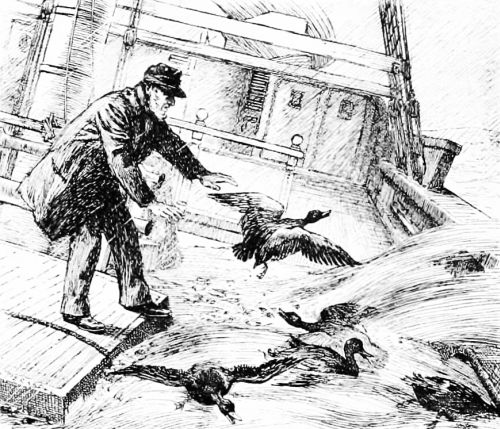
The ship heeled over until the scuppers were awash. The weight of all the fresh water on deck as the ship inclined to the squall and rose on the next wave was thrown against a lee port aft near which the ducks were disporting themselves. Now it happened that the lashing of this port was only of spun-yarn, rotten at that. The wash of the water against the port parted the lashing, swung the port wide open, and away went a dozen of the ducks into the sea with a great whir of wings and clamorous cackling.
One of the sailors closed and secured the port before any more of the birds escaped. Then the rest of the watch came aft, running helter-skelter at the hurried hail of the mate, and drove the rest of the flock into their pen. Had there been the slightest chance of capturing the runaways the Captain would have backed the main-topsail, hove the ship to, and lowered the quarter-boat.
Meanwhile the wind had died out. The sails flapped lazily against the mast, and the ship rolled sluggishly on the heaving bosom of old ocean. The clouds rolled away, and the pitiless burning sun shone down on the deck and dried up all the moisture on wood and rope in a few minutes. It was one of those sudden meteorological changes so common in equatorial latitudes. An awning was rigged up over the man at the wheel. The skipper put on a huge topee, or Indian pith helmet, to shelter his head from the sweltering rays which made the pitch boil and bubble up in the seams of the main-deck, and promised plenty of work for the carpenter's calking-irons.
The ducks, obeying a sort of homing instinct, I suppose, swam up to the now almost motionless ship, and continued their sport nearly within a stone's throw. Suddenly a bright idea struck the skipper.
"See the lee quarter-boat clear for lowering!" he shouted to the second mate. Then he put his head down the cabin skylight and ordered the steward to bring up his breech-loader and a lot of cartridges. The boat was lowered and manned. A side ladder was rigged; the Captain with his gun descended and took up a position in the bow, from which he directed operations. The cockswain seized the tiller-ropes. "Shove off let fall give way!" he cried, all in one breath, without any regard to punctuation, so excited was he, and in such a hurry to get within gunshot of the ducks. If he could not catch them alive, he meant to have them dead.
The boat was headed for the flock. When within easy range the skipper let them have it right and left. His aim was so good that he brought down three. It took some time to pick them up, which gave the scared flock an opportunity to get out of gunshot. None others, as it happened, were fated to fall victims to the deadly breech-loader of our sportsman-skipper. The dorsal fins of six sharks were observed sticking up above the surface of the water, and converging from different directions on the doomed ducks. Sharks are abundant in equatorial waters, and they follow ships for miles. Some of them are very large. All are voracious and ugly customers to tackle.
The way those sharks gobbled up those ducks was a sight to behold. They were disposed of in three minutes. The Captain was terribly angry. He tried to revenge himself by peppering the sharks with shot, but it is doubtful if the leaden pellets made the slightest impression on their tough hides, even if he succeeded in hitting them.
The boat pulled back to the ship, and was hoisted to the davits. The calm continued. Four of the sharks came up alongside, eager for more ducks. Such appetizing fare was seldom theirs. Stray garbage from passing ships, flotsam from the forecastle, composed the diet upon which they usually depended in addition to their steady prey of fish. The Captain brooded over the loss of his ducks for some time. Then he made up his mind to have a little shark-fishing, and thus combine revenge and recreation.
He sent below for a brand-new shark-hook with a sharp and cruel barb. To the ring of the hook was attached a stout chain a fathom long. A shark's teeth are so sharp and strong that they can bite through the stoutest rope with singular ease. To the end of the chain the skipper bent on a two-and-a-half-inch manilla line, and having impaled a four-pound piece of pork on the hook, hove it overboard, with the remark that he intended to have a slice of fresh shark for supper.
The sharks were playing about the rudder on the lookout for any stray trifles that might come along their way from a sailor down to a beef bone. They are not at all fastidious or dainty. It was my first experience of shark-fishing, and I was a keen and interested observer. The water was so clear that I could watch every motion of the four monsters as they swam slowly about, each one attended by his own particular body-guard of pilot-fish—pretty little creatures shaped something like perch, with blue vertical stripes. Ichthyologists declare that these fish attend the shark for the purpose of preying upon the parasites that infest him. This may be a true explanation, but I cannot understand how it is that a hungry deep-sea shark, that will snap up anything living or dead, permits these plump little fish to play unscathed about his enormous jaws. There are other curious things about these pilot-fish that naturalists cannot explain. They only attach themselves to the pelagic species found in deep water; there are always five or seven of them to each shark, never an even number; they stick to the shark while he is floundering about in the water with a hook through his jaws, but as soon as he is hoisted above the surface of the sea they immediately disappear. Nobody knows what becomes of them.
I have had several good opportunities of studying the habits of sharks, and have always been curious about them. As a matter of fact, very little is known concerning the ocean variety, which is quite distinct from that of the shore.
No sooner had the pork plashed into the sea than one of the rapacious monsters made a rush for it. The remarkable velocity of this fish was surprising to me, who had never before seen a deep-sea shark in his native element. The water was so beautifully limpid that his every action could be accurately observed. I thought he would gorge the bait immediately, but he did not. When he came up with it, he made a sudden stop. Then he sniffed at it with an air of expectant and suspicious curiosity. The next thing he did was to turn his tail to it contemptuously, and swim away a considerable distance.
"WATCH HIM MAKE A DART FOR IT NOW," SAID THE SKIPPER.
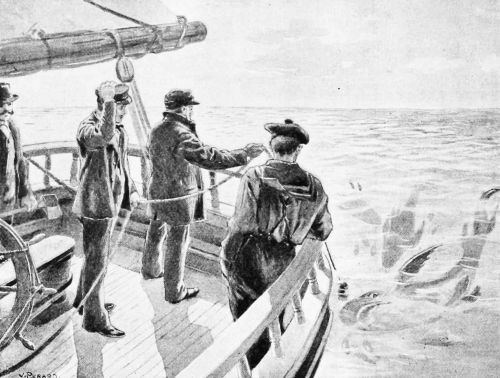
"Watch him make a dart for it now," said the skipper, who was an old hand at shark-catching.
Like a flash the hungry fish went for the tempting bait, turning over so that he might grasp it more conveniently with his wide and cruel jaws. In an instant it was engulfed in his maw. And then there was such a floundering and threshing in the water as I had never before seen. The fierce shark, maddened with the pain of the sharp hook, made frantic but fruitless efforts to escape. He snapped savagely at the strong chain attached to the hook, with the sole result of damaging his own cruel-looking teeth. Meanwhile the fish had been dragged forward to the starboard gangway in spite of his wild struggles. A running bowline was sent down the line that held him, and as the shark was hoisted over the side it was passed over his body and hauled taut round his tail, in order to control the movements of this his most formidable weapon. Instances have been known of a blow from a shark's tail breaking a man's leg on the deck of a vessel immediately after being hauled in over the side.
This fish in question was gigantic. It took eight men to hoist him in-board. "Chips," the carpenter, stood by with a keen axe, and as soon as Mr. Shark's struggling carcass was landed on the deck, with one powerful blow he severed his tail from his body, and thus incapacitated him from mischief. From time immemorial it has been the ship carpenter's privilege and duty to out off the tails of all sharks captured during a deep-sea voyage, and the cook generally despatches him much after the fashion of a Japanese when he performs on himself the queer right of hari-kari.
"Chips," said the skipper, addressing the carpenter, "before you cut that shark up, just pull that rule out of your pocket and measure him. He seems quite a big fellow."
And a big fellow he proved to be, measuring 30 feet 8½ inches long. The Captain said he was the largest one he had ever seen, but the chief mate declared he had once captured one that measured 38 feet, and he had sailed with a skipper who had hauled one in-board that was fully 40 feet in length. As a matter of fact, specimens of pelagic sharks are displayed in museums that exceed 40 feet, but they are very rare. In Florida varieties of fossil sharks have been dug up whose length "over all" averages more than 50 feet, but these are now happily extinct.
Seafaring men are not as a rule a bloodthirsty race, but they look upon sharks as their natural enemies, and against them they wage relentless warfare; and whenever one is hooked they rejoice with an exuberant pleasure, and will sacrifice their watch below in order to see him cut and carved. There is also much curiosity with regard to the contents of his interior. I once had for a shipmate a man who swore hard and fast that he once found in a shark a ship's chronometer that was still ticking. He was quite a truthful man too, but somehow I never believed that yarn. Of course a shark is one of the most ravenous and rapacious of fishes, and queer articles have undoubtedly been discovered in their stomachs.
Inside the one just caught there were two of the Captain's ducks, and not a morsel of anything else, which probably accounted for the greed with which he swallowed the four-pound chunk of briny pork. It is a tradition among sailors that sharks will not bite at a piece of beef, and I never heard of one being hooked with any bovine bait. In this the shark shows excellent taste and judgment, for the "salt junk" served out to seafarers is by no means a succulent or dainty dish. As a matter of fact, I have known a sailor to whittle out of it a fair model of the hull of a ship, and to dry it in the sun for two or three weeks, when it would come out for all the world as hard as a block of mahogany, which it resembled—and this too after the beef had been boiled for hours in the cook's coppers!
The Captain ordered the cook to cut off the fins and prepare them for his own particular use after the Chinese fashion, the almond-eyed Celestials esteeming them as an especial dainty. Then he carved two long cutlets from the back, which he also ordered to be cooked for his supper. The rest of the huge carcass he surrendered to the crew. The boatswain cut out the heart of the shark, which was still palpitating, and placed it in a tin dish. He told me it would continue to beat till sundown, when it would suddenly become motionless. I did not believe him, and told him so, but he prophesied truly. I watched that throbbing heart pretty closely for several hours. It beat firmly and regularly until the upper rim of the sun disappeared beneath the western horizon. Then it made a sudden stop, and became limp and pulseless. This may seem a yarn fit only to tell to the marines, but it is gospel truth on the word of a sailor. I have told the story to scientific men, but they have pooh-poohed at it, and declared it to have been impossible. But then it was not to be supposed that they would know anything about sharks, having got all their knowledge from musty books instead of from the sea itself. Old sailors who have crossed the line will, however, corroborate me as to this phenomenon.
The carpenter claimed the backbone, which he fashioned into a quite handsome walking-stick by impaling the finest sections of the spine on a slender bar of steel. And I may as well tell you that the "shark walking-canes" so frequently offered in South Street by impostors disguised as hardy mariners are as a rule made of sections of ox tails, prepared in a very cunning manner, and well calculated to deceive the inexperienced.
The Captain gave me the jaws, which were immense. I boiled them all night in a big kettle until all the flesh fell off them and they shone like ivory. I preserved them for many years as a souvenir of my first deep-sea voyage and of the first shark I had seen hooked.
The tail was nailed in triumph to the end of the flying jib-boom, replacing one of much smaller dimensions that had long braved both wind and weather. Sailors think that a shark's tail at the extreme end of a ship's "nose-pole" is the harbinger of good luck. While these things were being done the rest of the shark's carcass was thrown overboard for his mates to gorge upon. The only people aboard the Rajah that ate shark for supper that night were the Captain and the spinner of this yarn. The skipper feasted on the fins, followed by a big dish of cutlets. Of the last named delicacy I partook very sparingly, I warrant you, being actuated less by appetite than by curiosity. Not being an accomplished ichthyophagist like my Captain, I am forced to confess that I found his flesh to be not only flavorless but coarse.

It is an excellent thing for young men to be eager and enthusiastic in their pursuit of sport, but they should never allow their eagerness and enthusiasm to get the better of them. In a hotly contested game it is sometimes impossible for spectators to retain that composure which lends dignity to the Supreme Court, but, on the other hand, we should never allow our partisanship to carry us beyond the bounds of good behavior. I don't want to preach a sermon here on the etiquette of sport, because I am fully aware that my readers know just as much about the subject as I do; I merely want to urge them now to act on the grand stand, or along the ropes, or in the field itself just as in calmer moments they know they ought to act, and feel confident that they will.
In looking over a bundle of school papers the other day, I came across an editorial which started me to thinking about the behavior of spectators and players at school games, and I want to quote a portion of it. It does not matter what particular schools are under discussion, and so I have eliminated their names from the paragraph, substituting A and B, but otherwise the quotation is taken word for word. I did not write it myself.
There is one thing that we must condemn, and condemn very strongly, too, and that is the ungentlemanly conduct on the part of our boys, in jeering their opponents and trying to rattle their contestants. It is true that the "A" School started this, but this is no excuse for the boys to so far forget themselves and their school, and act like anything but gentlemen. The boys feel somewhat justified in the act, in that they did not begin jeering for quite a while after the "A" School had started, but at no time and for no cause are they excusable for forgetting that they are gentlemen. But to cap all this, a free fight was engaged in after the field day on some trivial cause. The less said about this the better, but we very strongly condemn the conduct of both the "B" and "A" schools in the field day on Saturday.
The occurrences referred to above took place at a track-athletic meeting, but they might just as well have happened at a football or a baseball game. The two schools are rivals in sport, and the single aim of each is to defeat the other. This spirit is commendable and should be encouraged, and I know of no one who will yell louder and longer for his own side than I will. But when it comes to jeering, we must draw the line. It is unsportsmanlike, and that means that it is ungentlemanly, cowardly, and indecent. We go into sport in order that the best man may win, and if the best man is on the other side, this may be a disappointment, but it is never a disgrace. If we start in to jeer at the best man's efforts we are openly trying to prevent him from winning, which is conduct directly opposite to the motives that led us to encourage the competition. It is as cowardly to jeer at an opponent as it is to adopt unfair means to defeat him: and any act calculated and intended to injure the chances of an antagonist is unsportsmanlike.
As to the particular case mentioned in the editorial, I can make no comment beyond what has already been said, except that fighting after a friendly contest is wholly irreconcilable to sport. I don't know, of course, whether there was an actual fight or not. The editor may have exaggerated; let us hope that he did. But to allow one's feelings to get the upper hand in sport is always a sign of weakness, and persons of such weak character as not to be able to restrain their passions should not indulge in sport. They do not belong among sportsmen.
There is nothing better than athletic contests to develop character and to teach a man to restrain himself. Aside from all ethics in the matter, and looking at the case purely from the point of view of securing advantage, it is better to be able to master one's passions and feelings. The man who loses his temper on the football field, and begins to "slug" his opponent, or to adopt mean methods of play, invariably weakens his own efforts, because he is giving more thought to his spite than he is to his game. Of two teams absolutely evenly matched in every physical respect, the team whose members keep cool and collected, and do not lose their tempers, is bound to win every time. It is so in everything; in business the same as in sport. Therefore, let me repeat that whereas enthusiasm and eagerness cannot be too highly commended, any display of ill-feeling or displeasure in sport cannot be too severely condemned.
At a number of schools it is the custom to allow instructors to play on the football and baseball teams, and these instructors frequently go into match games against other school teams. Such a system, of course, is bad; but it is fortunate that it is not countenanced at those institutions which hold a prominent place in the interscholastic world. It is mostly at small private schools that the teachers play, but the principle is the same. In the first place, a man who is old enough to be a professor is too old to play against boys. He outclasses them in experience and in strength, and it is unfair to pit such a player against a young athlete who has gone into sport for the sake of trying his skill against his equals. It is also discouraging to any team of young men to have to face opponents among whom there may be one or more college graduates. The mere presence of an older man on a boys' team serves to overawe the other side.
A Captain is perfectly justified in refusing to play against any school team that puts an instructor or professional trainer into the field with the school players. In fact, I should strongly urge every Captain of a school team to refuse to arrange games with any institution where the professor habit prevails, and to retire from any contest in which the opponents propose to play an older man. A few years ago there was a school team in Pennsylvania that won most of its baseball games simply because the pitcher was so much superior to any school pitcher the team ever met, and so much better an all-round player than any school-boy could be, that their opponents had no chance. That was not sport. There was no glory in those victories. The school team did not win. It was the professor against the field. He was a graduate of Williams College, I think, and had been the crack pitcher of his year among college baseball teams. But I think that he no longer performs for that school, and I believe that the boys there have a truer appreciation of the ethics of sport now, and fight their own battles on the diamond and on the gridiron.
It is all very proper for instructors who were athletes in college to give the scholars at the school they teach in the benefit of their experience by coaching the players, and even by going out on the field and playing against the first school team. But they should always play against the team, not with it, except for the purpose of demonstrating a play. By coaching the school players they are doing much good for the school team and for sport. But by joining the school players in games against other schools they do injury both to the players and to the cause of sport.
The absurd reports which appeared in some of the New York daily papers concerning the injury received by Captain Mynderse, of the Betts Academy team, in the recent game against the Berkeley School eleven, only serve to corroborate the statements made by this Department two weeks ago. Fortunately Mr. Ely, the coach of the Berkeley team, came out promptly with a statement to the effect that the boy was not at all seriously injured, and that he returned to his school the next day with his companion players, and was not, as reported, laid up in the hospital in a critical condition. In closing, Mr. Ely remarks: "Any team of school-boys who are properly looked after and cared for while playing the game, and who are physically fit to play it, need have no fear of doing so, nor need their parents have any fear that their sons will be permanently injured or incapacitated from pursuing a collegiate or business career from injurious effects sustained upon the football field." Mr. Ely is perfectly right; and let me add that boys who are not properly looked after while playing the game, or who are not physically fit to play it, should not be allowed on the field.
The most promising eleven in the New York League, up to date, is the Berkeley School team. Bayne has been made Captain instead of Irwin-Martin, and he will, no doubt, put more life and snap into his men. The change is a good one, for Martin is a good deal of a back number in scholastic athletics, and has thoroughly outgrown the class of players who properly belong on school teams. The protests against him on the score of age will probably again this year pop up with persistent regularity in the meetings of the I.S.A.A. Martin ought to get a certified copy of his birth certificate from the Bureau of Vital Statistics, and settle this disputed question once for all.
The league games began last week, and the schedule is divided into two sections, as the baseball schedule was:
FIRST SECTION.
Oct. 22.—Cutler School vs. Hamilton Institute.
Oct. 29.—Trinity School vs. Columbia Grammar School.
Nov. 5.—Hamilton Institute vs. Trinity School.
Nov. 12.—Cutler School vs. Columbia Grammar School.
Nov. 19.—Cutler School vs. Trinity School.
Nov. 22.—Hamilton Institute vs. Columbia Grammar School.
SECOND SECTION.
Oct. 25.—Barnard School vs. De La Salle Institute.
Nov. 1.—Barnard School vs. Berkeley School.
Nov. 8.—Berkeley School vs. De La Salle Institute.
Nov. 29.—Championship game, winner first section vs. winner second section.
Should there be a tie, the deciding game will be played on November 26th at the Berkeley Oval, where all the championship matches are to be held.
The Brooklyn series began almost a week earlier than the New York games, and will be continued in this order:
Oct. 16.—Adelphi Academy vs. Bryant & Stratton.
Oct. 19.—Adelphi Academy vs. Pratt Institute; St. Paul's School vs. Bryant & Stratton.
Oct. 22.—"Poly Prep." vs. Bryant & Stratton; Boys' High-School vs. Bryant & Stratton.
Oct. 26.—Brooklyn Latin School vs. Bryant & Stratton; "Poly Prep." vs. Pratt Institute.
Nov. 2.—Pratt Institute vs. Boys' High-School; St. Paul's School vs. Adelphi Academy.
Nov. 5.—Brooklyn Latin School vs. Boys' High-School; St. Paul's School vs. "Poly Prep."
Nov. 9.—St. Paul's School vs. Pratt Institute.
Nov. 13.—"Poly Prep." vs. Boys' High-School.
Nov. 16.—St. Paul's School vs. Boys' High-School; Pratt Institute vs. Brooklyn Latin School.
Nov. 20.—"Poly Prep." vs. Boys' High-School; Brooklyn Latin School vs. Adelphi Academy.
Nov. 23.—Brooklyn Latin School vs. St. Paul's School.
Nov. 26.—"Poly Prep." vs. Adelphi Academy.
The game between Lawrenceville and the Princeton 'Varsity showed considerable improvement on the part of the school team; but it also emphasized the fact that the end players are still weak, and that both quarter and full back can be materially strengthened. On the whole, the playing was sharp, and the work of the team as a unit showed that it was made up of good stuff that will, no doubt, be moulded into shape by the time of the Andover game. The tackling and breaking into Princeton's interference were good, but the men were slow at the start off. Their own interference did not form in time, and as yet the defensive work is far inferior to that of last year's eleven.
Crane, r. e. Cheney, h.-b. Eliason, h.-b. Ellsworth, h.-b. Cook, r. t. Babcock, m'gr. Reiland, l. g. Warner, f.-b. Savage, l. e. Brown, r. g. McKelvey, q.-b., Capt. Hixon, c. McCormick, l. t. THE HOTCHKISS SCHOOL FOOTBALL ELEVEN.
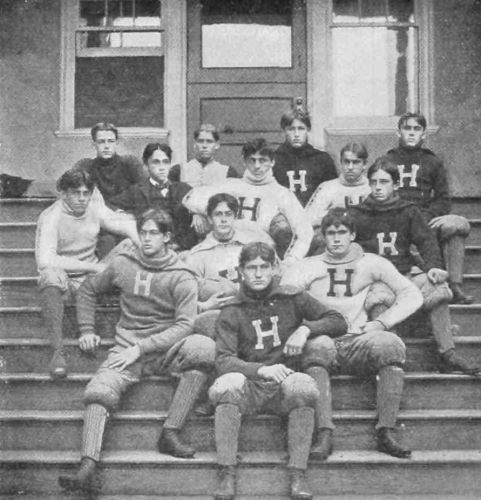
At the Hotchkiss School, Lakeville, the outlook for football is good, notwithstanding the loss of such men as Cheney, Conner, Sheldon, Spencer, Gray, and Wells. Many players who were raw last year are developing well, and some good new men have come in. The line is heavier than last year, and will be better, but the ends and backs are light, averaging perhaps 140 pounds. Hixon, centre, plays a strong and steady game, and may always be depended on. Reiland, left guard, though he puts up a stiff game, is apt to lose his side much ground by off-side plays. Brown, right guard, makes good holes and breaks through well, but runs poorly with the ball. McCormick, left-tackle, is playing well, and runs with the ball with force, but is inclined to be overconfident, does not follow the ball closely, and is consequently out of many plays. Cook, right tackle, is playing hard, but has much to learn. Crane, right end, although very light, tackles well but is apt to be blocked off by the interference. Savage, left end, breaks up the interference well, but is a little weak in tackling.
McKelvey, at quarter-back, makes an excellent Captain, passes accurately, and shows good judgment in the generalship of his team. Warner, half and full, hits the line well, and plays a strong defensive game. Ellsworth, left half, runs around the ends well, but is weak in tackling. Warner must learn to punt better in order to hold his position at full back. At present the team plays a better offensive than defensive game. In offense the line-men block well and make good holes, but in the defense they do not break through quickly enough, and do not follow the ball as well as they should.
As the season advances and the teams of the Connecticut League get into form, the struggle for the championship seems to be narrowing down to a close fight between Hartford High-School and Hillhouse High of New Haven, with the chances slightly in favor of the former. Hartford played a strong game a week ago against the Yale Freshmen.
The Graduate.
This Department is conducted in the Interest of Girls and Young Women, and the Editor will be pleased to answer any question on the subject so far as possible. Correspondents should address Editor.
Gwendoline writes that she wishes to know the secret of being popular. "I'd like to be a popular girl," she says, "a girl beloved by everybody."
This is a natural wish, and in itself not wrong. There is a temptation to wrong in it if the desire be carried so far that, in order to become popular, the girl sacrifices valuable qualities of character, as, for instance, independence of judgment and sincerity.
But there is no need of this. The girl who chooses to be popular needs first to be unselfish. She must not consider her own ends first nor chiefly. The atmosphere enfolding her must be that of love and kindness. You know how some girls always try to have the best things, the best places, the pleasant things, while they do not try to pass the good times along to others. These are not popular girls. Nobody can be fond of a selfish person.
Again, a really popular person must have courage. Courage enough to be a leader. There are only a few leaders in any city, or school, or other corner of the world. Most people are followers. I heard of a leader this morning. She went to a boarding-school a long way off from home. Among the teachers there was a little shy Miss Somebody whom the girls did not like. They made fun of her prim manner and her queer tow-colored hair, and a sort of mincing walk the poor lady had, and they did not see that she was really a very learned woman who could teach them a great deal if they would attend to her. Maria Matilda observed the state of affairs, and decided that it was unjust, so she championed the little teacher. She sent flowers to her desk. She listened respectfully when Miss Diffidence was in the preceptor's chair. She began to be very fond of her, and discovered that Miss Diffidence was really a dear, only frightened out of her wits, among a crowd of unfeeling girls. Before long Maria Matilda changed the whole situation, and, she being a born leader, the rest followed her willingly. I need not add that Maria Matilda is popular, very popular.
Another requisite for the popular girl is savoir-faire; she must know how to do things. Any one of us can have this power. It is a mere affair of paying attention, of will, and of considering it worth while to be able easily, in whatever place you are, to do the right thing, in the right way, at the right time.
Charm of speech, charm of look, charm of manner belong to the popular girl. Do you know how she acquires charm? By simply being genuinely interested in those about her. When she talks to you she looks you in the face. She has nothing to conceal. When you look at her, you see a good heart shining in her eyes.
Now that I have said all this, I must add that you would far better be unpopular your whole life through, than to make a study of the thing merely for the sake of ambition or vanity. He that saveth his life shall lose it, says the best of Books, which means that one who does anything for purely selfish—which are always purely low—motives, will in the end be sadly disappointed.