HOW TO FIND AND MOUNT SIGNETS.
Reading edition
Scarabæus.
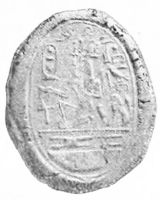
There is nothing prettier or more attractive, hanging on the walls of one's parlor or chamber, than a group of signet impressions in sealing-wax of various colors, artistically arranged and handsomely mounted; while the pleasure to be derived in seeking them is quite as keen as that which the coin or stamp hunter enjoys, without the expense attached to them, for our seals cost comparatively nothing. The outfit is simple, consisting of a dozen sticks of sealing-wax in different colors—black, brown, red, gold, white, and green, making a charming combination with any other shades that take the fancy of the collector. A light wooden or strong pasteboard box to carry the articles, a box of matches, a white taper (cut in half for convenience' sake), and, later on, a piece of stiff white card-board (16 x 22, 22 x 28 being good sizes) to mount them on.
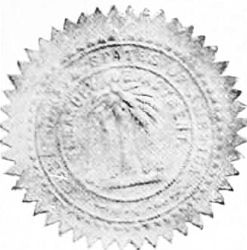
Seal of Confederate States.
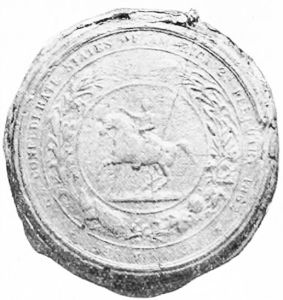
Keep in the bottom of the box containing the wax a dozen or more pieces of thick, white, unruled writing-paper cut into ovals, circular, oblong, and square shapes, varying in size from one-half inch in width to two inches in length. This is all that is required. Now for our hunt. As you meet friends and acquaintances notice their rings and watch-charms. When any are discovered with a figure, title, handsome monogram or initial on it, borrow it, and make your impression. This is accomplished by laying a piece of your writing-paper, at least half an inch larger than the seal to be used, on some smooth surface like a table. Then take a stick of wax between the thumb and forefinger of the right hand. With the left hand light a match or taper, and bring them together just on the paper where the wax melts sufficiently to drop freely, rub the end of the sealing-wax quickly over the middle of the paper. Then moistening the seal with the tongue to prevent the stone adhering to the burning wax, press it firmly into the hot bed prepared for it, a second or so, being careful to lift it straight up when taken off, thus securing a clean edge. If this is properly done a fine impression of your subject is secured. Repeat this operation several times, taking different-colored wax for duplicates, which will enable you to make exchange with other collectors, who are unable to get these same figures, but have others not in your collection.
Knights of Golden Cross.
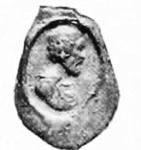
Socrates.
In this manner one is able to secure rare and beautiful heads of men and women, animals, birds, and fishes. These should be placed in a box by themselves carried for the purpose—as fast as taken. When the writer started his group, which was mostly made in Washington, D.C., a few of the young people met one evening at a friend's house and decided to begin together, which greatly enhanced our amusement. Some one suggested we should assemble once a week at each other's homes, and bring our friends with us, so that all could see the impressions and make exchanges.
This was carried out an entire winter, and we found such a course added immensely to our finds and pleasure, as there is no collecting that adapts itself better for club purposes than this for both boys and girls. The capital proved, too, a particularly good field for us, being full of people who had seals gathered from all parts of the world. English, French, German, Italian, and Spanish coats of arms were found, besides quite a variety of exquisitely cut heads in antique rings, gathered from the tombs and curiosity shops of Greece, Italy, and Egypt. In most cities the seals may be found in museums and private collections, and as the act of making an impression in wax is not injurious to them, and requires but little time, we found people generally very willing to allow it. When a sufficient number of seals are gathered, i.e., enough to fill a card-board, they are mounted by first marking the place where they are to go faintly with a lead-pencil. Begin by making a square-cut line in the centre of the board, a little smaller than the writing-paper which contain the seal impressions. This is for the largest of them, then, according to size, graduating to the smallest.
Homer.
Treasury Dept. Con. States.
The others may be clustered around the first, which should have the most space about it, with at least an inch of border. When the outlines are all drawn take a sharp knife and, following the pencil marks, cut entirely through the mounting-board.
The seals are placed in their proper position by covering the outer edges of the paper they are on with mucilage and then pressing the card-board on to them, taking care that the seal shows through the centre of the cut space.
For a pretty effect, if the largest seal in the middle is red, surround it by a circle of yellow ones, followed by blue, gold, brown, and black, giving a harmonious whole. Some collectors run a line of blue or red ink about the card-board, with ornamental curves at the corners as a finishing touch.
Have it framed in some light wood, like ash, oak, or holly, three and a half to five inches in width, with a glass over it.