THE DEMON OF SNAGGLE-TOOTH ROCK.
Reading edition
BY AGNES CARR SAGE.
here were weeping and wailing within the Saunders' modest "one-story-and-a-jump" cottage. Monongahela's eyes were red from crying; the twins, Dallas Lee and Jemima Calline, had for once lost their appetite, even for corn-pone and molasses; and Washington Beauregard, the eldest of the brood of youngsters, frowned gloomily, and ground his teeth in deep if silent rage as he polished up his antiquated old rifle and thought upon vengeance. Only the baby crowed and gurgled as lustily as ever, shaking his gourd rattle in blissful infantile ignorance of the loss that had befallen the family—a loss most keenly felt by the children, for it was that of the bonny ewe-lamb, their pet and plaything by day, and almost their bedfellow by night; while the manner of its disappearance was shrouded in profound mystery.
"Mebbe 'twas Butcher Killem who tuck him," suddenly suggested the lugubrious boy twin. "Tuck him to make roasts 'n' chops of; 'n' if it was, we may be eatin' Cotton Ball for dinner some of these fine days."
A dire prediction, which immediately sent Jemima Calline off into a wild paroxysm of grief, flinging herself flat upon the floor, and drumming a funereal tattoo with her best Sunday shoes on the gay rag carpet of domestic manufacture. "I'll never taste mutton again; never, never, the longest day I live," she howled.
"Now, Dallas Lee, see what you've done!" scolded Monongahela, usually called Monny for short. "You've set her off agin, and we'll have her in 'sterics direckly. Thar ain't no need of any sech fool talk either, and slanderin' your neighbor into the bargain. Mr. Killem is an honest man, who buys 'n' pays for all the critters he cuts up. Besides, I caught the lamb myself, and shet her up in the wood-shed before ever we started for the bush-meetin'. I locked the door 'n' took the key in my pocket. The door was still locked when we came back."
"Ya—as; but ye couldn't lock the hole in the roof," drawled Wash, looking up from his polishing. "The hole pap 'n' I hev been calculatin' to mend for some time back, but 'ain't got at yit, more's the pity. Thar's where the thief come in. For thar on the shingles is where the locks of wool are a-hangin'."
"But I can't see how anybody could clamber up thar, drop through a hole, and git back agin with a big kickin' beast in his arms; for if he'd killed it on the spot ther'd be blood spattered 'round."
"Mebbe nobody could, but mebbe something might."
"Some thing! What sort of a thing? A fox or any other animal?"
"P'r'aps so," but Wash would say no more. He was famous for holding his own counsel, and did so now, until the yellow moon had risen from behind the glorious mountain peaks surrounding their little primitive West Virginia home, and he and his favorite sister wandered out together into the soft, pine-scented night. Then, however, their thoughts naturally reverted to the mysterious disappearance, and the girl asked somewhat curiously, "So, Washington Beauregard, you won't allow that the 'ornery' thief what stole our pet come on two legs?"
"No, Monny, nor on four legs nuther," answered her brother. "Though I didn't want to say much afore the chillen. But I've been a-studyin' over this matter, and I begin to fear that he comes on wings."
"On wings! Law, then, he must be a bird! But I never saw a hawk or even an eagle big and strong enough to tote off a half-grown sheep like Cotton Ball. Strikes me it's dumb foolishness you're talkin', Wash."
"Waal, I dunno about that. Hevn't you heard the old hunters, on winter nights, tell of a curisome-winged thing that once made its nest over yonder on Snaggle Tooth?" and the youth pointed to a high, dark, jagged crag silhouetted against the purplish-blue sky. "It did a power of mischief in this neighborhood, totin' off chickens 'n' dogs 'n' sheep, and some say even tacklin' a calf. 'Twas a cute old fowl, so nobody could git a crack at it; but was up to so much devilment, that they called it the Demon of Snaggle-Tooth Rock."
"Oh, yaas, I've heard o' that often; but it was years ago, before you or I were born, an' the critter hasn't been raound here since."
"That's so; but what has been kin be; and the other day Tim Harkins tole me a yarn about jest sech a bird havin' been seen lately over Stonycliff way. A monstrous chap, something like a golden eagle, only bigger an' wickeder-lookin', with a more crooked beak, an' feathers of a dirty brownish-gray. At the time I thought Tim was jest a-humbuggin', but after the little beast disappeared so unaccountable like, I begun to reckon it must be true, sure enough."
"Oh, Wash, I can't bear to think of it!" and Monny's face looked quite pale in the moonlight. "Poor, dear little Cotton Ball! Fancy that demon and his mate tearing her limb from limb. It 'most breaks my heart." And long after the girl had climbed the ladder leading to the low attic under the clapboard roof, which she had shared with the younger children ever since their mother's death one year before, she lingered at the tiny two-paned window gazing off at the peaceful-seeming hills, but in imagination following the lost lambkin to the eagle's grim eyrie on wild, inaccessible Snaggle-Tooth Rock.
"It is dreadful, dreadful; but I won't tell Jemima Calline," was her last thought as she crept into bed beside her sister.
For Monongahela was old beyond her fourteen years, and bravely strove to fill the place of their lost parent to the motherless little ones, sending them trim and tidy to school and "Methody meetin'," feeding them on plenty of bacon, corn-dodgers, and apple-butter, and every morning, in spite of grimaces, dosing them all round with "whiskey and burdock" as an antidote against dyspepsia, the curse of that hog-eating, excessive coffee-drinking community.
Within a few days Washington's fears were painfully confirmed. Our young mountain folk were out one afternoon on the hill-side gathering ginseng and other herbs, when they met the circuit-rider who visited in turn the churches of their vicinity, and whom Mr. Saunders had frequently entertained. He paused for a chat, and informed them of the consternation created in a neighboring valley by the appearance of the terrible bird to prey upon any poultry or small animals left out over night; while one man had been severely wounded in an almost hand-to-claw tussle in order to save his dog.
The following morning, then, when Monny, with the baby toddling by her side, went out early to milk the cow, she heard a continuous firing, and came upon her brother armed with the old flint-lock rifle which he had inherited from his grandfather, popping away at the brown and purple cones on the top of a tall pine-tree, and deftly snapping off the one at which he aimed nine times out of ten.
"Well, Washington Beauregard, I'll allow you are a pretty fair marksman," she remarked, after a moment of admiring watching. "Not many private hunters kin wing a bird as well as you, kin they?"
"Reckon I could hold my own agin most of they-uns if I only had a new-fangled gun," returned the boy. "This old fowlin'-piece ain't wurth much, and I do hope I kin sell enough 'sang'[1] this year to buy another. 'Tain't much fun to git a fine aim at a buck and lose him 'cause your gun misses fire. As it is, though, I believe I could snip a curl off the baby's head an' hardly scare the darlin'. Jest hold him up, honey, an' let me hev a try." But to this William Tell arrangement Monny objected in horror, and scurried off with the infant, followed by Wash's roar of laughter and shout of "Ho, scare rabbit! But anyhow I mean to keep in practice,'n' hev a cold-lead welcome ready for that air eagle if he ever shows hisself this way agin."
The bird did not come; but about noon Tim Harkins did, ambling along on a rawboned sorrel nag, and reined up at the gate with a long-drawn-out "Whoa, thar'!"
"Wash Saunders! Oh, Wash!" he called, and that youth, rising from the dinner-table, appeared in the ramshackle porch.
"Hello, Tim, is that you? Step in an' hev a bite, won't yer?"
"No, thankee. I'm jest on my way to a gander-pull over nigh the Springs, 'n' on'y stopped to fotch you a message. Ye wouldn't keer, naow, to hire out for a few weeks, at a dollar a day, would yer?"
"What to do?"
"Oh, jest to show a gentleman through the mountings, an' pint out the hants o' the wild birds. 'Pears this Perfessor, as they call him, is stoppin' over to the Spring Hotel, an' the landlord, Poke Dickson, axed me ef I knowed any o' the neighborhood boys who would like the job. Somenn what wuz a first-rate shot, an' 'quainted with all the trails. Yaas, I tole him Wash Saunders am the very chap, ef you kin git him. But, I added, the Saunders air pooty ticky, an' Wash, mebbe, won't relish playin' pinter-dorg to any one. For, sez I, his pappy am a forehanded man, who keeps his fambly comf'ble. He hez a good corn 'n' tobaccy field, 'n' the gyurls hez a kyarpet on the best room, 'n' curtings to the windys, 'n' everything mighty slick. Still, sez I, 'twon't do no harm to ax, so here I be."
"Sho, Tim, you know I ain't so ticky as that. Dunno but I'd like it first rate, for I'm strivin' to get a new rifle. Granddaddy's old 'Sally Blazer,' as he used to name it, is about played out."
"Waal, naow, then, here's your chance, 'n' I'm real tickled. But I must be ajoggin'. G'lang, Juniper! Shall I tell Poke you will go over 'n' see the Perfessor?"
"Yes, I will, this very evenin'"; which the boy did, and returned jubilant. "It's a snap, a reg'lar snap," he declared to the group of brothers and sisters who ran to meet him. "Professor Stuart is real quality, an' no mistake. He's an orni—orni—waal, I don't rightly remember the name, but he's plumb crazy about birds, 'n' comed here a purpose to see those what live in West Virginia. It's a curous notion, but he's nice, 'n' so is Mis' Stuart, though she lies on a sofy most of the time, and looks drefful white 'n' pindlin'."
"Air there any chilluns?" inquired Jemima Calline.
"Yaas, two. An awful pooty gyurl, with eyes like brown stars, an' all rigged out in white, same as an angel, with big, puffy sleeves; an' the jolliest small boy you ever see. He's a downright little man, though he's only five year old, an' he's curls down to his waist."
"Waal, then, sence they were so friendly, I s'pose you came to some bargain?" said Monongahela.
"Sartain; an' I'm to meet Mr. Stuart to-morrer mornin' at the cross-roads an' show-him a red-bird's nest. He wants to collect eggs an' live specimens."
When, then, the Professor rode up to the appointed rendezvous on the following day, he found Wash awaiting him, "Sally Blazer" in hand, and a powder-horn and shot-pouch slung from his neck by a leather strap. His feet, too, were encased in moccasins that his footfall might not startle the shy creatures of the wildwood.
"Ah, my lad, I see you understand the business," remarked the ornithologist, with an approving nod, "and I predict we shall be fine friends."
Thus, too, it proved and for both. That was the beginning of a month of happy, halcyon days spent in the open; a perpetual picnic, scaling the rough but ever-enchanting hills, wandering through the beautiful solemn pine forests, following Nature's most winsome things to their chosen haunts, and always breathing in the resinous health-giving mountain air. Sometimes, when the tramp was not to be too long a one, small Royal accompanied his father, gay and joyous as a dancing grig, and looking like a little Highland princeling in his outing costume of Scotch plaid, proudly flourishing a tiny wooden gun.
"We are good chums, ain't we, Wash?" he would say, in his precocious friendly little way—"good chums, going hunting together. But we mustn't kill things just for fun. That is naughty. Papa says food or science is the only excuse. He never takes but one egg from a nest, and would rather snare birds than shoot them."
Occasionally, too, pretty Jean would join the party at a given point, driving over with a dainty lunch from the hotel, and then there would be a merry out-door meal in some cozy green nook, near to one of the cold clear mountain springs which furnished the purest and most refreshing beverage.
And what a revelation this experience was to poor little Washington Beauregard! Not only the bits of knowledge he picked up from the ornithologist's learned discourses on the gorgeous Virginia-cardinals and orioles, the red-capped woodpeckers and flitting humming-birds, but in a different style of girlhood and more refined mode of life than he had ever known. Day by day, too, he became fonder of and more devoted to his new friends, and looked forward with dread to the time when they must part. All too speedily, then, that date drew on apace, until the morning set for their last pleasant tramp dawned. The Professor and Washington started early, while at noon Jean and Royal met them on the hills above Stonycliff, climbing the last rough incline, that being too steep for the horses and carriage, which were left with the driver at a small clearing part way down the mountain.
"And just think, papa," cried Jean, "we found the squatter's wife at the log house below in sore trouble. Yesterday that horrible eagle, of which we have heard so much, swooped down and carried off her milch-goat almost before her very eyes, and now what she is going to do for milk for her baby she does not know."
"Well, that is a misfortune truly," said the Professor, "and we must see what we can do to help her, but I wish I had been here to have a peep at that abnormal bird. I imagine the stories regarding it are much exaggerated, but if not, it cannot be an eagle, must belong to the semi-vulturine family, though those are rarer than white black-birds in this part of the world. I really am curious to get a glimpse of the creature." And as it chanced, he was destined to have his curiosity satisfied in a way he little dreamed of.
The collation eaten that day under the trees was an unusually bountiful one, reflecting credit on mine host of the Spring House, and after it the ornithologist stretched himself out to enjoy an afternoon cigar, while Jean, followed by her small brother, wandered off to sketch a charming view that had taken her fancy. Meanwhile Wash cleared away the remains of the feast, packing the dishes in the hamper, and carefully saving any fragments of good things for the little ones at home.
He had just completed his task, when a frightened cry of "Sister, oh, sister!" and a blood-curdling shriek from the girl made him snatch up his fowling-piece and fly in the direction the young Stuarts had taken. The Professor also sprang to his feet and followed suit, while, as they emerged from the shadow of the wood, both were almost paralyzed by the sight they beheld. For there stood Jean, white to the very lips, but bravely endeavoring with her climbing-staff to beat off an enormous bird, in whose great cruel talons struggled little Royal, upon whom had been made a sudden and fierce attack.
"My goodness! it's the demon!" gasped Wash, while the father, overcome by a sickening horror, fell back against a tree. Even too, as they approached, the huge, repulsive creature spread its big dusky wings and began slowly to rise, bearing off in its claws the poor child, who stretched out his tiny hand, sobbing piteously, "Oh, papa, save me!" There was one terrible nightmarish second, when nobody had power to move, and then the Professor, with a wild lunge forward, caught at his vanishing boy. But the gay kilt slipped through his fingers, and still the bird of prey soared relentlessly upward and onward.
But at that moment Granddaddy Saunders's old rifle was raised and levelled at the monster.
"Oh, Wash, pray be careful: you may hit the wee laddie," cried Jean, sinking down and covering her face.
"MAY OLD 'SALLY BLAZERS' NOT MISS FIRE THIS TIME!"
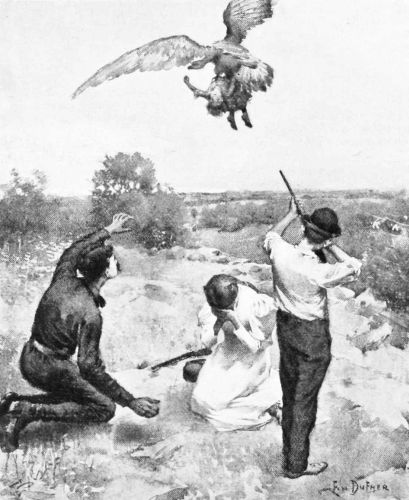
No one knew the danger better than the mountain-bred youth, but he held himself well in hand and kept cool. "I must only maim, not kill, the critter outright," he thought, "and may old 'Sally Blazers' not miss fire this time!"
Then he took careful aim, a bullet whistled through the air, and the "demon's" left wing dropped powerless at his side. They could see the wrathful red gleam in the creature's eyes as it paused, wavered, and careened to one side, but the right pinion still flapped vigorously, and kept it up, while it still retained its clutch on the little fellow, who no longer screamed, but now appeared ominously quiet and white.
"Ef he gits over the precipice all is lost," murmured the young sportsman, with a glance toward the edge of the cliff upon which they stood, and he wasted no time in reloading and firing again. And oh, joy! again he winged his victim, which, uttering an unearthly, discordant cry, began to flutter slowly downward. But now a fresh danger threatened Royal, for the bird, maddened by pain, suddenly released its hold, and the fair little head must surely have been crushed on the jagged rocks beneath, had not Wash been prepared for this, and, springing forward, caught him in his strong young arms, although the precipitancy with which the child came almost flung both to the ground. There was just an instant, too, in which to stagger to one side, before, with a whirl and a whir, the mighty fowl was upon them, striking the stony ledge with a dull, sickening thud. Wounded, but by no means dead, was the Snaggle-Tooth demon, and he fought desperately with beak and claws, and beat himself against the granite, until a third shot from old "Sally Blazers" finally ended his career forever.
Meanwhile poor little Royal lay stretched on a bed of moss, pale and unconscious, his garments torn to tatters, and blood streaming from his chubby legs and arms.
"He is dead; my bonny wee laddie is dead, and how ever shall I tell his mother?" sobbed the Professor, completely unnerved; but Jeanie never stopped chafing the dimpled hands, and bathing the white forehead with cold water; until, after what seemed an eternity, a low sigh issued from between the child's pale lips.
"No, papa dear, he is breathing, and it is Wash, good brave Wash, who has saved him"; and when the young girl turned and thanked him, and her eyes filled with grateful tears, the uncouth backwoods boy, though he could only stammer and blush, felt it to be the proudest moment in all his fifteen years of life.
Soon Royal regained consciousness, but seemed so dazed and frightened, clinging to his sister and imploring her to "hide him from the awful, scratching claws," both father and daughter looked worried. "For it will kill mamma to see him in this condition," groaned Jean.
"Oh, then," put in Wash, eagerly, "jest tote him down to our house. Monny would admire to hev yer, 'n' she's a fust-rate nuss."
"Do you think so? Would your sister really not object?"
"'Deed no; she will be plumb right glad."
So it was decided, and so the young Stuarts made the acquaintance of Monongahela, Jemima Calline, Dallas Lee, and the baby, and slept in the room with the "rag kyarpet and the curtings," which was hastily prepared for the unexpected guests, while by the fitful light of six pine knots the killing of the Snaggle-Rock demon was rehearsed again and again. Monny lost her heart to gentle, ladylike Jean, and concocted such a bowl of "yarb tea" for Royal that he slept soundly all night, and awoke his own bright, bonny, little self.
"It has been a strange conclusion to a most satisfactory summer," said Mr. Stuart, when he appeared at the cottage the next day. "And but for you, Washington, would have been a very tragic one."
But when he attempted to reward the boy with money, he stiffened in a moment. "No, thankee, sir," he said. "I can't take it. Why, I love that leetle R'yal most as much as I do Dallas Lee, 'n' I won't be paid for rescuin' him. Besides, I had a grudge agin that air eagle, on my own account, all along of Cotton Ball."
"That vulture, you mean; for I was not mistaken. It belongs to the vulture family, though sometimes erroneously called the 'golden eagle.' Well, I am not sure but you will get a nice little sum for that specimen, as it is a rare and unusually large one. Suppose I take it to the city, and see what I can do for you?"
To this Wash agreed, and the huge bird of prey, which was found to measure fourteen feet from tip to tip of its broad wings, after lying in state, and being visited by half the county, was shipped to New York, while the amount returned by the Professor for the great carcass seemed a veritable fortune to the Saunders, whom the neighbors say are more "ticky" than ever.
Certainly St. George never won more local fame by his dragon slaying than did Washington Beauregard by his lucky feat, and he is proud of the handsome silver-mounted Winchester rifle, the gift of "his grateful friend Royal Stuart," that hangs side by side with the ancient gun which shot the voracious bird of prey now adorning a city museum, labelled "The Lammergeir, or Bearded Vulture," but which in the West Virginia mountains will go down to history as the Demon of Snaggle-Tooth Rock.