GREAT MEN'S SONS.
Reading edition
BY ELBRIDGE S. BROOKS.
THE SON OF SHAKESPEARE.
Many years ago had you been, let us say, a tinker travelling with your wares or a knight riding by, you might have passed, upon a small arched bridge that spanned a little river in the heart of "Merrie England," a small boy, hanging over the railing, now watching the rippling water, or with eager eyes looking along the roadway that ran between green meadows toward that distant London, from which, perhaps, you were tramping or riding.
"HAVE YOU SEEN MY FATHER AS YOU CAME ALONG?"
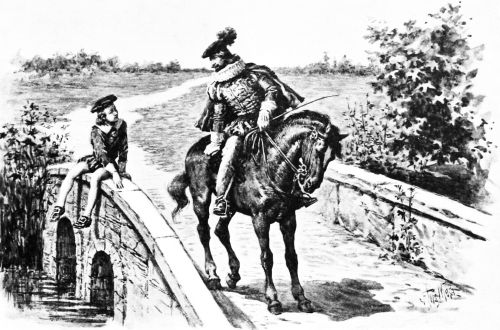
I think, as you passed, you would have looked twice at that small boy on the bridge, whether you were low-down tinker or high-born knight. For he was a bright, sweet-faced little ten-year-old in his quaint sixteenth-century costume, and the look of expectancy in his eyes might, as it fell upon your face, have shaped itself into the spoken question, "Have you seen my father as you came along?"
Whereupon, had you been the lordly knight you might have said, "And who might your father be, little one?" Or had you been the low-down tramping tinker you would probably have grunted out: "Hoi, zurs! An' who be'est yure feythur, lad?"
To either of which questions that small boy on the bridge would have answered in some surprise—for he supposed that, surely, all men knew his father—"Why, Master William Shakespeare, the player in London."
For that little river is the Avon; that small bridge of arches is Clopton's mill-bridge, that small boy is Hamnet, the only son of Master William Shakespeare, of Henley Street, in Stratford-on-Avon. And in the year 1595 the name of William Shakespeare was already known in London as one of the Lord Chamberlain's company of actors, and a writer of masterly poems and plays.
Perhaps if you were the tinker, you might be tired enough with your tramping to throw off your pack, and, sitting upon it, to talk with the little lad; or, if you were the knight, it might please your worship to breathe your horse upon the bridge and hold a moment's converse with the child.
Were you tinker or knight the time would not be misspent, for you would find young Hamnet Shakespeare most entertaining.
He would tell you of his twin sister Judith—something of a "tomboy," I fear, but a pretty and lovable little girl, nevertheless. And as Hamnet told you about Judith, you would remember—no, you would not, though, for neither tinker nor knight nor any other Englishman of 1595 knew what we do to-day of Shakespeare's plays; but if you should happen to have a dream of the little fellow now, you might remember that Shakespeare's twins must have been often in the great writer's mind; for they stole into his work repeatedly in such shapes as that charming brother and sister of his Twelfth Night—Sebastian and Viola—
"An apple cleft in two is not more twin Than these two creatures,"
or the twin brothers Antipholus of Ephesus and Syracuse, and those very, very funny twin brothers of the Comedy of Errors, forever famous as the Two Dromios.
And if young Hamnet told you of his sister he would tell you, doubtless, of his grandfather who was once the bailiff or head man of Stratford town, and who lived with them in the little house in Henley Street; and especially would he tell you of his own dear father, Master William Shakespeare, who wrote poems and plays, and had even acted, at the last Christmas-time, before her Majesty the Queen in her palace at Greenwich. For you may be sure boy Hamnet was very proud of this—thinking more of it, no doubt, than of all the poems and plays his father had written.
Then, perhaps, you could lead the boy to tell you about himself. He might tell you how he liked his school—if he did like it; for perhaps, like his father's schoolboy, he did sometimes go
"with his satchel And shining morning face, creeping like snail Unwillingly to school."
He would, however, be more interested to tell you that he went to school in the chapel of the Holy Cross, because the old school-house next door, to which his father had gone as a boy, was being repaired that year, and he liked going to school in the chapel because it gave him more holidays.
Ah, he would tell you, he did enjoy those holidays. For the little house in Henley Street was a bit crowded, and he liked to be out of doors, being, I suspect, rather a boy of the woods and the fields than of the Horn-Book, the Queen's Grammar, and Cato's Maxims. He and Judith had jolly times abroad, for Judith was a good comrade, and really had it easier than he did—so he would tell you—for Judith never went to school. In fact, to her dying day, Judith Shakespeare—think of that, you Shakespeare scholars!—a daughter of the greatest man in English literature could neither read nor write!
So the Shakespeare twins would roam the fields, and knew, blindfold, all that bright country-side about beautiful Stratford. Their father was a great lover of nature. You know that from reading his plays, and his twins took after him in this. Young Hamnet Shakespeare loved to hang over Clopton Bridge, as we found him to-day, watching the rippling Avon as it wound through the Stratford meadows and past the little town. He knew all the turns and twists of that storied river with which his great father's name is now so closely linked. He knew where to find and how to catch the perch and pike that swam beneath its surface. He and Judith had punted on it above and below Clopton Bridge, and on many a warm summer day he had stripped for a swim in its cooling water.
He knew Stratford from the Guild Pits to the Worcester road, and from the Salmon Tail to the Cross-on-the-Hill. He could tell you how big a jump it was across the streamlet in front of the Rother Market, and how much higher the roof of the Bell was than of the Wool-Shop, next door—for he had climbed them both.
He knew where, in Stratford meadows, the violets grew thickest and bluest in the spring, where the tall cowslips fairly "smothered" the fields, as the boys and girls of Stratford affirmed, and where, in the wood by the weir-brakes just below the town the fairies sometimes came from the Long Compton quarries to dance and sing on a midsummer night.
He had time and time again wandered along the Avon from Luddington to Charlecote. He had been many a time to his mother's home cottage at Shottery, and to his grandfather's orchards at Snitterfield for leather-coats and wardens. He knew how to snare rabbits and "conies" in Ilmington woods, and he had learned how to tell, by their horns, the age of the deer in Charlecote Park—descendants, perhaps, of that very deer because of which his father once got into trouble with testy old Sir Thomas Lucy, the lord of Charlecote Manor.
The birds were his pets and playfellows. And what quantities there were all about Stratford town! Hamnet knew their ways and their traditions. He could tell you why the lark was hanged for treason; how the swan celebrated its own death; how the wren came to be king of the birds; and how the cuckoo swallowed its stepfather. He could tell you where the nightingale and the lark sang their sweetest "tirra-lirra" in the weir-brake below Stratford Church, and just how many thievish jackdaws made their nests in Stratford spire. He could show you the very fallow in which he had caught a baby lapwing scudding away with its shell on its head, and in just what field the crow-boys had rigged up the best kind of a "mammet" or scarecrow to frighten the hungry birds.
So, you see, little Hamnet Shakespeare could keep you interested with his talk until it was time—if you were the tramping tinker—to toss once more your heavy pack on your shoulders, or, if you were lordly knight, to cry "get on" to your now rested horse. And by this time you would have discovered that here was a boy who, with eyes to see and ears to hear all the sights and sounds of that beautiful country about Stratford and along the Avon's banks, had learned to find, as his father, later on, described it:
"tongues in trees, books in the running brooks, Sermons in stones, and good in everything."
A clatter of hoofs rings upon the London highway. The boy springs to his feet; he scarcely waits to give you his hasty good-day, but with a hop, skip, and jump, flies across the bridge and along the road. And, as he is lifted to the saddle by the well-built, handsome man with scarlet doublet, loose riding-cloak, white ruff, auburn hair and beard, who sits his horse so well, you know that father and son are riding home together, and that there will be joy in the little house in Henley Street. For Master William Shakespeare, the London player, has come from town to spend a day at home in the Stratford village he loved so dearly.
Perhaps, two or three years later, you may be led again to tramp or ride through Stratford town. As you loiter awhile at the Bear Tavern, near the Clopton Bridge, you recognize the arches and the pleasant river that flows beneath them, and then you remember the little boy with whom you talked on the bridge.
To your inquiries the landlord of the Bear says, with a sigh and a shake of the head,
"A gentle lad, sir, and a sad loss to his father."
"What—dead?" you ask.
"Yes, two years ago," the landlord replies. "Little Hamnet was never very strong, to be sure, but he sickened and died almost before we knew aught was wrong with him. A sad loss to his father. Master Shakespeare dearly loved the lad, and while he was gathering fame and wealth he thought most, I doubt not, of that boy to whom he was to pass them on."
"So Master William Shakespeare has grown rich as well as famous, has he?" you say, for all England knows by that time of his wonderful plays.
"Indeed yes," the landlord answers you. "See, across the trees, that big house yonder? It is New Place, bought in the spring of this very year of 1597, by Master Shakespeare, and put into fine repair. And there all his family live now—his old father, Master John, his wife, Mistress Ann, and all the children. But little Hamnet is not there, and I doubt not Master Shakespeare would gladly give all New Place and his theatre in London too, for that son of his back again, alive and well, and as happy of face as he used to be in the old house in Henley Street."
The landlord of the Bear is right. Hamnet Shakespeare ended his short life on the 11th of August, 1596, being then but eleven years old.
We know but little of his famous father's life; we know even less of the son he so dearly loved. Nor can any one say, had the boy but lived, whether he would have inherited anything of his father's genius.
The play of Hamlet may have been called in memory of the boy Hamnet, so nearly are the names alike; even more is it possible that the lovely boy, Prince Arthur, whose tragic story is a part of Shakespeare's play of King John, may have been drawn in memory of the writer's dead boy. For King John was written in the year of young Hamnet Shakespeare's death, and with the loss of the boy he so dearly loved weighing upon his soul, the great writer, whose name and fame the years only make yet more great, may thus have put into words a tender memory of the short-lived little Hamnet, the gentle son of Shakespeare.