IRVING'S STORY OF KING ARTHUR AND THE ROUND TABLE.
Reading edition
BY JOHN RUSSELL DAVIDSON.

any of the wide-awake Knights and Ladies of the Round Table read the daily newspapers, and by this time know that Sir Henry Irving, the great English actor, has been treating the people of New York to a magnificent production of a play that deals directly with the ancient founder of the Order of the Round Table.
THE MAGIC MERE.
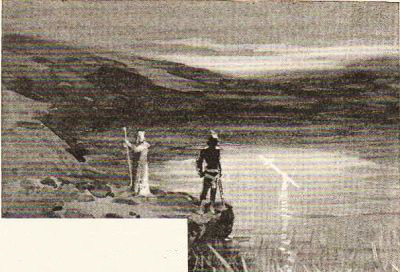
Mr. J. Comyns Carr, the writer of this beautiful and sadly picturesque drama, does not give us many glimpses into the lives of the great company of valiant knights that bound Merlin's table with a hand of steel, but there is much in the stage pictures to interest and instruct those who have fed upon the legends of Tennyson. In the prologue we find the young King Arthur by the Magic Mere or Magic Lake, receiving from the spirit of the lake the mighty sword Excalibur, and with it predictions of great power for the future of this warrior knight who was to rule over a kingdom that should rule the sea. The old sage Merlin is standing by, telling Arthur that the blade is of such a temper that no man can withstand its stroke, and that the scabbard is worthier than the sword.
As the play progresses a band of one hundred knights of the Round Table are seen gathered together in the great Hall of Camelot, kneeling before the King, and begging his permission to leave the court to search for the sacred cup of Christ's, known throughout the world as the Holy Grail. This Holy Grail, the legend tells us, was a cup filled at the cross with the Saviour's blood and brought to the British Isle by Joseph. Some unknown hand had stolen it away, and the burning desire of many a brave knight in those days was to seek, and, happily finding the holy treasure, to restore it to its proper place.
"WE WHO GO FORTH TO SEEK THE HOLY GRAIL."
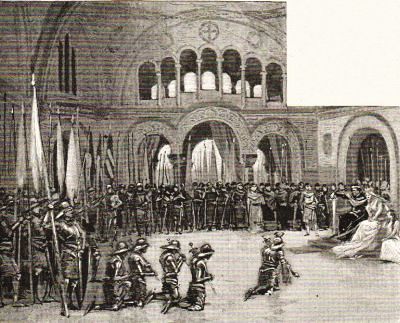
Our illustration of this scene pictures the spokesmen for the departing company of knights craving the King's blessing on their quest. As they rise to go, Sir Lancelot enters and kneels before the throne; he is encased in full armor, and carries a great sword on his left arm. This youth, possessing so many of the graces and traits that were necessary to add lustre to the fame of an English knight in the olden time, had endeared himself to the good Arthur and all his court, and so great was the King's love for Lancelot that he refused to grant the earnest prayer of the gallant knight that he might be permitted to take his departure from his sovereign's side, and join his companions in their wellnigh hopeless search for the Holy Grail.
The next act brings us to a beautiful nook in a vast forest. It is the Queen's Maying, and the great old trees and the blooming flowers tremble with the glad music of Guinevere's laugh and the joyful songs of her ladies-in-waiting.
Sir Lancelot remains at Arthur's court, and being ever near the gracious Queen, his love for her grows deeper and dangerous, until at last it becomes known to the King, who banishes the unhappy young knight and condemns the Queen to imprisonment. From the moment when Sir Lancelot enters Camelot the play deals with that which is sad and fateful—the love of Arthur for Guinevere, the mutual love of this lovely Queen and Sir Lancelot, and the traitorous acts of Arthur's trusted Sir Mordred that finally end in the King's death by Sir Mordred's hand.
Merlin had told Mordred that he, being born on the May day, was the only man whose power could prevail against the mystic charm of Arthur's sword.
In King Arthur's life the great sword Excalibur plays a prominent part; it is ever present and exerting vast influence in his victories and rapid rise to mighty power. Morgan le Fay, the mother of Sir Mordred and active partner in his schemes to overthrow their master, enters the King's chamber at night, steals the scabbard, and throws it into the lake from which it came; and as Arthur is dying he charges his faithful follower Sir Bedevere to take the blade to the forest and cast it back into the depths of the Magic Mere. At Arthur's death Queen Guinevere is condemned to be burned, but is saved from the flames by the faithful Sir Lancelot, who in turn slays the false Sir Mordred. This latter knight had usurped the throne some time before the dying moments of King Arthur.
"And after he was dead Arthur was borne by the three Queens of Night to that sweet isle of sleep which is called Avalon."
We read books, we idly turn the pictured page of history; but here we have before us a scene painted in colors deeper than the artist's brush can know—a picture infused with the vitality of living humanity clothed with the garments of the Middle Ages. All this, stirred with the gleam of spear, the clink of mail, and the thrust of sword, bathes our dream of the early mother-land with an interest that is alive, and a reality that otherwise we could never know.
To be noble then was to be a man of war; to be noble now is to be a man of peace.
The formation of a National Interscholastic Athletic Association, that shall be for the schools of this country what the I.C.A.A.A. is for the colleges, seems now assured. At a meeting of the New York I.S.A.A. two weeks ago it was decided to invite all the interscholastic associations whose names and addresses could be obtained to send delegates to a convention to be held in this city on or about December 28th. At this convention the New York association will propose the formation of a national association, and the plans for organization will be discussed, and officers will doubtless be elected. This is probably the most important step ever taken by the schools for the welfare of scholastic athletics, and it should be encouraged in every way possible by all who are interested in matters interscholastic. The legislators will no doubt find a number of difficulties to overcome at first, and they should not hesitate to seek the best advice obtainable, or assistance, whenever required, from older sportsmen.
Such an association of schools cannot fail to benefit track and field sports. It will simplify the schedule of events, and officially recognize those that are distinctly athletic; it will raise the standard of performance; it will bring the best material of American schools together; and it will establish definite figures in records, which up to this time have, in many cases, been subject to doubt. The question as to when and where the first field meeting should be held is just now a matter of secondary importance, but one that the prospective delegates to the convention will do well to keep in mind. The questions to consider at present are the best methods for organizing the association, and the best means of putting it upon a firm basis. It should be remembered that no business enterprise can be run on any but a business basis; and whereas the proposed association will not in its foremost features be a business enterprise, there will be many business transactions in connection with its management that must be attended to in a businesslike manner.
Above all things, the association should be kept free from politics. Politics is enough to ruin the best-regulated enterprise. The offices should not be looked upon as spoils, and divided among the several component associations. Elect those men to the offices who are the best qualified to carry out the work and to fulfil the duties entrusted to them. In almost every school, or association of schools, there is one man who is recognized as a "worker," one man whose interest in whatever he undertakes is such that it helps him to perform his duties better than others could. Such a man—such men, indeed, are needed to take charge of and conduct the affairs of the National Association. If such men are put into office, the organization cannot fail to be prosperous, and to reflect credit upon all the institutions that are members of it.
The Thanksgiving day game between Berkeley and St. Paul's, the first of a series of annual contests, should attract a large crowd. Both teams are in prime condition, and good football may be expected. Berkeley will undoubtedly win, and St. Paul's will score if her men get the ball in the first half. On the other hand, if St. Paul's kicks off, and the ball goes into Berkeley's hands, the New-Yorkers will have things all their own way should they score in the first ten minutes of play. St. Paul's is weak in defensive work, and her men seem to lose heart if scored against early in the game. I can not quite account for this in a team that has had such good training, but it is a characteristic particularly noticeable this year. Their offensive play is good, and the men put up a fast and strong game in both halves—when they don't lose heart. The centre and guards are weak, but the other positions are pretty well taken care of.
Platt. Baker. Linn. Starr. Glenny. Starr. Brown. Hare. White. Hall. Loraine. Goldsborough. Cluet. Gardiner. Symons. ST. PAUL'S, GARDEN CITY, FOOTBALL TEAM.
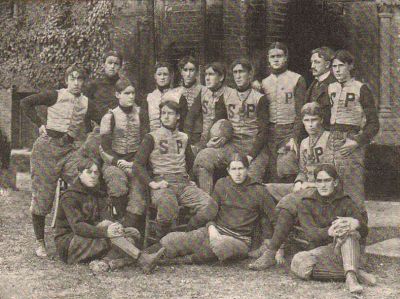
Captain Starr is a veteran player, although new to the position of full-back; he is a fair runner, a good punter, and better at plunging through the centre than at circling the ends. Blackstone and Goldsborough are good running half-backs, not afraid of the crowd, and the latter is particularly clever at following his interference. Baker, at quarter, passes well, is a good general, and tackles hard. Both the end men follow the ball well, and Weller is the strongest defensive player on the team, but is liable to get pocketed by the interference. Gardiner, at tackle, is another strong man in the line, and is a ground-gainer when given the ball. Symons, the other tackle, is a new man, but is learning rapidly, and is one of the best tacklers of the eleven. Cluet blocks poorly at centre, but breaks through well; his guards, Glenny and Brown, are somewhat slow, and do not hold their men. They will have their hands full with Lefferts and Hayden.
The Berkeley team that is to line up against these players is the best eleven the New York school ever put into the field. The end players are particularly good. Young got his experience at Lawrenceville, and won a reputation on the '94 team there. He is quick, rarely misses his man, and on kicks gets away very fast. He blocks well, and strikes interference hard and low. Hasbrouck, the left end, is powerfully built and stocky. He is seldom put out of a play, tackles his man hard and sure. Captain Bayne plays next to him at tackle, and the two work well together. Bayne played on the champion team of 1893. He weighs 192 pounds, and is very strong. He is good at bucking the line, striking it low, with head well down, and is sure for a good gain every time he is sent with the ball. Yale will have a valuable acquisition in him. E. Irwin-Martin, the right tackle, is an aggressive, hard-working player, six feet tall. The strongest feature of his play is a trick he has of twisting when running with the ball, and then breaking away from his tacklers. He tackles hard, but has a bad fault of getting his own head under his opponent, instead of giving his man the full force of a hard fall.
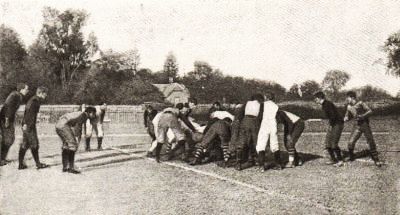
BERKELEY SCHOOL VS. SCRUB—SHOWING THE SYSTEM OF LINE UP.
Berkeley's three centre men have been constantly improving this season, and are now in condition. Rand, the centre, weighs only 165 pounds, but he has held his end up in every game played. His great faults are lack of aggressiveness and slowness. During the last week, however, he has taken a brace that has made a marked improvement in his play. He is very steady in putting the ball in play, breaks through well, and tackles hard. His strongest feature is in following the ball and getting into every play. Lefferts and Hayden give promise of developing into first-class guards. Both are comparatively green men at football, but their willingness to learn and determination to succeed have already made them most valuable in the play of the team. Lefferts plays left guard. He is strong and a fast runner. His great fault earlier in the season was his inability to block centre plays. This he has overcome to a great extent, and now stands firm. He runs fairly well with the ball, and on the defensive goes in with dash and aggressiveness. Hayden, the right guard, is a powerful player, and weighs 162 pounds. Like Lefferts, his great weakness has been in stopping centre plays, but now he is showing marked improvement. He can always be counted on for a good gain when given the ball. At interfering he also does good work, and puts a man out of the play when he goes against him.
For a school team Berkeley is especially strong back of the line. Scott has shown such marked improvement at quarter-back during the past week that he has succeeded in making the team, although Hurlbert gave him a hard fight for it. His weight was a strong factor in aiding him, Hurlbert weighing only 127 pounds. His great faults are nervousness and an inclination to fumble, but he is fast growing out of them under constant coaching. He is a hard worker, gets into every play, is very fast, and tackles well. Clinton Irwin-Martin, the right half-back, and field Captain of the team, is a tower of strength. He is six feet tall, and weighs 180 pounds. At tackle, end, guard, or back he does equally good work, but it is especially at half-back that his work stands out most prominently. His line-breaking is unusually good, and once clear of the end he is seldom caught, as he is a good sprinter. Galloway, at left half, is fast rounding into a reliable back. Some of the longest runs made this season have been placed to his credit. He follows his interference fairly well, but is inclined to run back at times. His great fault in centre plays is striking the line high instead of with head down, and though he is a ground-gainer, he would cover greater distance if he always plunged into the opening with head well down. Franklin Bien, Jun., Captain of the 1896 baseball team, is at full-back. He has developed rapidly. Not only is he a strong kicker, but he is a running full-back too, and bucks the line low and hard. His baseball experience makes him a sure catch, while his punting and drop kicking are of a high order. He has several times kicked goals from the 35-yard line, and on the kick-off easily sends the ball over the opponent's goal-line. Always cool and steady, he is said not to have missed his man once this season, whenever the runner has passed the line. The most prominent substitutes are Hurlbert, Jackson, Poor, Irvine, Thomas, Boyeson, Shinkle, Doudge, and Blakeley.
The two most important games played thus far this season were at Andover on the 14th, and at New Haven on the 16th—the first between Lawrenceville and Phillips Academy, the second between Hartford and Bridgeport High-Schools. Both were of the closest and most exciting description, particularly the latter, which was played to decide the tie of 10-10 of November 9th, and resulted in a second tie, 4-4. The Andover contest was a hard battle, resulting in a victory of 12-10 for Lawrenceville, but this score (as is very often the case with football scores) does not really show what the players did. The weight of Lawrenceville had been greatly exaggerated, the centre men being reported to weigh 210 pounds. As a matter of fact the average was 187, and the entire team averaged 167. Andover averaged 165.
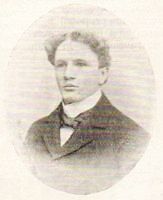
C. W. DIBBLE, Captain Lawrenceville Football Team.
The centre men of the two teams seemed about equal in strength, and no gains were made at that point by either side. Andover gained twice around the ends, one gain resulting in a touch-down. Chadwell of Andover was better than either of the Lawrenceville ends, while Young, the P.A. Captain, showed up about on a par with Eddy and Righter. Goodwin played the best game for Andover, making both touch-downs, the first after a brilliant run of fifty yards. Andover was outplayed at the tackles and guards, for here is where Lawrenceville has played strongest all through the year. Captain Dibble did the best work by far for the Jerseymen, making seven long runs with the aid of fine interference. Powell surpassed himself, making only one fumble, whereas Wentworth did wretched work, devoting more of his attention to personal encounter than to the science of the game, which finally resulted in his being disqualified near the end of the first half for punching Dibble. Lawrenceville got through a number of times and brought either Andover's quarter or half back down for a loss. Andover gained a great advantage by having Goodwin kick right back of the line. Kafer for Lawrenceville outpunted Barker of Andover, his best punt being fifty yards.
Lawrenceville's first touch-down was made in eight minutes after the game began. Plays on the tackles and ends brought the ball down well toward Andover's goal line, when Dibble rushed it over, and Cadwalader kicked a good goal. On the line-up Lawrenceville secured the ball, and, by a double pass, got Powell through Andover's whole line for the second touch-down, after he had run fifty yards. Hereupon was made the only wrong decision of the game. The ball was brought back by the umpire for alleged holding. None of the other officials could uphold him. On the next two plays Andover made her first touch-down by Goodwin's good runs around Lawrenceville's right and left ends respectively. Barker kicked an easy goal. On the next line-up Lawrenceville rushed the ball to Andover's fifteen-yard line, when time was called. During this first half Andover played a kicking game entirely, rushing with the ball only seven times.
In the second half Lawrenceville rushed the ball down the field, making a second touch-down by sending Dibble through the tackles and around left end. After the goal had been successfully kicked, Barker kicked off for Andover, Dibble catching. Kafer then attempted to punt on the first down, but Mull blocked the kick, and the ball went flying off on the grand stand, whereupon Young secured it on Lawrenceville's two-yard line. A fumble lost two yards, and it looked as though Andover would lose her opportunity to score, but Goodwin carried the ball over on the next play. He punted out to Butterfield, who made a pretty catch, but Barker failed to kick a goal. Lawrenceville took a big brace after this, but just as a thirty-yard run by Dibble had brought the ball to Andover's twenty-yard line, time was called on account of darkness, although there still remained eight minutes of playing time. Andover's cheering was very effective, and served to prevent the fast playing that Lawrenceville is usually capable of. The Jersey team also suffered somewhat from the effects of the 300-mile trip from Lawrenceville.
The second game between Bridgeport and Hartford was a better exhibition of football than the first—although little fault could be found with that. The day was an ideal one for the sport, and both elevens showed the result of the week's training with the benefit of the knowledge each had acquired of the other's play. In the first game Bridgeport made most of her gains around Hartford's left end; but in the second contest Morcom was put into that position, and Bridgeport found it easier to turn the right flank and to plunge through left tackle and end. Foster went around right end for the touch-down, while Ingalls scored for Hartford through guard and centre. The play was mostly confined to short gains, and outside of a thirty-yard run by Ives, and two twenty-yard runs by Goodell, most of the advances were secured five yards at a time. On the whole, Bridgeport played a steadier game than Hartford, keeping a high average in both halves. Hartford was weak in the first, especially in interference, although her centre was solid; she remained almost entirely on the defensive, becoming aggressive only in the second half. Bridgeport was aggressive all the time, and punted rarely. Her interference was excellent, and her ends the best I have seen in the Connecticut League for some years, excepting perhaps Cady and Winslow of last year's Hartford eleven.
As for individual play, Goodell excelled by far any player on his side both in running with the ball and in tackling; Lyman and Morcom made good gains; Ingalls blocked splendidly, and made his distance every time he took the ball; Luce did some first-rate punting and got around the ends well; and Chapman deserves especial credit for his plunges through the centre. For Bridgeport, Foster did the best work. He is a strong runner, and frequently travelled down the field with two or three men on his back struggling to down him. Ives seldom missed a tackle, and headed the interference in line style. Keane played a good game, but could not quite meet Luce in a punting match. Hartford worked Bridgeport's centre for slow and sure gains, and occasionally sent a man around the right end.
The Graduate.