GIRLS AND CHAFING-DISHES.
Reading edition
BY CHRISTINE TERHUNE HERRICK.
Never before was the chafing-dish so popular as now. And yet, in spite of the books that have been written directing how it is to be used, and the classes that have been formed for learning its capabilities, there is still a very general impression that its chief function is to cook Welsh-rarebit. As there is a prejudice against these as unwholesome, it is not strange, perhaps, that young girls and lads have had little practice with the chafing-dish. It has been rather reserved for their seniors, whose digestions may be supposed to have become case-hardened. But there are many other delicious dishes besides Welsh-rarebit which may be cooked over an alcohol flame. Even this much-abused compound, if properly prepared, and eaten at a reasonable hour, need not cause dyspepsia. It has gained a bad name because it is usually devoured late at night, and not followed by the vigorous exercise that is necessary if one would digest cheese comfortably.
The chafing-dish, however, is a really valuable aid in teaching young people something about cookery, and that in an easy, pleasant fashion. A chafing-dish is a charming possession for a young girls' club in which light and inexpensive refreshments are served. It is not always easy for the cook to prepare eatables for a club that meets every week or fortnight; and yet all girls—and boys—know how the sociability of any little gathering of this sort is heightened if there is something to eat. Girls who cannot have the "spread" prepared in the kitchen generally regale themselves with cream-puffs or éclairs, chocolate creams or caramels. And the boys—what do the boys eat? Peanuts, apples, pop-corn balls, varied by chewing-gum, and occasionally a cigarette "on the sly." Surely none of these are as good or as wholesome as some hot dainty prepared in a chafing-dish. The constant nibbling at sweets is very likely to prove injurious in the long-run, and to cost as much as the chafing-dish cookery.
But, some one may ask, what is there that can be cooked in a chafing-dish that will not give trouble to prepare in advance? There is no sense in planning for dishes that will keep the cook at work for an hour or so beforehand.
Certainly not. The right sort of chafing-dish cookery can all be done, at a pinch, in a chafing-dish. This ceases to be useful when it makes demands upon the kitchen stove, the cook, and every-day pots and pans.
There are many delicacies that the little cook can prepare with no help except that of her own clear head and her deft hands. It is not worth while to rehearse all of the dainties she has at her command, but here are a few of them: Scrambled eggs, eggs with cheese, eggs with curry, poached eggs, eggs with tomatoes, eggs with ham, curried eggs, creamed salmon, grilled sardines, panned oysters, broiled oysters, stewed and creamed oysters or clams, barbecued ham, fricasseed dried beef, creamed tomatoes, and cheese fondu.
For none of these need the cook's services be required, nor call be made upon the larder for any but uncooked provisions, except in the dishes where ham is used. And in these days, when cold boiled ham may be bought at every delicatessen shop and many groceries, it is no more trouble to supply one's self with that than with fresh eggs.
The girl who wishes to provide a feast for the little club or circle to which she belongs, should first make out a list of all the utensils and materials she will need. Then she may collect them and arrange them upon the table where she means to do her cookery. The chafing-dish must stand on a tray; close at hand should be a half-pint measuring-cup, a small wooden spoon for stirring, a couple of teaspoons, a table-spoon, and a knife. If eggs are to be cooked there must be a small bowl to beat them in and a fork. The ingredients must be arranged in the order in which the cook will have to use them.
All this may be done before the guests are met. The lamp under the dish must be filled and matches laid near. Then, when the cooking is to be done, all the girl will have to do will be to pin a napkin on in apron fashion, to protect the front of her gown from possible splashing, take her place behind the chafing-dish, and set to work. If she has been wise enough to try over the recipe beforehand, and will keep a steady head and avoid flurry, she may be sure of a happy result.
Let us suppose that she means to cook eggs with ham. If there are eight girls to be present, she will need six eggs, a quarter of a pound of cold boiled ham sliced thin and cut into squares, a table-spoonful of butter, a teaspoonful of minced onion, a salt-spoonful of mustard, and as much white pepper.
SERVING.
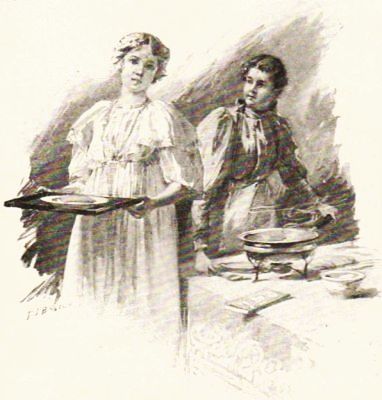
The butter goes into the blazer as soon as the lamp is lighted. (The blazer is the pan that is used directly over the flame, when there is no need to cook over hot water.) As soon as the butter melts the onion is put in and fried for a minute, and then the ham goes in. The chafing-dish may now be covered and left to take care of itself while the eggs are beaten. They are broken into a bowl, without separating the whites from the yolks, and whipped with a fork until they are well blended—say for a minute and a half. By this time the ham should have begun to crisp nicely. If it has not reached this stage, it may be allowed to cook a little longer. Then it may be sprinkled with the mustard and pepper and the eggs turned into it. After this the stirring must be continuous. The eggs are very likely to stick unless they are kept constantly scraped from the bottom; but there is no danger of burning unless the dish is neglected. As soon as the eggs are firm the dish is ready, and the lamp may be extinguished. A pile of plates or saucers, with spoons or forks, should be in readiness, and a plate of crackers may be passed with the eggs.
Another excellent dish easily prepared is curried eggs. For these there will be required six hard-boiled eggs, shelled and cut into thick slices, a table-spoonful of butter, a table-spoonful of flour, half a pint of milk, a teaspoonful of minced onion, and a scant teaspoonful each of salt and curry-powder. This dish, too, is cooked in the blazer. The butter goes in first, with the onion, and when the butter is melted, the flour and curry-powder are stirred in quickly. As soon as these and the butter are well blended and begin to bubble, and before they have a chance to stick, the milk is poured in. After about two minutes' steady stirring the sauce begins to thicken. It should come to a boil, and then the eggs may be put in, the salt added, and all simmered about a minute and a half more before the lamp is put out.
A pleasant and profitable little entertainment may be given with a chafing-dish for any pet charity or mission. There is probably not a church in the country which does not contain one or more societies or guilds of young girls who are interested in some especial work. They may be "King's Daughters," or "Christian Endeavorers," or "Willing Workers," or anything else. Their object is always a worthy one, and their great desire is to secure funds for it. It is very easy, with a couple of good-sized chafing-dishes, to cook enough supper for from thirty to sixty people, when the hot dishes are supplemented by sandwiches, rolls, coffee, and cake. Each guest pays a fixed sum for his supper, and this secures him a portion of the product of the chafing-dish. If the cookery is done in the sight of the guests, and the recipes given at the same time, there is little chance that the entertainment will prove uninteresting.
FIRST LESSONS.
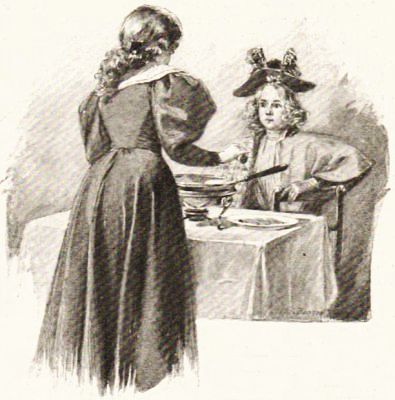
If such a dish as eggs and ham be prepared, a dozen eggs and half a pound of ham can be readily cooked in one chafing-dish, and this, judiciously served, should supply fifteen people. As soon as the eggs are cooked they can be turned out upon a platter, the chafing-dish can be washed, and a second instalment prepared. Creamed oysters or salmon or panned oysters are quick dishes for such an occasion. Panned oysters are unusual, simple, and very good. To prepare them, melt two table-spoonfuls of butter in the blazer, lay in twenty-five oysters, and cook these, turning them once or twice, until they grow plump and the edges begin to curl. Season them with pepper and salt, and serve upon toast, or, if this is not convenient, upon crackers or Graham-bread.
As a matter of course, four chafing-dishes are better than two at such an affair, if there is a numerous assembly, unless the dishes are unusually large. The audience on these occasions is, as a rule, good-natured, and quite willing to wait for the second or even the third relay of refreshments.
A pretty home lunch given by a young girl may have the principal items prepared in the chafing-dish. The lunch might begin with bouillon, served in cups. This, of course, should have been made in the kitchen. The first dish cooked on the table may be panned oysters or clams, served on toast. After this, the young hostess may broil lamb chops, or cook a dish of lobster or of creamed chicken, and with this a vegetable should be served. Should she desire, there may be a chafing-dish at each end of the table, and while she prepares the meat dish, her vis-à-vis may curry tomatoes, or cream potatoes, or sauté green peas.
STIRRING THE DESSERT.
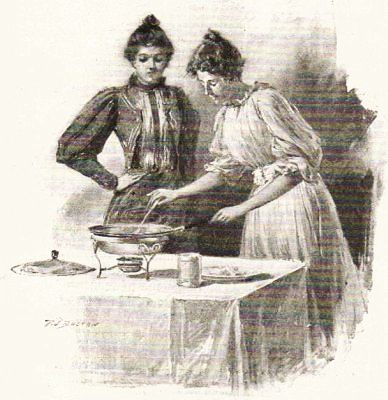
After this may come a cheese fondu. This is a mild and comparatively harmless form of Welsh-rarebit, and is cooked in the inner vessel of the chafing-dish over boiling water. To make it, put in a cupful of milk, a table-spoonful of butter, a scant cupful of fresh bread-crumbs, and two cupfuls of soft American cheese, grated. Add salt to taste, and a pinch of red pepper. Let all cook together, stirring often, until the cheese is melted, and the ingredients well blended. Have ready two eggs beaten light, and stir these in very slowly. Cook two minutes after they go in, and serve.
The salad which follows the cheese dish may be of lettuce with a French dressing, or of tomatoes with mayonnaise, and the making of the dressing may in either case devolve upon one of the guests or the hostess.
The final course may be fruit, or, if it is desirous to have one more chafing-dish dainty, it is easy to prepare a simple dessert. Open a can of preserved peaches or apricots. Split six stale lady-fingers or small sponge-cakes, melt two table-spoonfuls of butter in the chafing-dish, and in this brown the halved cakes on each side. Take them out, arrange them on a hot plate, and on each piece lay a half of a peach or apricot. Add a teaspoonful of cornstarch to the butter in the chafing-dish, blend well, and when the mixture bubbles add to it a scant half-pint of the liquor from the preserve. Stir this until it thickens, pour it over the cake and preserves, and serve. It is good with cream.
A chafing-dish need not be an expensive luxury. Those made of nickel are excellent, and cost from three to five dollars apiece. Still, cheaper dishes are made of agate iron and of block tin, and serve their purpose well.