THE YOUNG BEACH-COMBERS OF MONMOUTH.
Reading edition
BY AGNES CARR SAGE.
"I say he sha'n't come in!"
"And I tell you he shall!"
The boys' voices rose high and angry; their attitude was threatening; and at the sound of contention a bevy of other barefooted urchins came scampering over the damp sand, shouting, "Hi! a scrap, a scrap!" and eager to see fair play.
"What's it all about?" inquired Ned Eaton, a good-looking youth, rather better dressed than his companions.
"It's about little Jem Ferguson," spoke up the shorter and stockier of the belligerents. "Kit Bandy here says he oughtn't to be let into the beach-combing, and I hold it's mean as cramp-fish to bar him out just because he's weak and pindlin' and no account in a boat."
"So it is, so it is," chorused the listening youngsters.
But Kit put in quickly, "All right, let him in then; but if you do he'll hoodoo every mother's son of us. Who killed the luck bird last June?"
"Not Jem," cried Herbert Woolley.
"No; but his daddy did, and if he had been drinking too much hard cider at the time, that makes no difference, and the whole family has had a powerful sight of bad fortune ever since. Jest two weeks after their cow choked to death with a green apple; Jem's hip trouble grew worse; and Jake Smithers told me that the smack in which Dan Ferguson sails is sure to come back with a light haul. The men all look on him as a Jonah, for fish don't come to the nets of those who take the life of a hawk."
"Well, but ill-luck can't be inherited, like consumption or the shape of one's nose," protested Herbert, "and even if it could, Jem's having a bit of sand to sift couldn't affect the rest of us."
Still the boys glanced at each other doubtfully, and one muttered. "We'll each have more ground, and so more chance, if he isn't there," while Kit clinched his argument by declaring, "Oh, if Bert has his way we all may as well give up all hope of winning that," pointing, as he spoke, to a flaring yellow poster which adorned one of the bathing-houses.
ONE HUNDRED AND FIFTY DOLLARS!!!
was the heading, in conspicuous capitals two inches long, and below this amount was offered, in smaller type, as a reward for the return of a diamond earring lost by one of the summer visitors in Benton, the pretty New Jersey village where these lads lived, and which was a quasi-fashionable seaside resort for three months of the year. Now, however, the broad white beach was given into the hands of those young natives who in the early fall make a business of going carefully over it, rubbing the iridescent sand between their fingers, and seeking for any articles there lost and hidden during the gay warm season.
In grim silence, then, the boys re-read the advertisement which all knew by heart, and Ned Eaton suggested, "Let's take a vote. Those who want Limpy Jem to have a show drop a white shell in my hat, and those who are for freezing him out a purple one."
"Yes, yes, that is a good way; that will be fair." And the members of this hastily formed Beach-Comber's Union turned aside with relief to select their ballots from the deep-sea treasures cast up by the bobbing foam-capped waves.
Five minutes later, then, the polls were open, and Kit looked triumphant and Bert annoyed as both noted that the majority of the voters were endeavoring to conceal dark mussel-shells in their brown little fists. There was no doubt that Jem's fate was sealed, when suddenly a faint shout attracted their attention, and all started at sight of a slender auburn-haired lassie speeding toward them from the direction of the village. "Gee whizz, but it's Eileen Ferguson!" shrieked small Teddy Todd, "and her temper is as fiery as her curly mop."
Certainly there was a dangerous flash in her big gray eyes and a sharp ring in her young voice as, coming nearer, she cried: "So, Kit Bundy, you are playin' the snake in the grass again, are you? You never did like my brother, and now I hear you are tryin' to have him put out of the beach-combin'. Poor Jemmy, who is too sickly to go to the fishin'-banks, and has so looked forward to the fall in hopes of earnin' a few dollars for the mither! I should think ye'd be ashamed of yourself! Dickson, the bathin'-master tould me how you were talkin' to the others; but you won't mind him, will you, boys?" And there was that in the appealing, half tearful glance which the earnest little sister turned upon them that made most of her hearers look sheepish, and become deeply absorbed in stirring up the sand with their toes.
But Kit, was furious. "What?" he roared; "be dictated to by a girl? Not if I know our combers. Go on, fellows, and vote as you intended; while, Miss Impudence, the sooner you take yourself off the better."
Instinctively, however, Eileen turned to young Woolley. "Oh, Bert, Bert!" she wailed, "don't let them throw my Jemmy out. He has had such a dreadful summer, and this—this will break his heart. We need the money so much, and niver did he dream his old friends could treat him so." Then all at once her wrath dissolved in a girlish burst of tears.
"Pepper me if I can stand that, bad luck or not," growled Ned, hurriedly picking up a white shell and flinging it into the hat; and as boys, like older people, are very much akin to a flock of sheep, the majority followed suit, and Jem Ferguson was, as in former years, numbered with the beach-combers, the three purple shells cast by Kit and two of his chums not being sufficient to rule him out.
"A thousand thanks, boys! You are blissid darlints, ivery one of ye—barrin' that trio," exclaimed Eileen, who, though American born, in moments of excitement sometimes betrayed her ancestry by her speech.
When, then, on the morning of September 18th, the combers gathered to commence operations, one of the happiest faces there was that of little "Limpy," hopping briskly along on his crutches, and nodding gay greetings to his old comrades. They found the beach evenly measured off and divided by stakes. The plan of the lads of Benton was to draw lots for their respective portions, a strict though unwritten law being that no one should poach upon another's grounds.
"See, Kit, you and I are neighbors," said Jem, cordially, to young Bundy. "And such fine sections as we have! right in front of the great Naiad Hotel. We have a good chance for the diamond. Oh, but don't I wish I could find it!"
But Kit only growled something about "luck-bird-killers" under his breath, and strode away to his own preserve. Always rather a leader among his companions, he was chagrined by his defeat, and felt injured and annoyed by the cripple's presence.
As the day wore on, however, he found it difficult to keep up his antagonism to cheery Jem, who ignored all rebuffs, and chatted away in the most friendly as well as quaint manner—now about the sea, wondering why it changed its hue from blue to green and green to gray; and now about the fish-hawks circling overhead, and longing to be one of them, that he too might fly off to some warm Southern land before the cold, biting winter came on.
"What a queer un you are!" remarked Kit at length. "What makes you think of such things? Why, I'd a heap rather be a boy than a bird."
"Yes, 'cause you are so big and strong. You can make your way in the world, and your back isn't crooked, and your legs all drawed up. Now I, you see, am neither flesh nor fowl nor good red herring," and Jem cackled a feeble little laugh, but without a tinge of bitterness. How, too, he enjoyed the lunch eaten on the beach, and insisted that every one must taste the pie Eileen had made for him out of "two pertaties and a bit of a lemon."
For three days the weather was perfect, and the combers "made hay while the sun shone," gathering quite a profitable collection of old iron and nails, children's toys, small coins, and inexpensive pins and pieces of jewelry, while Bert Woolley had the good fortune to come upon a silver watch little the worse for its sojourn in the damp sand.
But on the fourth morning there came a change. Heavy clouds obscured old Sol from view, the sea roared with a low ominous undertone, and the wind blew raw and chill from the northeast, making the lads shake and shiver, and seeming to freeze weakly Jem to the very marrow and set his limbs to aching. Then in the night the storm broke, one of those fierce September gales which often sweep the coast, and for forty-eight hours roared and raged without, while the impatient urchins grumbled and raged within.
It was an exceedingly wet world that at last emerged, bright and glistening, after the deluge, but Kit Bundy was early astir and down on the shore to see what havoc the tempest had made. Dead fish, drift-wood, portions of wrecks, and other flotsam and jetsam strewed the beach, up which he slowly sauntered, kicking before him a round stone that bounded merrily across the sand. Presently, in front of the Naiad Hotel, a particularly vigorous kick sent it high in air, and then landed it in a deep hollow worn by the waves. Mechanically Kit paused to lift his improvised plaything from the hole, when something beside it caused him to fall on his knees with a low stifled gasp. Not another sound escaped him, but there was a new and curious expression on his face when he finally rose and almost ran to the boarding-house he and his father called "home." Later in the day the long line of beach-combers were electrified by the message that passed from mouth to mouth, "Kit is the lucky one; he has found the diamond earring."
From far and near the boys hastened to behold the jewel, about which there could not have been more interest had it been the Koh-i-noor itself, and the finder had to point out just where he discovered it in his section, deeply buried a foot from the surface.
"Not so dreadfully hoodooed after all, were you, Kit?" Bert could not resist remarking; but most of the lads swallowed their own disappointment, and congratulated him warmly, while Jem threw his hat in the air, piping,
"Hip, hip, hurrah for Bundy, the prize-winner!"
But the hero of the hour did not appear particularly pleased with these attentions. He grew very red, and turned away, muttering, "Oh, shut up, fellows! It isn't worth makin' such a fuss over."
"Just hear the Rothschild," squeaked Teddy Todd. "One would think he picked up gems every day in the year. I shouldn't be so grumpy if I had had his luck."
"Which he don't deserve," said outspoken Eileen, who had come down to gather drift-wood. "Oh dear! how unequal things are in this world! If Jem had but drawn that side of the stake instead of the other, we would be fairly spinnin' with the joy, and whiskin' him off to the best doctor in the county. Poor lamb! he scarce slept a wink last night, with the pain in his hip, and oughtn't to be out here to-day."
And the next morning Jem was missing, his sister coming to fill his place, and, with her ready Irish wit, parrying all the boys' jokes on "the first girl comber of Monmouth." But from that time the interest in the beach-combing flagged, and the work soon came to an end.
One afternoon, not long after, a youth, conspicuously conscious of his Sunday clothes and stiff collar, rang the bell of a handsome New York residence, the shining door-plate of which bore the name, "J. C. Landon, M.D." He was admitted by a supercilious colored boy in buttons, who, ushering him into a luxuriantly furnished office, told him to "Wait, the doctor was engaged at present." And he did wait a full half-hour before the physician emerged from an inner apartment, accompanied by a lady who gently supported a young girl, richly attired, and with long fair hair floating on her shoulders, but who limped painfully, and in whose sweet face was an expression of suffering that somehow reminded Kit—for Kit it was—of Jem Ferguson.
"Yes, yes, Mrs. Graham," Dr. Landon was saying. "I see no reason why Miss Ethel should not walk without crutches in time. Science works wonders nowadays. She would get on faster if you could consent to let her go to my sanitarium, but since you are unwilling, I will visit her often and do the best I am able; while I can at least promise that there will soon be no more of the neuralgia that causes such excruciating agony." With which he bowed his visitors out, and, returning, asked briskly, "Well, my lad, what can I do for you? You don't look like an invalid."
"No, sir; I'm pretty hearty," responded Kit, with a grin. "I came because—because I have found this," and without further words he produced a small box and opened it.
"My wife's lost earring! Why, she will be overjoyed!" exclaimed the physician. "But I shall have to turn you over to her, as I am due at the hospital, and haven't a moment to spare. Here, Nero, ask Mrs. Landon to step down to the office." And without more ado the busy man hurried off, leaving the confused and stammering Kit to the tender mercies of the mistress of the mansion.
But these proved very delightful, for not only did the lady shower him with graceful thanks, but ordered up a dainty little collation for his refreshment, which he ate to the sound of the surgeon's praises as sung by Nero, who declared his master to be "De berry bestest doctah in all de United States. Why, sah, he kin mos' raise de dead, and I 'low he makes de lame to walk ebery day, and tinks nottin' ob it"; and, when he finally left the house, it was with a fat roll of greenbacks snugly tucked in his pocket.
This was the hour to which Christopher Bundy had been looking forward, and he proceeded to make the most of it. Of course he went to the theatre, and from a high gallery seat glowed and shivered in sympathy with the hero on the boards, and he followed this up with an oyster-stew in a gayly decorated and illuminated restaurant. But, strange to say, he was not as happy as he should have been, and—it was very queer—the features of "Limpy Jem" would keep rising before him, curiously intermingled with those of the lame girl he had seen that day, while he seemed to hear again a weak voice piping, "That's because you are so big and strong, and your back isn't crooked and your legs all drawn up. I must have the vapors," he concluded, as he tumbled into bed.
The following evening, when Kit stepped off the train at Benton, he was met by a delegation of beach-combers, all shouting: "Hullo, old fellow! Did you get the reward, sure enough? Goin' to stand treat now, ain't yer? Ginger-pop and sodas for the crowd!" and insisted upon bearing him off to drink his health at his expense.
"Wish poor Limpy was here too," remarked Ned Eaton, as he drained his glass of sarsaparilla. "Does any one know how he is to-night?"
"Dreadful bad," answered Teddy Todd. "They think he's dyin'."
"What! Is he so sick as that?" and Kit's voice sounded sharp and unnatural.
"Yes; he took cold that day before the storm; fever set in, and the doctor says he won't get well."
It was nine o'clock, and the little seaside town was settling down to sleepy repose, when a timid knock summoned Eileen to the Fergusons' humble portal. Her eyes were red and swollen, as could be seen by the blazing pine-knot she carried, and her lips quivered as she cried: "Kit Bundy at this hour! What brings you here?"
"To see Jem. Stop, Eileen! Don't say I can't, for I must, indeed I must. I know I've been mean to him and rude to you, but there is something I must tell him before he dies."
There was so much wild anxiety in his manner and imploring in his tone that the curt refusal on the girl's tongue was hushed, and instead she said, "Come, then; only don't stay long," and led the way to the dreary room where Jem lay. A wan smile flitted across his face at sight of his guest, and he murmured:
"Howdy, Kit; do you know, I guess I'll get my wish, after all, and fly away like the luck-birds."
With a low cry, however, the older lad threw himself down beside the bed, and sobbed: "No, no, Limpy; don't say that. You must stop and be comfortable and happy here, for see, this is yours, all yours"; and he flung upon the patchwork quilt the roll of bills paid him by Mrs. Landon.
Jem gasped. "What a big, big lot of money! It's the reward, isn't it—the reward for the diamond? But you mustn't give it to me."
"It belongs to you. I never had any right to the diamond, for—for I found it on your side of the stake, and buried it in my part of the beach."
THEN JEM WHISPERED: "POOR KIT! BUT I'M GLAD YOU'VE TOLD ME."
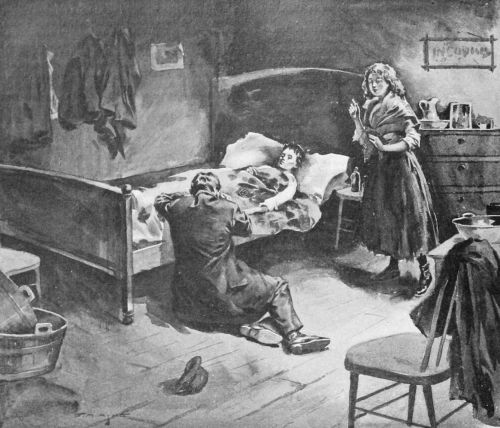
After this confession there was dead silence for a moment. Then Jem whispered: "Poor Kit! But I'm glad you've told me."
"So am I; though the beach-combers will hiss me out of their company when they know. Here's the hundred and fifty dollars, however, every penny of it; and you, Eileen, must spend it all for your brother"; and he thrust the greenbacks into that astonished maiden's hands.
But Jemmy protested with all his feeble strength, "I cannot, I will not take it all," he said. "You were the finder, even if it was in my portion of sand. But we will divide, half for you and half for me, and then the other fellows need never know. It shall be our secret." And as he was growing dangerously excited, to this arrangement Kit had to consent.
Before leaving, though, he told the sick boy and his sister of the marvellous cures Dr. Landon was said to have made, and of the fair cripple he had seen in his office, concluding with, "Now, Jem, if you could go to his hospital, mebbe science would work some of those wonders on you."
"Oh, if he could, if he only could!" sighed Eileen.
Hope, however, is a great restorative, and the following day Jem was stronger than he had been for some time, which encouraged Kit to take another trip to New York, where he astonished Dr. Landon by suddenly appearing before him and demanding, "Tell me, sir, is seventy-five dollars enough to put a chap in your hospital and get him cured.'"
"Well, that depends," laughed Dr. Landon, much amused. "Who is this chap, and what is his trouble?"
As concisely as possible the boy told the story of lame Jem, but so interesting the kindly physician that he ran down to Benton expressly to see the case, and the result was the new year found the young invalid established in a great airy ward, where the sunshine sifted in through a beautiful lattice-work of window plants, and cheery, bright-faced attendants were ready to answer every call and supply every want.
"It seems like Paradise," said Jem, nestling among the soft pillows, and that proved a truly blissful winter, in spite of some pain and discomfort he had to endure, while he made life-long friends of Mrs. Landon and Mrs. Graham, who paid him frequent visits, and brought him lovely flowers and delicious fruit from the fair-haired Ethel.
And at length, when the spring-time came over the land, Bert Woolley and Kit Bundy one evening helped off the cars a very pale but very radiant lad, while the former said,
"See, Limpy, there are all the beach-combers coming to welcome you home."
Cordially the rough youths crowded about their young comrade, healed and restored as though by a miracle, and shook him warmly by the hand, wondering to see in a slight limp the only trace of his former lameness. But the throng parted as an auburn head suddenly flashed through their midst, and Eileen, throwing her arms around her brother, cried:
"Oh, Jem, Jem! this is the happy day for sure—to see you walking on your own two feet, while the father has signed the pledge, and a pair of luck-birds are building their nest in the big pine-tree right forninst our door."