Chapter VI
Reading edition
IN THE DRAWER.
immieboy clambered up the side of the bureau with some difficulty too, because he was now so small that the bureau was not so easy to climb. In a few minutes, however, he was comfortably fixed inside the drawer, and the Wizard, taking the key from the lock, followed him. Once inside he touched a spring on the side of the drawer, and with a bang it shut itself.
"There we are," said the Wizard, locking the drawer from the inside. "How do you like it, Jimmieboy?"
"It's awfully dark," said the little fellow. "I can't see an inch in front of my face."
"Then take my hand," said the Wizard, "and I'll lead you to where it is light."
Jimmieboy did as he was told, and the two little creatures groped their way along in the dark until the Wizard found a small door. Turning the knob to this he threw it wide open, and Jimmieboy looking through it saw a beautiful garden in which sweetly perfumed fountains were plashing merrily, and through which there were scattered beds and beds of the loveliest and withal the most singular-looking flowers he had ever seen.
"My!" he cried in an ecstasy of delight. "Isn't this magnificent!"
"Oh, yes—pretty good," said Thumbhi. "I suppose when one sees it for the first time it must look like the most beautiful place in the world, but to one whose prison it has been it isn't quite so beautiful. You never heard my song,
"'I would rather be free in a dungeon cell Than a captive at large in a flowered dell.'
"Did you?"
"No," said Jimmieboy, "I never did. How does it go?"
"This way," replied the Wizard, and then he repeated these lines:
"'I would rather be free in a dungeon cell Than a captive at large in a flowered dell; I would rather be free 'neath a load of chains Than a prisoner roaming the country lanes. I would rather be free in an ice-bound cave Than to sit on a throne as another's slave; For all the great blessings with which man's blest 'Tis freedom, sweet freedom that I love the best.'"
"That's a pretty song," said Jimmieboy. "And I think maybe you are right. I feel that way myself sometimes. Once in a while when I'm told I can't do something, I feel that way. I always want to do that thing more than ever."
"You are just like me, then—though really I didn't think much about freedom and how nice it was, and what a dreadful thing captivity was, until I had a little chat one night with a song-bird. She was cooped up in a cage, and sometimes she nearly broke her wings flattering up against the bars of it trying to get out. As I watched her I wondered how she could sing so happily when she was shut up that way, and I asked her about it. She answered me softly, 'It isn't I that is happy. It is my song that is happy because it is free.' And then she sang this little verse to me:
"Though they shut me close in these brazen bars, Though they keep me a captive long, Yet my notes will rise Till they touch the skies. No man can imprison my song."
"I've always felt sorry for birds in cages," said Jimmieboy, when the Wizard had spoken. "And I've wondered, too, how they could sing so sweetly when all the day long they were locked up with nothing to do but jump from one perch to another, or swing in that little swing at the top of the cage."
"Well, there's one thing that's nice about their lives," said the Wizard. "They don't have anybody to quarrel with. I think that's very fine."
"That's true," said Jimmieboy. "And then, too, when one bird wants to swing there isn't any other little bird that he has to give up to; but I'd rather be free, and take my chances of getting the swing, wouldn't you?"
"Rather!" ejaculated the Wizard. "But, my dear fellow, we are wasting time. The Merboy will be back in a few minutes, and if you want to see all the wonders of this place we must hurry. Come. Let's go out into the garden."
The queer little fellow leading the way, the two new friends went out of the drawer. As they sauntered along, Thumbhi reached out his hands and plucked two pretty flowers from a bush at the side of the path, and putting one of them in his mouth handed the other to Jimmieboy.
"You must be hungry by this time," he said. "Eat that."
"Flowers aren't good to eat, are they?" asked Jimmieboy.
"Cauliflowers and the flowers of this garden are. That is nothing but a biscuit-bush I plucked those from. Didn't you ever see a biscuit-bush?"
"Never," said Jimmieboy; "though I should think they'd be very nice."
"They are," said the Wizard.
"How do you make them grow?" asked Jimmieboy in surprise.
"Simple enough," said Thumbhi. "Take the Buckwheat-cake bush, for instance. Buckwheat cakes are nothing more than cooked buckwheat, so instead of planting the seeds raw we plant them cooked, and when they grow up and sprout, instead of putting forth raw buckwheat out come the cakes. Try one."
Jimmieboy needed no second bidding, for as the Wizard spoke he had reached over to the buckwheat-cake bed, and plucked a half-dozen hot, steaming cakes.
"My!" ejaculated Jimmieboy, as he swallowed the first one, somewhat greedily, perhaps, for he was very hungry. "My! How sweet they are."
"Aren't they!" said the Wizard. "And why shouldn't they be? We water the Buckwheat-cake bushes with maple syrup."
The idea was so overpoweringly lovely that Jimmieboy could not find words to express his delight over it. He simply let his eyes open a little wider, but the twinkle in them showed the Wizard how he felt.
"Now here," said the Wizard, tapping a little door in a curious-looking summer-house—"here is where we keep our tools. They are the funniest tools you ever saw in your life. They do all their own work. I'll introduce you to some of them. Mr. Rake!"
"Well?" came a voice from within. "Well, what's wanted? If you are the gravel path you might as well trot away. I can't smooth you off to-day, and if you are the weed path, I've asked Mr. Hoe to attend to you. I'm having trouble with my teeth."
"It's I—Thumbhi," said the Wizard.
"Oh," came the answer. "Why didn't you say so."
Here the door was opened, and the Rake hopped out.
"Good-morning," he said. "I didn't know it was you or I wouldn't have kept you waiting. Who is your young friend?"
"Jimmieboy," returned the Wizard. "This is his first visit, and I didn't know but what you'd show him how you do your work."
"I'd be very glad to," said the Rake, "but it's impossible this morning. I spent all day yesterday raking the candy field, and it has made my teeth ache like seventy-two—which is twelve more than like sixty; but if he's fond of jokes I can give him a few. Why is a—"
"Well, really," said the Wizard, who knew the Rake's jokes were very bad, and who was therefore anxious to spare Jimmieboy the trouble of hearing them, "we don't like to bother you. We'll run along—"
"No bother, I assure you," said the Rake. "I know it by heart. Why is a trolley-car like a grindstone without any handle?"
"I couldn't possibly guess," said Jimmieboy, with a grin.
"They don't either of them smoke cigarettes, of course," said the Rake. "I should think anybody could have told that. Now, can you tell me why a—"
"Thumbhi!" came a voice in the distance.
"Excuse me for a minute," said Thumbhi. "I think I hear somebody calling me," and he was off.
"You'd better follow him, Jimmieboy," said the Rake, kindly. "Don't lose sight of him for an instant. This is his way of getting rid of you. He brought you in here to tell you his history, didn't he?"
"Yes," said Jimmieboy.
"Well, he hasn't got one," whispered the Rake. "He hasn't got one, and he never had one, and this having himself called away is only one of his tricks. Keep your eye on him or you're lost."
JIMMIEBOY STARTED IN PURSUIT.
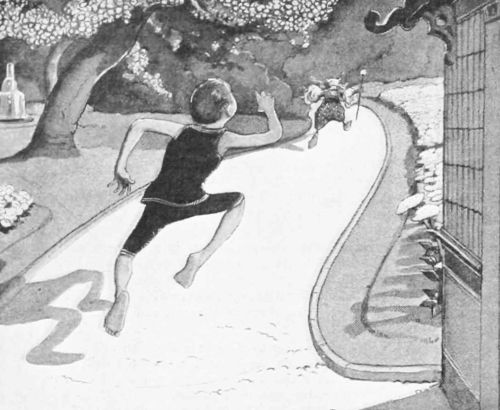
With this the Rake slammed the door of the tool-house, and Jimmieboy turning about peered down the path at the Wizard, who was running as fast as his legs could carry him. Jimmieboy started in pursuit—and what a pursuit it was! Like the wind they ran, mile after mile round and round the garden, through forests that turned up on the road here and there, and once in awhile with great bounds jumping over rivers and mountains, until finally Thumbhi turned suddenly, ran backwards directly past Jimmieboy, and before the little visitor had time to turn around was lost to sight.
Jimmieboy was now quite lost. He had no idea as to his whereabouts. The garden had long since disappeared, and so fast had he run the boy had failed to notice in what direction he had come.
"Humph!" he said, seating himself by the road to catch his breath. "Here's a muddle. I wonder where the Merboy is?"
"Here I am," came a subdued little voice that sounded miles away. "Take the first door to your right, open it, and you'll find me."
Jimmieboy started up and walked, it seemed to him, for hours, but no door appeared anywhere until, just as the sun was setting, he came to a big oak-tree with a little bit of a door half-way up its trunk.
"I wonder if that's it?" said the puzzled boy, scratching his head.
"Yes," came the voice from the inside. "Climb up and come in."
"I can't climb 'way up there," said Jimmieboy.
"Then we'll let the door down," returned the voice behind the door. Sure enough down came the door. Jimmieboy opened it and walked in, and there was the Merboy only he had become a goldfish in the aquarium in the nursery again, and was swimming around as unconcernedly as if nothing had ever happened.
"Wasn't it queer?" said Jimmieboy, as he told the story to his father.
"Very," said his father, "but queer things often happen to boys who eat as much fruit cake as you do."
Which was the only explanation of his strange adventure that Jimmieboy ever got.
the end.

Although the inter-city games at the Berkeley Oval, a week ago Saturday, were at no time exciting, because of the marked difference in strength of the contesting teams, yet in many instances the contests were exceedingly interesting, and, take it all in all, the occasion was worthy of a greater display of public interest than it received. I was surprised at the small size of the audience present. I had expected to see twice as many spectators as there were at the Oval on the previous Saturday, and no doubt there would have been if the games had been properly advertised. As far as I know not a daily newspaper of this city announced, on that morning, that there would be interscholastic games at the Oval that afternoon. This is not the fault of the newspapers; it is the fault of the managers of the Inter-City games, who should have made it their duty to see that the occasion was duly advertised and heralded. These same managers were so anxious to fill their coffers as to make all contestants pay an entrance-fee into the grounds, like ordinary spectators. If they had spent a few dollars in reading notices in the daily papers, and a few cents in postage on polite notes to the various City Editors, they would have doubled the number of spectators present, and the contestants could have been admitted free—as they should have been in any case. I hope my words on this subject will not be taken as a complaint or as fault-finding, for they are not so intended. Contestants in track games, as in other sports, can do better if encouraged by a crowd, and so I think, in justice to them, no reasonable efforts should be spared to attract a large audience.
Otherwise the games were pretty well managed. The events might have been run off a little faster, but as it was they did not drag, and by five o'clock the programme was at an end. The advantage of having few entries was clearly demonstrated, and a tiresome succession of trial heats was avoided. How much better it would be if the Interscholastics could be conducted on some such plan next year. The programme was a compromise, and a very good compromise at that. The mile walk and the Junior 220 were omitted, and the bicycle race was made two miles instead of one mile. The latter change was commendable, because the inter-collegiate event is two miles, and so it is in almost all of the other interscholastic programmes of the country. The long distance makes a better race, and the fact that New-Yorkers won every place in the event proves pretty conclusively that the N.Y.I.S.A.A. riders can cover that distance as well as they have been doing the mile.
The Long-Islanders started out with a spurt, and earned 22 of their 33 points in the first four numbers on the card. Stevens, the B.L.S. sprinter, was responsible for 10 of these, and he showed himself a strong runner. He is tall and slim, somewhat resembling Sherrill in his build, and will no doubt equal Sherrill's and the other champions' time before he retires from the track. He ran a dead heat with Hall in the first 100, doing 10-3/5, and on the run off he was victorious by about a foot in 10-4/5. Hall is not strong after his first dash, and seldom does himself justice in the finals. I believe that if he would train hard, however, he could get staying power that would enable him to do as well in the third heat as he now does at his first trial. Whether under any circumstances he could defeat Stevens is a question, for the Long-Islander showed his mettle by following up his first hard victory, and winning the 220 in the record time of 22-4/5 seconds. He could have done even better if he had known he was so close to these figures.
Fisher, of Harvard School, who holds the scholastic record of 52-1/5 sec. in the 440, was counted on by the New-Yorkers to take that event. Fisher has been training for it all spring, but since his injury last year he has not been able to get into very fit condition. He started off at a rapid gait and held the lead for about 300 yards, when his wind gave out, and Jewell, who did so much for Adelphi, in Brooklyn, the previous week, passed him easily, and came in an easy winner, with Fisher a weary third. His time, 54-1/5, was 1-2/5 seconds better than his winning time at the L.I.I.S.A.A. games. Meehan again had an easy victory in the half-mile, running as strong and pretty a race as he did the week before. In the mile, Tappen did not appear, having gone out of training, but McCord, who ran third in the N.Y. Interscholastics, came to the scratch and won in 4 m. 58-4/5 sec. He is a promising athlete, and this performance is especially creditable, as it is only his second race. Mosenthal, who beat him home the week before, ran second.
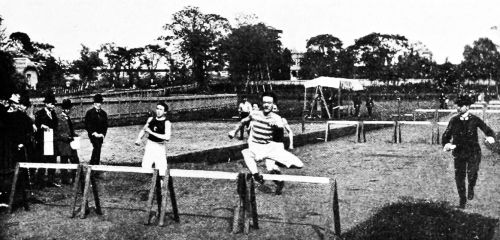
Harris. Pell. Syme. FINISH IN FINAL HEAT LOW HURDLES OF THE I.-C. GAMES.
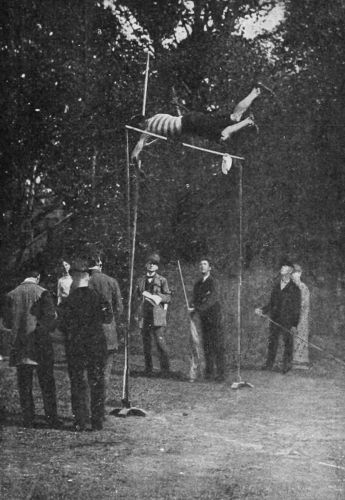
POLE VAULT AT THE I.-C. GAMES. Simpson clearing the bar at 10 feet.
The high hurdles were run in three pretty heats. Beers came home ahead in the first in 16-1/5 sec. with a couple of Brooklyn men upsetting the hurdles behind him, and Vom Baur took the second heat in 16-2/5. Then came a neck-and-neck race between these two. Beers, who won the Interscholastics, ran well, and both men leaped together all the way. But Vom Baur was a little stronger at the finish, and left his opponent only a few inches behind him. It was an exciting race, and an exceedingly close finish. Syme won the final of the low hurdles easily, after coming in behind Harris in his heat, and Brooklyn was closed out of any points in the event by Harris and Pell. Powell took the lead in the bicycle, and made creditable time, 5 m. 32-2/5 sec. This was doubtless due to the pacing of Ehrich, which was permitted by the mutual consent of the Interscholastic Committees.
The field events were more interesting than the track events, especially the hammer, in which the record was broken by two men. Batterman threw first, and landed at 123 ft. 7/8 in. The record is 117 ft. 4-1/2 in., made by Irwin-Martin at the Interscholastics on May 11th. Irwin-Martin did not appear at the Inter-City games. Having made so good a throw, Batterman felt confident of victory, but Ayres stepped up and threw 123 ft. 11-1/4 in. Neither mark was bettered after these two performances. Baltazzi kept up to his mark in the high jump, and cleared 5 ft. 10-1/2 in. Then he had the bar put up to 6 ft., and tried for a record. He nearly did it, touching only with his ankle-bone, and he did not try again. My assumption that Baltazzi would represent the N.Y.A.C. in the International games in September has proved correct. Captain Baxter has asked him to become a member of the N.Y.A.C. team. Cowperthwaite jumped half an inch further than he did at the Interscholastics, but came near being defeated by Jewell, who cleared 20 ft. 10 in., then lost his balance and fell back. Jewell is one of the best all-round men in the schools. Simpson's work in the pole vault was of the first order, his best jump, 10 ft. coming within 3/8 of an inch of the interscholastic record established by him the year before. The accompanying table will show the day's record. The names of the Long Island representatives and schools are italicized for convenience of reference.
RECORD OF THE INTER-CITY GAMES, BERKELEY OVAL, MAY 18, 1895.
Event.Winner (Five Points).
100-yard dashStevens, B. L. S.10 4-5sec.
100-yard dash, for JuniorsRobinson, St. Paul's11 2-5"
220-yard runStevens, B. L. S.22 4-5"
440-yard runJewell, Adelphi54 1-5"
Half-mile runMeehan, Condon2m.9"
Mile runMcCord, Dwight4"58 4-5"
120-yard hurdleVon Baur, Barnard15 4-5"
220-yard hurdleSyme, Barnard27 3-5"
Two-mile bicyclePowell, Cutler5"32 2-5"
Running high jumpBaltazzi, Harvard5ft.10 1-4in.
Running broad jumpCowperthwaite, Col. Gram.20"8 1-2"
Pole vaultSimpson, Barnard10"
Throwing 12-pound hammerAyers, Condon123"11 1-4"
Putting 12-pound shotAyers, Condon40"
Second.Third
Event.(Three Points).(One Point).
100-yard dashHall, YaleStevenson, Poly. Prep.
100-yard dash, for JuniorsWilson, BarnardArmstead, Berkeley
220-yard runWashburne, BarnardUnderhill, Poly. Prep.
440-yard runDraper, CutlerFisher, Harvard
Half-mile runHollingworth, Poly. Prep.Van Orden, Poly. Prep.
Mile runMosenthal, SachsRomer, Adelphi
120-yard hurdleBeers, D. L. S.Moeran, Berkeley
220-yard hurdleHarris, CutlerPell, Cutler
Two-mile bicycleMortimier, BlakeGillespie, Col. Gram.
Running high jumpWenman, DrislerGunnison, Adelphi
Running broad jumpJewell, AdelphiPowell, Cutler
Pole vaultPaulding, DrislerHurlburt, Berkeley
Throwing 12-pound hammerBatterman, HarvardFairbank, St. Paul
Putting 12-pound shotBigelow, W. & K.Mason, Poly. Prep.
Points made by
Event.N. Y.L. I.Schools.
100-yard dash36Barnard21
100-yard dash, for Juniors45Condon15
220-yard run36Cutler13
440-yard run45Adelphi10
Half-mile run54B. L. S10
Mile run81Harvard9
120-yard hurdle90Poly. Prep.7
220-yard hurdle90St. Paul's6
Two-mile bicycle90Col. Gram.6
Running high jump81Drisler6
Running broad jump63Dwight5
Pole vault90Berkeley3
Throwing 12-pound hammer81Yale3
Putting 12-pound shot81Sachs3
____D. L. S.3
9333W. & K.3
Blake3
___
126
Next Saturday the schools of the Pennsylvania Inter-academic League will meet on Franklin Field, Philadelphia, to decide the championship of the association in track athletics. I expect to see Jones of Penn Charter, who did 10-3/4 in the 100, last year, take the event again this spring, with Hunsberger, his schoolmate, second. Unless some new man develops, Branson of Penn Charter and Remington of De Lancey will fight it out between them for first in the high hurdles. Jones should be heard from again in the 220, and McCarty of Germantown will probably take the quarter. Thackara will push him. Thackara will also have a close contest with Hedges in the half-mile, as both are good men, and Thorpe of Penn Charter will see that they make their best time. Branson has a record of 5 feet in the high jump, and it is doubtful if any one else in the I.A.A.L. can better it. The pole vault is uncertain, but Beasley of Germantown has cleared nearly 8 feet. The running broad will probably go to Remington, whose record is 18 feet 5-3/4 inches, but it will be closely contested by Hunsberger and Shoenhut. As Boyd of Cheltenham M.A. will not contest this year, the hammer and shot are uncertainties, and will go to new men.
An unusually large number of schools came into the I.A.B.B. League this year, and some good games were the result. Germantown Academy and Cheltenham M.A. defeated all their opponents, and met last Friday to decide which school should fly the championship banner. The game was played too late in the week for me to be able to notice it in this Department, but I shall treat of it next time. The De Lancey School stands third in the race, with two defeats. Cricket is not a regular I.A.A.A. sport; but a cup, offered by the Haverford College Cricket Club, was contested for last year, and has been played for again this year by a number of the schools in the league. In 1894 De Lancey headed the list, with Germantown, Penn Charter, Haverford Grammar, and Episcopal Academy following in the order named. The struggle this spring will be between Penn Charter and De Lancey, neither having yet suffered defeat. Penn Charter has two strong bowlers in Jones and Brown but in my opinion neither one is quite up to Graves, De Lancey's plucky little, all-round cricketer.
The next three weeks will see some hard training among the athletes of the New England schools, for all the principal scholastic track meets in that region come during the first days of June. The first important meeting will be the dual games between Andover and Worcester Academy, which will probably be held in Worcester, on June 1st. Then the Interscholastic games of the New England League come, at Cambridge, on June 15th, and they will be preceded on June 8th by the Western Massachusetts I.S.A.A. games at Amherst, and by the Connecticut I.S.A.A. games at Hartford. At the latter we shall see some records broken, for Beck of Hillhouse High is throwing the hammer (16 lbs.) 111 feet in practice, and is putting the shot (also 16 lbs.) 39 feet. He is sure to add ten points to the New Haven school's score.
At the meeting of the N.E.I.S.A.A., held in Boston, May 2d, the legislators very wisely voted to keep men over twenty years of age out of all interscholastic contests. Cushing Academy and Phillips Andover wanted to change the constitution so that young men over twenty years of age, if at school, could participate in games held under the rules of the N.E.I.S.A.A. But, as I anticipated, they found few supporters, and the motion to refer the question to a committee was promptly defeated, and the subject dropped. Lynn High and Mechanics' High schools applied for membership in the League, and were admitted. The New England Association is now the largest interscholastic organization in the country, having twenty-eight schools in its membership.
The dual games between Phillips Andover and Worcester academies will be close, and will furnish an exciting contest. It seems a difficult problem at this early date to name the winner, for there are so many unknown quantities to consider. Nevertheless, the 100 will probably rest between Senn, P. A., and Bryant, W. A., with Barker, P. A., third; and the winner should certainly cover the distance in 10-3/5. The order of the 220 is likely to be Gaskell, P. A., Barker, W. A., and Woodward, P. A.; but as none of them are crack men, the time will be slow. Laing, P. A., and Fish, W. A., will have a tussle for supremacy in the quarter, and will make good time. Laing is the better of the two, and will probably take the half-mile, with Gaskell and Tyler, both P. A., behind him. Richardson, of the same school, will finish first in the mile, with Milner, W. A., a close second, and Lewis, P. A., behind him. Clare of Worcester ought to get the high hurdles away from Hine, who is Andover's best man over the sticks; but Hine will undoubtedly take first in the low hurdles. Barker, W. A., will push him hard, and Fish should come in third. Lockwood, W. A., will have an easy time of it in the walk, and it is uncertain if Andover has any one good enough to secure better than third place. The bicycle race will also go to Worcester, with Crouse, P.A., possibly in one of the places. Holt of Andover should take the shot event, and he will earn second in the hammer; while Edmunds, W. A., will reverse matters by getting first in the hammer and second in the shot. Andover ought to get third in this last event with Maltby. The broad jump is the most doubtful of any event, as neither school has any very good man for that number on the card. The high jump, however, will stay at Worcester in all three places, the probable order being Johnson first, Edmunds second, and Coelith third. Johnson will also win the pole vault for Worcester, as he can clear 10 feet 8 inches. Lewis, P. A., will come nearest to him.
The Graduate.
RECALLED STORMY TIMES.
"Well, that looks natural," said the old soldier, looking at a can of condensed milk on the breakfast table in place of ordinary milk that failed on account of the storm. "It's the Gail Borden Eagle Brand we used during the war."—[Adv.]