THE SHIP WITHOUT A LIGHT.
Reading edition
BY EZRA HURLBURT STAFFORD.
"Well, my boy, what can I do for you?"
It was in the Custom-house, and the Chief was sitting at his desk opening a letter. A boy of perhaps sixteen was standing awkwardly at the door. He was dressed rather roughly, and the Customs Inspector thought it would be a good idea to despatch the boy's business before he read the letter, which he had by this time drawn from the envelope.
"Well?" he repeated; but the boy still hesitated, and glanced uneasily across the room towards a tall lady, who was standing at the window with her back towards him.
"Anything very particular?" the officer went on, with a touch of annoyance.
"I guess I'd like to speak to you alone."
The lady evidently heard him, for without speaking she hurriedly drew her veil down over her face, and noiselessly left the room by a door which he had not noticed before. The boy caught a glimpse of her face as she turned, and gave a little start, he hardly knew why. It was a strange face.
"Now, then, we are quite alone, what have you to say? It's growing late."
"I wanted to speak to you, sir, about something I saw last night out in Puget Sound. I thought you ought to be told about it."
"Yes?"
"A boat, sir, that I think is smuggling opium in from the British Columbia coast."
"What is your name?"
"Thomas Walton. I'm a fisherman."
"What makes you think the boat is smuggling opium?"
"Because she passed down the channel about two o'clock last night and carried no light."
"What sort of a craft?" asked the customs officer, with a peculiar look.
"I should think she was a sailing sloop, sir— I couldn't see noways plain."
"When did you say?"
"Last night."
"Tell me all about it. Where do you live?"
"At my father's ranch on Padilla Bay; he's dead, and I live with my mother and sister there. I fish during the salmon season."
"Were you alone last night?"
"No; an Indian boy and myself have a boat between us; it was Jo saw her first."
"Well?"
"A MINUTE AFTER IT WAS LIGHT FOR AN INSTANT AND WE GOT SIGHT OF HER."
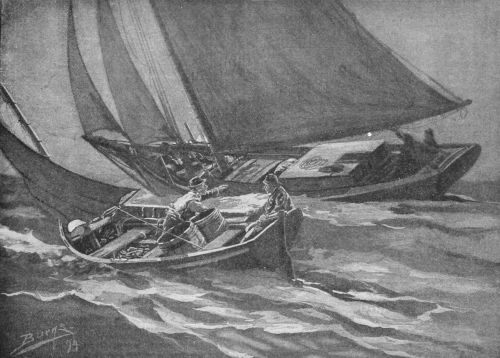
"We were tacking across the channel, and it was very dark. We had just come about, and suddenly I heard a swish in the water and felt something a yard or so off sweeping by. I couldn't see what it was at first. It seemed to pass in the air. Jo heard it too, and we were both pretty scared. A minute after it was light for an instant and we got sight of her, a few yards to windward of us, bending under her sail. Jo pointed her out to me, and the next moment she seemed to disappear. We got into port this afternoon very late with our fish, and as soon as I could I came to tell you."
"How many times have you seen this—this ship without a light?"
"Just the once. We don't carry a light ourselves, or we mightn't have seen her this time."
"Where was this?"
"To the south of Fidalgo Island."
"In the outer channel?"
"No, right below the slough, to the inner side of the island and the main shore."
"Where did the boat seem to come from?" the Inspector asked, looking straight in the boy's face.
"Well, we couldn't exactly be sure; but Jo seemed to think that she had come from the slough—that was what set us to thinking she must be a smuggler."
"Have you told anybody about this?"
"No."
"Don't. How about this Indian boy, this Siwash?"
"He hasn't said a word about it to any one. I made him keep it quiet till I had told you."
"Sure no one else knows?"
"No one; at least no one but the man in the outer office here."
"What did you tell him for?" the Chief asked, with sudden vexation.
"He wouldn't let me in till I told him what I wanted; he said you were busy."
At this moment the door opened and a man in uniform entered.
"Ah," he said, glancing at the boy, "he's told you, then. Had we better put any confidence in the tale? I've been speaking to the Captain of the Madrona about it. He is in the outer office now. He seems to think there is something in it."
"You may go now," said the Chief, with a preoccupied look, to the boy; "you had better go right home, and next time carry a light yourself. Good-evening."
"I am sorry you let the boy go," the deputy began, as the door closed; "we may need him for evidence. But here's the Captain."
A tall gentleman, in the uniform of the United States navy, entered the room at this moment. "I've been having a word with your salmon-fisher," he said, "and I think he's telling the truth. I'll catch them to-night when they're getting back north, and give them more light in Puget Sound than they will find altogether convenient. Where was it he saw them now?"
"I don't think the boy said," the deputy answered. "Did he tell you?" and he turned to his superior.
"Yes, he did, now I recollect."
"Was it in the main channel, or below the slough to the inside of the island?"
"In the outer channel; it was too large a boat to get through the slough."
"Why, I thought he said it was a sailing sloop," mused the Captain, turning to the deputy.
"So did I."
"No; the boy told me distinctly," the Chief replied, "that it was a much larger vessel, and that she passed him in the outer channel; though candidly, as to her carrying no light, we must remember that boys sometimes have wonderful imaginations."
"Then we'll keep the main channel;" and the Captain left the room.
Down among the ships in the harbor a small boat was moored. It had all the unmistakable signs of being a fishing-boat, and a youth with a large round face of a heavy brown mahogany color was sitting lazily at the edge of the wharf, when Thomas Walton made his appearance. They both got into the boat and pushed from the dock. It was growing quite dusk. The harbor lights were already lit.
"You told them, Tom?"
"Yes."
"What did they think?"
"I hardly know. I wish now I hadn't gone near them at all."
"Didn't they treat you white?"
"I don't know."
"You don't?"
"Well, they didn't seem to believe what I said, anyway. And there's something else I don't like the looks of."
"What else?"
"Oh, nothing much. I think I was followed down to the wharf. Look over there. Can you see? Is that a man or a woman in that boat there—the one that just came around the stern of the Umatilla?"
"A man."
"No, the other. You can't see now. She got down low the moment she saw me looking at her. Give her another haul. There; that'll do." The last remark referred to the sail which the Indian had hoisted as Tom was speaking.
"Why, Jo, where did that boat go?" he continued a moment afterward, looking back among the shipping.
The skiff was gone.
A couple of hours later they were cutting across Puget Sound before a fresh wind, with the slap and drench of the rising waves against their bows. The timbered uplands were darkly visible a mile or so ahead, and Tom called out to his companion in the bow:
"I say, Jo, I'm going to tack for the inner channel, and wait in the slough. I have been thinking this thing out, and I've got an idea in my head. I didn't tell the man at the Custom-house about the landing at the rocks."
"You didn't?" came a sleepy voice from the darkness.
"No; I was too confused at first, and afterwards I thought I wouldn't, anyway."
A mile up this narrow channel, or slough, as shallow places of the kind are called on the Pacific coast, there was a small bay, almost hidden by the vast overhanging fir-trees. On one side the shore was steep and rocky, but on the other there was a small strip of very convenient beach, where the boys had landed three or four times to mend their seine. The last time they had been there, Jo, in the spirit of exploration, had pushed his way into the thick woods, and a little way back had come upon a faint trail, which, after making a detour, they found led up to the steep rocks on the other side of the little bay. They never took the trouble to follow it inland.
"Place where the lumbermen land," Jo had remarked upon this occasion, pointing to the trunk of a cedar near the edge. There was a slightly worn place in the bark where a ship's rope had been fastened.
Afterwards they had remembered that the island was part of an Indian reservation, where no lumberman had any right to touch the timber.
Until the incident of the night before they had, however, given this no thought. But it had occurred to Tom then that the mysterious trail in the uninhabited island might possibly have some connection with the strange vessel.
"What are the customs officers going to do?" Jo asked.
"From the little I could hear I expect that the Madrona will keep watch for the smugglers in the open waters of the Sound. The slough won't be guarded at all, in that case, and I'm going to wait here till towards morning; then, if nothing passes, we can put into the bay, and see if there are any signs of anybody having been on the trail the last few hours."
"Not likely."
"Well, I'm not so sure of that—at all events we'll wait here through the night, and see if anything does happen."
"But if it isn't an opium smuggler at all; if it's a—a—"
"A what?" Tom asked shortly, familiar with the other's superstitious nature.
"Have we the gun?" said Jo, changing the subject.
"I don't know."
"Yes, it's here," answered the Indian, rummaging for it among a lot of odds and ends at the bow. "I wonder if it's—"
"Don't bang it off into me to find out if it is."
Some hours after midnight the boat of the boys was standing in for the little bay spoken of. They had waited further up the slough, but Tom, who of the two was the one who had kept awake, had heard nothing pass. It was still quite dark.
Jo suddenly started.
"Say, did you see that? There—there it is again!"
The boys looked upwards, and a great white bar of light, like a comet, swung across the sky above them. Then it swung slowly back again, faltering here and there, and appearing to rise and fall in certain places.
"It must be the Madrona's search-light," said Tom, "and they are right south of here."
They still had a full view of the open waters of Puget Sound.
"They seem to be coming this way," muttered the Indian; "there it goes again!"
As he spoke, an intensely bright cone of light leaped forth suddenly into the darkness, and moved from place to place along the high rocky shores.
"I'm glad it isn't as dark as it was last night," Jo said, as they rounded the point, and glided onward noiselessly upon the calm black water. "Do you see anything in the bay?"
"No; drop the sail," Tom whispered, and he steered the boat slowly through the suspicious inlet. It was quite dark in the shadow of the gigantic trees. As the bow grated gently on the sand, Jo stepped out, followed at once by his companion.
The next moment they were both appalled by an unexpected sound. It was the soft flap of a sail. As their eyes grew more accustomed to the gloom of the thick forest trees, they could see dimly a vessel of considerable size, moored to the very rocks they had been thinking of. It was the mysterious ship of the night before. It awed them too, to see it lying so near to them with its white sails all spread, and yet not a sign of life upon it. There was something weird about it all, and Tom could hardly prevent the Siwash boy from making an immediate retreat.
They continued to listen for some moments, but all remained still upon the vessel and upon the shore.
"I wonder is there any one aboard of her?" Jo said in an undertone.
"Keep still!"
In spite of this warning, Tom was himself the first to break the silence.
"Perhaps they've abandoned her."
"Then where can they be?"
"Do you want to know real bad?" asked Tom.
"Yes!"
"Well, you're good at following a night trail; just you follow that one back into the island, and you'll stand a fair show of seeing where they are."
This was humor, and Jo grinned appreciatively.
"Where is the gun?" Tom asked, presently.
"I have it; what are we going to do?"
"We're going to get that sloop out into the Sound, and sail her up to the city dock at daybreak. I'll show those customs inspectors—"
"They'll say you're the smuggler."
"Well, I'm going to risk it."
"Perhaps they're aboard now—asleep."
"Keep the gun ready, then!"
The boys were making their way towards the sloop along the narrow strip of sand yet uncovered by the flood tide, but as they spoke, they stopped with one accord, for they heard a sound from the trees near by.
"Cougar?"
"No," whispered the Indian, "a man!"
"Stand very still, then, and watch what happens."
They could hear the branches being pushed aside softly, and dull footfalls upon the forest moss.
Presently two dark shapes emerged upon the neighboring rocks. They were talking rapidly, but the boys could not catch what they were saying.
The Madrona was moving to the south of the island, and standing in towards the mouth of the slough. One of the new-comers saw the search-light.
"They'll be upon us in half an hour," Tom could hear him say; "we must steer around the point, and get up the slough, where a vessel of such deep draught as theirs cannot follow us. We'll he done for if we stay here."
The voice seemed familiar, but the boy was too excited to give the fancy a second thought. What he saw, only too plainly, was the easy way in which the supposed smugglers could make their escape, and, laying prudence aside, he instantly called out in what he intended to be a very commanding voice,
"Ahoy there! you can't go aboard till you say who you are, and what you are doing here."
Hardly were the words spoken when Tom saw a bright red flash, and was almost stunned by a loud report. He heard the crash of a rifle bullet through the branches behind him, and heard the echoes running along the opposite shores, growing fainter and fainter in the distance.
The shot was instantly returned, and there was a quick sharp cry from the rocks. He turned and saw Jo at his side, lowering the gun from his shoulder.
The next moment he heard a rustle in the trees near him, and hardly thinking of the peril in which he was throwing himself, he turned in swift pursuit. He struck the trail almost at once, and still heard the same odd rustle a short distance ahead of him.
He guided himself as well as he could in the darkness, often stumbling over the bared roots, or grazing his head against the low cedar branches. At times he stopped to listen. It soon became evident that he was catching up.
The pale light of the early morning was beginning to show dimly through the trees. The person ahead tripped once or twice, and Tom knew that he was now almost at hand. The unseen fugitive appeared to be moving with great difficulty. A moment later the boy heard a heavy fall a few yards in front of him, and running hastily forward was suddenly met by—a woman!
At this mishap, speaking for the first time, she uttered a harsh sound in a deep voice which there was no mistaking.
It was a man then, and not a woman, after all, Tom thought, and in his heart he blessed the smuggler's awkward disguise, which had allowed him to catch up.
But the smuggler, in the mean time, had drawn his revolver, and was on the point of aiming it mercilessly at the unarmed lad, when the latter, watching his motions with difficulty in the uncertain light, snatched quickly at his hand. The weapon was thus turned at random as the trigger was pressed, and Tom, deafened by a sudden report, drew back as the revolver flashed in his face.
The disguised man fell to the ground. The boy watched him for a moment, but he lay there quite still in the shadow.
A feeling of fear swept through the boy's heart, and he hurried back to the shore to call for help. The man might not be dead. He was surprised to find what a long distance it was back. He had not, in his first excitement, thought he had gone more than a couple of hundred yards.
As he drew near to the water's edge he heard the sound of a number of voices. The day was beginning to break. Coming out on the shore, he saw the Madrona lying at the mouth of the slough with the thick smoke wreathing from her funnel.
On the rocks near by several men in uniform were standing in a group about some object upon the ground. With a strange presentiment the boy made his way around the shore and joined them. What he saw there was a man lying upon his face. He did not need to see the features to recognize who it was.
It was the Chief of the Customs Department.
"Where have you been, Tom?"
The boy turned around at these words, and saw the Captain of the Madrona. The sight of his bluff honest face made the boy feel himself again; and reminded him, too, of his errand, which he had forgotten for the moment.
"I followed the man dressed up like a woman who was with him," Tom answered, excitedly; "he's a mile back in the woods now— I want to take a surgeon along, for I think he's killed. I caught at his hand with it in, and it went off somehow—the revolver, I mean—and I think it killed him—but I didn't mean to; I couldn't see."
"I'll go back with you at once—who did you say it was?"
The boy told what had happened as they hurried back through the trees.
"That must be Tee Ling."
"Who?"
"Tee Ling; you've heard of him—the most notorious opium smuggler on the coast— I see it's a trail."
"Yes, all the way. So it's a China man, then?"
"Of course. There's not a more detestable scoundrel among all the Chinese in America. He has a den some place on the British Columbia coast, and probably we'll unearth his southern headquarters within a mile or so of where we stand. He dresses as a woman simply as a disguise. He has a hundred of them. You've had a terribly narrow escape from him, my dear boy."
"I saw him at the Custom-house last night, when I was reporting what I had seen."
"Where—in the office?"
"Yes."
"Who would have thought it! We knew that the Chinese gang were working into the hands of one of our men, but we never thought it could be into his. There it is, a man's sin will always find him out in the end! What's the matter?"
"I—I feel kind of sick like. I guess I'm sort of a coward, but the thought of him lying there dead that way! I suppose a man like you gets used to it, but I—it makes me—"
"You needn't be ashamed to own to a feeling of humanity, my boy; no good man ever gets used to death or crime, though good men sometimes have to see a deal of both."
"Here is the place; but—oh!—"
"Yes, Tee Ling has wisely departed, I see. I expected as much, for Tee Ling is very sagacious. It's just as well we didn't bother about the ship's surgeon. Besides, he is too good a Chinaman to take our medicine, much less the dose of medicine the United States has ready for him. He's wanted in 'Frisco, you know."
"Well, I'm mighty glad he's alive, all the same," Tom remarked, in a tone of great relief. "I was dreadfully afraid he was dead, and I—I never killed anybody!"
"We will be sure to catch him during the day, nevertheless, for he can't get off the island, unless he disguises himself as a brown bear, and I'll tell the boys to shoot all the brown bears."
Tom laughed at this mild drollery, and they returned to the shore without seeing any trace of the Chinaman.
A lieutenant was standing on the deck of the smuggler's sloop. "There's ten thousand dollars' worth of gum opium aboard of her, Captain."
"Yes, and very likely double that amount more hidden some place in the island. Tom, what do you set your fortune at?"
"I guess about a hundred dollars would be more than I would ever know what to do with."
"What extravagant ideas you have! I think we will be able to suit you, though. Something like a hundred times over at the very least."
"Why, how do you mean?"
"Mean? Simply that this is to a great extent your 'find.' We heard your gun, and our suspicions were aroused at once. If it hadn't been for your nerve in the first place they would have got away. Are you willing to be fired at twice for nothing?"
One of the Madrona's men came up before the boy could answer, if, indeed, he had any answer to make, and whispered a few words to the Captain.
"Alive, is he?" the Captain exclaimed. "Get a stretcher and take him aboard at once or he may die yet of his wounds. Perhaps that would be the best thing he could do; but that's not for us to say."
To a boy of Tom's generous and manly nature it was a great relief to see the unconscious Customs Inspector carried aboard the Madrona. But he said nothing.
The Captain was silent also for a long time. Presently his attention was attracted by something unusual on the beach, and, dismissing an unpleasant train of thought, he broke out, "What have you there, men?"
Four of the Madrona's men were seen at this moment coming around the point on the shore with a very unwilling prisoner.
"There!" said the Captain. "I told you we would have him before the day was out. The lost are found, and the dead are alive, sure enough. Where did you get him?" he hailed, in a louder voice.
"Hiding on the shore."
"I'm afraid Tee Ling is getting childish," the Captain commented, in a voice aside to Tom, "if he is going to venture down to the water when things are as hot as they are now."
The men, who seemed to be having a great deal of difficulty, came nearer, and Tom called out in surprise,
"Why, it's Jo."
"Jo?" echoed the Captain.
"Yes; that's not Tee Ling; it's Jo."
"Who's Jo?"
"Why, the Siwash Indian who fishes with me. Hello there, Jo! Where in the world have you been?"
Jo's face was a pale fawn color with fear, but he did not answer.
"Let him go, boys," the Captain said, smiling. "It's all right. He's not the one we are after."
"It's all right, Jo," Tom repeated; but the latter, though now at liberty, was still silent and very serious. There were many cloudy thoughts shaping in his bewildered mind. He had expected to be sent to prison for being a smuggler, and hanged for shooting a man. It was difficult for him to get rid of these ideas on short notice.
Indeed, it is hardly probable that he ever clearly understood the strange turn which events took in the next few hours.
At any rate he was not heard to utter a single word for two whole days.