BOYS AND GIRLS OF NEW YORK STREETS.[1]
Reading edition
BOYS AND GIRLS OF NEW YORK STREETS.[1]
A DAUGHTER OF THE TENEMENTS.
BY EDWARD W. TOWNSEND.
In one of the Roosevelt Street buildings called "back tenements," because they are built in the spaces which were once the back yards of the buildings in front of them, when those buildings, years ago, were occupied by single, well-to-do, and sometimes fashionable, families, Gabriella Moreno was born. Her parents were not the poorest, by any means, of those who lived in that neighborhood, for her father, Antonio Moreno (he was called "Tony" by all his English-speaking acquaintances) was the proprietor of a fruit-stand, and did quite a prosperous business. In fact, among the Italians of that neighborhood it was somewhat a mark of rank to own a fruit-stand instead of a fruit "push-cart." Tony Moreno had been a push-cart fruit peddler for years, but some time after his only child was born he became the proprietor of a little stand near the entrance of the Tivoli Theatre on the Bowery. Part of the space his stand occupied was a broad entranceway which had formerly been used as one of the entrances to the theatre, but which was now closed for that purpose. Tony was one of the first Italians to settle in the neighborhood of Cherry Hill, which is near Roosevelt Street, and his knowledge of and influence over those of his countrymen who followed him there made him useful to Mr. Kean, the proprietor of the Tivoli, who was also in the business of politics.
That was the way Tony came to have the privilege of running a fruit-stand in front of the Tivoli. His profits were so great that he and his wife and Gabriella were able to keep their one tenement room, and it was a large one, all to themselves, without taking in two or three boarders, as most of their neighbors did, to help pay the rent. This made Tony one of the aristocrats of the neighborhood, and when it became known that Gabriella had a cot to sleep on, instead of sleeping on the floor, as the children of other families did, the neighbors looked up to Tony more than ever before as a man of high standing and solid position.
Gabriella's little friends, however, were in the habit of calling her "proud" and "stuck-up" on this account. When she was six years old Gabriella was sent to Miss Barstow's Mission School, where many other little Italian children also went, to learn to speak and read and write in English. Most of the children left the school when they were eight, and very few remained there after they were nine years old; for at that age their parents thought them old enough to help at home, to care for the younger children when both parents were away at work, and even to learn to do sewing for the big clothing factories. Gabriella would have been taken away, too, had it not been for Miss Barstow, who went to talk with Tony and his wife. She told them that Gabriella was one of her best scholars, and it would be to their interests, as well as their daughter's, to let her remain at school until she was well enough educated to do something better than sew on coarse clothing for wages which would never support her decently. This pleased Mrs. Moreno, who was ambitious for her pretty child, but Tony grumbled a good deal.
Gabriella was old enough, he said, to help earn bread, as the other children of her age did. Had not her father and mother worked since they were six years old? he asked. Then why should their child be kept in idleness only to learn things out of books which were well enough for the rich, but did the poor no good?
Miss Barstow was more interested in Gabriella than in any other child of the tenements she had ever known, for the girl was really unusually bright and pretty, and she was determined to keep her longer in the school. She knew that Tony had his stand at the Tivoli by Mr. Kean's permission, and to Mr. Kean she went for aid.
Miss Barstow's fashionable friends would have been surprised to learn how often she went to Mr. Kean for aid and advice, and to know how often he gave his aid, and how valuable his advice always was.
Mr. Kean smiled when Miss Barstow asked him if he could not help her keep Tony's daughter in school, and said, with rough politeness,
"Yes, I guess so, miss."
What he did was simply to shortly order Tony to do just what Miss Barstow wanted, if he knew what was good for him; and Tony obeyed without question, as did every one else in that part of the city who received orders from Mr. Kean.
That was the way Gabriella remained in the school until she was past twelve years old, and until the time her mother, who helped Tony at the fruit-stand, was taken sick. Then Gabriella took her mother's place, but she too became ill, and Tony had to close his fruit-stand part of each twenty-four hours, which caused that very penurious Italian great misery of mind, for his was what is known as an "all-night" stand, and he bitterly lamented his loss of trade during the hours of closing. Gabriella, under the careful nursing of Miss Barstow, soon became well and strong again; but the mother did not, and that was the reason it became necessary for the girl to take her place at the stand part of the time, dividing with her mother the hours when Tony went home to eat and sleep.
Miss Barstow knew that if she interfered further to keep Gabriella off the street and at school she might, with Mr. Kean's aid, succeed in doing so; but her knowledge of tenement-house life made her realize that such action would make the girl's home life unhappy. So she let her favorite scholar go without protest, intending, however, to keep as close a watch over her as she could, and to regain her for her school later, if she found that the girl's mother became strong enough not to need Gabriella's help.
Gabriella's "watches"—that is, the time she was on duty at the fruit-stand—were always in the day-time, and Miss Barstow would stop there frequently to speak to her on her way to the Mission House. She did this to keep track of the girl, and to leave her a book now and then. These were the only happy moments in the poor girl's life. She had learned to love Miss Barstow, and to care very much for books and other things Miss Barstow had interested her in, which now seemed far removed from her life, except when they were recalled by these visits from her teacher.
Every day now she went to the fruit-stand on the Bowery in the morning to relieve her father. There it was her duty to keep the stacks and pyramids of fruit in order, to dust them, to replace with fresh fruit from the boxes underneath the stand the pieces which she sold, and to keep a sharp look-out against the nimble hands of thievish youngsters. Every piece of fruit was carefully counted by Tony before he went off the watch, and when he returned Gabriella had to account for every sale and every missing piece.
One day Gabriella stood by the side of the stand, thinking how much happier her life had been when she went each day to the Mission School. She was wondering, at the same time, where she could have ever before seen the smartly dressed boy who stood in the doorway of the theatre office smiling at her. Somehow he was associated in her mind with Miss Barstow, yet where and when, if ever, she had seen him before was as indistinct in her mind as the memory of a dream. For several days she had seen him standing there, and from the first she had the impression that she had seen him somewhere else. She could not place him; he was much better and more stylishly dressed than any of the boys she had ever seen about her home or the school. He always had a friendly nod and smile for her, and she nodded and smiled in return; and although they had never spoken, she had never given up trying to think where, if anywhere, she had seen him besides there in front of the theatre.
As he stood there this day, looking somehow as if he owned the Bowery, a rough young fellow loafed up to the stand and asked, in an impudent manner,
"Say, sis, how much are dese bananas?"
"A cent each," answered Gabriella.
"WELL, JUST CHARGE DIS ONE," HE SAID, SEIZING A BANANA AND STARTING TO RUN.
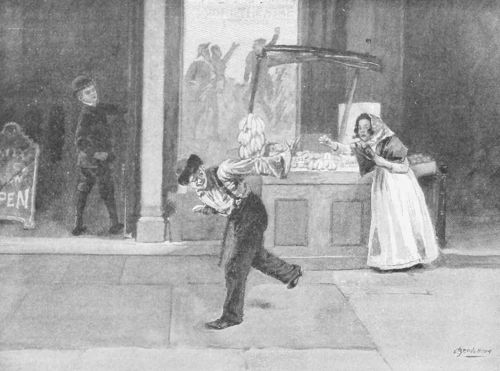
"Well, just charge dis one," he said, seizing a banana and starting to run.
As Gabriella began to cry out for the thief to stop, the smartly dressed lad in the doorway flew out like a Skye terrier after a rat. He had headed off the loafer with such surprising quickness that the latter was more amazed than frightened when the boy demanded of him to give up the stolen fruit. This demand only made the fellow laugh. The laugh soon came to an end, though, because Danny Cahill—for that was the name of the smaller boy—had not forgotten any of the quick and fierce methods he had learned to use in fighting larger boys when he had been a street arab. It was a very short struggle, and almost before the frightened Gabriella knew what was happening Danny was standing before her smiling, and her tormentor was skulking away, well thrashed for his meanness.
Danny's victory had been complete; he had not only vanquished the enemy but recovered the stolen property; and as he put the banana carefully back on the stand he said, good-naturedly,
"It's all right, little girl; what are you crying for?"
Gabriella stopped crying, and answered, "Because if that boy had got away with the banana, and I did not have a penny for it, my father would have whipped me."
Then to the great astonishment of Danny, Gabriella took a banana from the stand and offered it to him. Danny laughed outright at this, and exclaimed:
"Den if you haven't a penny t' show for de banana, your father will whip you just de same wedder de banana is stolen or you give it away to me. Won't he?"
Gabriella laughed too, now, and said, "Yes, but I'm willing to take a whipping for you, because you whipped that boy for me."
But Danny said he guessed he would rather pay for the fruit, and they were laughing and chatting over the adventure in the most friendly way when Miss Barstow came up. They told her the story, and she seemed greatly pleased. She told Gabriella that Danny was the boy who had helped take care of her and her mother the first night they were both sick with the fever.
"Then it was there I saw you before," Gabriella said to Danny, with delight. "I was not sure whether I had really seen you or just dreamed that I had."
"Well, you were doing a heap of dreaming dat night, sure," Danny answered.
"But you were a messenger-boy then," Miss Barstow said to Danny. "How is it you happen to be here and not in your uniform?"
"Oh, I'm Mr. Kean's office-boy now," answered Danny. "I'm to be his clerk when I'm big enough."
This information seemed to give as much satisfaction to Miss Barstow as it did to Danny.
"I like that," Miss Barstow said, "for now Gabriella will have some one to look out for her when she is on watch."
"Dat's right; as long as I remember how t' fight she will. Sure," Danny replied, earnestly.