Part 3 — CHAPTER IV.
Reading edition
THE BUREAU OF INFORMATION.
immieboy took the reins in hand, and the Merboy sprang lightly out of the carriage, and by means of his tail wiggled himself to where the bureau stood. He opened the top drawer, and from where he sat Jimmieboy, who was watching him with a great deal of interest, could see that it was divided up into sections, in each of which lay a dozen or more large envelopes, each fat with contents of some kind or another.
"I guess this must be the information I want about your lockjaw," said the Merboy, picking up an envelope. "Yes," he continued, as he took great slips of paper out of it. "It is. This envelope tells how to take spots out of carpets. Ha! ha! Listen to this: 'To remove an ink stain from the parlor carpet, take a pair of shears and cut out the spotted part.' That's good advice. Here's another telling how to start a fire. It says: 'First build your fire, and then procure a match. Any kind of match will do except one that has already been used. Light the match and apply the burning end to the kindling. If the kindling ignites, the fire is started. If it does not, light another match and apply the burning end to the kindling. Keep this up until the kindling does ignite!'"
JIMMIEBOY SAW A HUGE WHALE RUSHING DOWN TOWARD THEM.
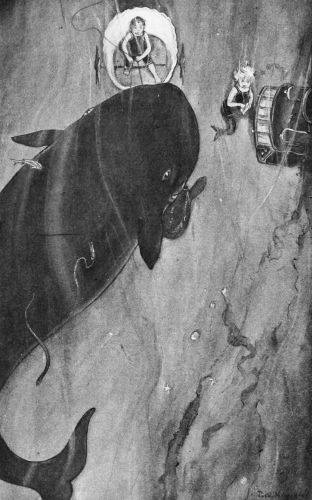
As the Merboy finished reading this a great commotion was heard in the water directly overhead, and looking up Jimmieboy saw a huge whale rushing headlong down toward him. At first he was a little frightened, but as the whale drew nearer and smiled pleasantly at him his fear for some reason or another disappeared entirely.
"Hullo, Merby," said the Whale. "What are you doing?"
"I'm after information," returned the Merboy, shaking the extended flipper of the Whale.
"So am I," returned the Whale. "I'm in great trouble."
"Indeed?" said the Merboy. "What's the matter?"
"I got into a fight with some whalers in the Arctic Ocean, and one of 'em threw a harpoon at me, and it stuck in my back. I want to get it out, but I don't know how. Which drawer has information for Whales in it?"
"I don't know," replied the Merboy. "I'm trying to find out what's the matter with Jimmieboy here. I'm afraid he's got lockjaw, but the only thing the bureau has told me so far is how to take spots out of carpets and start fires."
"What nonsense!" said the Whale. "Let me try it, will you? I'm suffering like everything."
"Certainly," said the Merboy, standing aside. "There isn't any special hurry about our case."
The Whale smiled gratefully and grabbed up an envelope. Opening it he extracted a slip of paper, and read:
"'To make a good peach pie get ten ripe sliced peaches, a tin plate, and enough dough to cover first the bottom of the plate and the top of the peaches. Put the whole into a hot oven and cook until done.'"
"Ho!" laughed the Merboy.
"This bureau's a nuisance," said the Whale. "The idea of telling a sea-monster with a harpoon in his back how to make peach pie."
Here he selected another envelope. This one contained a slip which read: "It is not polite to sneeze in company. If you like to sneeze, and are going out to an evening party, contrive to do all your sneezing before you go. If during the evening party you feel a sneeze coming on, rub the bridge of your nose, or press the middle of your upper lip with your forefinger, and the desire to sneeze will disappear."
"Nice advice to give a Whale," sneered the monster. "Where is my upper lip I'd like to know, or my forefinger for that matter? If I don't catch the right answer this time I'll hit that bureau with my tail and knock it all to pieces."
The Whale made one more effort. This time the slip he took out read, "If your teeth ache go to the dentist and have them pulled."
"That's a little nearer right," said the Merboy.
"I don't see how," retorted the Whale. "I haven't a toothache. I have a backache. Shall I go and get my back pulled?"
"No," said the Goldfish, "but perhaps you could get the harpoon pulled."
The Whale's face wreathed with smiles.
"That's so," he said, eagerly. "Wonder I didn't think of that before. It's a good idea. The bureau is some use after all—though if it hadn't been for you, Merby, I'd never have discovered it."
"Oh, yes you would," said the Merboy. "After you had thought it over a little while you'd have seen what was meant. Information isn't any good unless you think about it a little."
"Well, I'm obliged to you just the same," said the Whale, backing off. "It's pretty hard to think when one has a harpoon in his back. I suppose you don't know where I can find a dentist, do you?"
"No, I don't," said the Merboy. "I've never had occasion to use one."
"Oh, well, I suppose there are such things, and so I'll set about finding one. Good-by," said the Whale, and off he started in search of a dentist.
"He's a very dull creature," said the Merboy, returning to the bureau. "He never thinks much even when he hasn't a harpoon in his back. Now for our trouble again. This envelope looks as if it might tell us."
Again was the little fellow doomed to disappointment. All the information contained in this envelope related to the killing of potato-bugs, and the best way to keep mosquitos from biting.
"This is the worst failure of a bureau of information I ever saw, or else I don't know how to manage it," he said. "Suppose you try it, Jimmieboy. You may have better luck."
Jimmieboy dropped the reins and alighted from the carriage. Walking to the bureau he opened the second drawer and found it full of books. They were very handsome books on the outside, and if one could judge from their titles they were attractive inside too. One of them, for instance, was named The Porpoise of the Mediterranean, or A Minnow's Adventures on the Coast of Africa. Another was labelled Poems of A. Swordfish. Another was called Jellyfish Jingles, a title which so interested Jimmieboy that he opened it and read some of them. In a minute he threw his head back and laughed loudly, opening his mouth as widely as possible in his mirth. He was so amused that he couldn't keep his lips closed.
"Listen to this," he said; "it's called 'The Unfortunate Tale of the Polliwog:'
"The small sea-toad he climbed a tree One windy summer's day, And through the water chanced to see A pollywog grown gray; Whereat he cried, 'Oh, Pollywog, Come tell me, sir, I pray, How is it you are not a frog And yet have grown so gray?' "'Because,' the Pollywog replied, His visage turning pale; 'Because,' and here he deeply sighed, And sadly wagged his tail; 'Because,' he added, as the tide Grew wavy in the gale; 'Because I shed but tears; I've tried But cannot shed my tail.'"
"That's pretty good," said the Merboy, with a smile, noticing with a great deal of relief that Jimmieboy had at last opened his mouth. "Are there any more?" he added, just to see if Jimmieboy's cure were final.
"Yes," said Jimmieboy. "Here's one about 'A Sad Sea-Dog.'
"Oh, the sad sea-dog he has no fin, And he never moves, they say. He sits as still as a piece of tin, And he's never known to smile or grin, Or to wipe his tears away. "His chief delight is to bark and growl, And to yelp and screech and snap; He does not mind if the wild winds howl, He never will stir for fish or fowl, And cares not what may hap. "He shakes his flippers and wags his jaws, Delights in the awful gale, He breaks each one of the ocean's laws, And no one lives that can make him pause, From sharks to the mammoth whale. "And it's all because a fisherman— A man with a great green eye— Mistook him once for his black-and-tan, And whistled to him, and called him 'Fan,' In the days long since gone by. "When a sea-dog's name is Anthony Montgomery Varian, 'Tis apt to sour his spirit to be Miscalled as upon that day was he By a mean land name like Fan!"
"I should think so," said the Goldfish. "It's like being christened Algernon at church and being known as Petie in school."
"I don't wonder he sulked," said Jimmieboy.
"Nor I," said the Merboy. "But, say, Jimmieboy, you are cured of your lockjaw, aren't you?"
"Dear me, I forgot!" said Jimmieboy. "I wasn't going to open my mouth under water at all."
"Why not, pray?" asked the Merboy.
"For fear of swallowing the ocean," replied Jimmieboy.
"Ha! ha!" laughed the Merboy. "Why, you couldn't swallow a drop of it, much less the whole of it, the way I've fixed it. Is that all you were doing—just holding your month shut?"
"That's all," said Jimmieboy.
"Well, well! The idea!" said the Merboy. "You ought to have known better."
"Well, I didn't," said Jimmieboy, glad to find that it was not really necessary to keep his mouth closed.
"Apparently not—and it took the bureau of information to cure you. That's a very useful bureau."
"Very," said Jimmieboy. "I'd like to go through some of the drawers if we have time. Have we?"
"Lots," said the Merboy, taking the brush on the top of the bureau and fixing his hair with it. "We have ten times as much time as there is really."
"How can that be?" asked Jimmieboy.
"Well, never mind now," said the Merboy. "But some time you ask your papa how long a dream a boy can have who is asleep only ten seconds. You will be surprised at what he tells you. I once had a dream lasting forty years in a nap that was less than a minute long. So go ahead. You have plenty of time, and I dare say you will find lots of valuable information in the bureau. I will be back in a few minutes."
"You aren't going to leave me, are you?" asked Jimmieboy.
"No. I'm only going to drive the Dolphins around to the stable. I'll be right back."
The Merboy entered the carriage again and drove off, while Jimmieboy turned his attention to the bureau of information. As he turned, his eye caught sight of two little drawers that he had not noticed before on either side of the mirror which surmounted the bureau. He tried to open the right-hand drawer, but found it locked. The left-hand one opened easily, and in it Jimmieboy found a little golden key. This, as it turned out, was the key to the other drawer, and which, no sooner had the key turned in the lock, slid out as though pushed by a spring, and from it jumped the funniest little old man Jimmieboy had ever seen, hardly taller than his thumb, and dressed from head to foot in beautiful garments of silver and gold. In his left hand the little old man carried a jewelled staff, and his right hand he extended to Jimmieboy, as much as to say,
"Why, howdy do? I'm very glad to see you."
[to be continued.]

Although the New York athletes will by no means have a walk-over at the Berkeley Oval next Saturday, when the N.Y.I.S.A.A. and the L.I.I.S.A.A. contend for the Intercity championship in track athletics, they will certainly carry off the honors of the day, and they ought to do it by a good score. New York has better material this year than has Brooklyn, and the schools here have been devoting more time and energy to field sports than their rivals have across the Bridge. In fact, the Long-Islanders have shown a certain lack of interest in the Intercity contest which of itself is sufficient to betoken defeat. The relay race between the New York and Brooklyn Interscholastic teams was to have been run off at the Wilson and Kellogg games on April 27th, and a large number of enthusiasts gathered at the Oval to witness the sport in spite of the heavy downpour of rain. The hours passed, however, and no Brooklyn racers appeared. Not even a word of explanation came, and the race had to be postponed. It was thought at first that the Brooklyn team did not come over on account of the storm, but I learned the next day that the reason of its non-appearance was due to the fact that there was no team to come. Not enough candidates had applied at the Brooklyn trial heats for the managers to choose four capable runners. The very least these managers could have done, under the circumstances, would have been to notify the New York Interscholastic authorities of this fact. Young sportsmen, as well as older ones, should remember that one of the first considerations among amateurs is to fulfil engagements that have been entered upon, or if this is found to be impossible, to give ample and timely notice to their opponents of their inability to do so.
While it is gratifying to see such active interest displayed by the New York schools in out-door sport, it is also to be regretted, as I have had occasion to say before in this department, that so much of this interest should be turned in one direction. The New York school-boys have taken up track and field sports to so large an extent that baseball has suffered materially this spring, and tennis has practically been dropped. Such a state of affairs must surely bring evil results. It is a condition that cannot last long, but while it does last it works considerable harm. The genuine interests of field sports are not advanced by excessive indulgence. It is best to encourage every game that the season favors, and to attempt to do well in all branches of sport than to excel in but one. Such an excellence can be but ephemeral. In New England the school-boys are wiser in this respect. They endeavor to develop themselves in all branches. Only a few days ago Mr. D. S. Sanford, principal of the Brookline High-School, told me that from statistics he had prepared he had learned that twenty per cent. of the boys at the High-School play football, fifteen per cent. play baseball, fifteen per cent. take part in track athletics, and forty per cent. (of the boys and girls) play tennis. Fifty per cent. take part in no athletic games at all. From what I have observed in and around Boston I should judge that the athletic efforts of most of the other New England schools are distributed in a similar ratio. And yet, with only fifteen per cent. of the boys indulging in track athletics, they manage to make pretty fair records!
In Brooklyn baseball has not been allowed to suffer neglect because of track athletics, and so the race for the Long Island championship promises to be interesting. The teams are evenly matched with but one or two exceptions. Pratt Institute has no nine in the field, and Bryant & Stratton's is practically out of the race, having already been defeated a number of times. The St. Paul's team has a decided advantage over most of the other nines in the Association in that it is mainly composed of experienced players, most of whom were members of last year's nine. Hall is pitching well, and has good support. The Brooklyn High's team is made up wholly of raw material, with the exception of Captain Brum, but the men are working hard, and will do well before the season closes. One good feature in this year's High-School athletics is the barring out of all questionable candidates, the two forfeited championships of last year having evidently proved a salutary lesson. The Brooklyn Latin has one of the strongest nines in the league, and will probably make a strong bid for the pennant. Captain Litchfield is playing good ball at third, and both Goodwin and Sleven are doing good work at short-stop and first base respectively. Hall, of last year's Poly. Prep. team, is pitching, and Watt, formerly of Bryant & Stratton's, is catching.
The Adelphi Academy has turned out a better set of players than it had last year, and promises to make a good record. The team is made up pretty much of new material, but the men are working hard. Jewell and Simpson alternate in the box, with Forney as back-stop. Byers at first and Graff at third are capable players. Poly. Prep. is laboring under the disadvantage of an unfavoring faculty—a group of honest gentlemen who have not yet caught up with the fact that athletics have come to stay, and are, in moderation, a part of every educational system. As the school officers take no interest whatever in the sport, the players are working along as best they can under these adverse circumstances, and they are fortunately getting good support from their fellows. The authorities have gone further than being passive in their attitude toward athletics by ruling that Stevenson, the Captain of the nine, shall only play in league games. This is all very well if Stevenson neglects his studies for baseball, but as far as I am able to learn, such is not the case. Dunne is pitching fairly well, but to be successful he must get better control over the ball. Noyes, who is acting as substitute Captain, is putting up a steady game at second, and McKay is doing well at first. The other players are new. The out-field is weak, but the team work at times is fairly good, and the men certainly have a spirit and energy which are commendable.
Even a casual observer cannot fail to notice how much more is done for interscholastic sport in New England than in New York and its vicinity. Not only do Harvard and Yale universities take an active interest in the work of the young men whom they expect to gather into their own ranks, but even the Boston Athletic Association, which cannot hope to derive any material benefit from its exertions, offers cups and medals for interscholastic events, and does all that is possible to aid and advise the Boston school-boys. It seems to me that the New York Athletic Club could do worse than follow the B.A.A.'s good example. As far as I know, the N.Y.A.C. does nothing in the interest of school sports. To be sure, my indefatigable friend Evert Wendell performs enough good service as referee at scholastic contests to make up for many of the club's shortcomings; but Mr. Wendell does this purely as a lover of sport, and not as a representative of the club. Many of the best athletes of the N.Y.I.S.A.A. are members of the N.Y.A.C. They ought to get together in the near future, and, with the aid and advice of Mr. Wendell, endeavor to get the managers of the N.Y.A.C. to show more active interest in the exceedingly good work now being done by the schools.
In Boston, all the Interscholastic Committee meetings are held in the B.A.A. club-house on Exeter Street, and every winter the club holds an in-door meeting for the especial benefit of the thirty schools that compose the New England League. The silver cup which the B.A.A. has offered this year to be played for for five years by the school baseball teams is a fine trophy, and cannot fail to act as an incentive to the young players of the league. Harvard's work for the schools is even more active. Seven years ago the university was instrumental in forming the New England I.S.B.B.A., and in 1891 it organized the Interscholastic Lawn Tennis Association, whose fifth annual tournament was held on Jarvis Field, Cambridge, May 4th and 6th, with an entry list of over fifty names. The prizes offered each year are a gold medal or a cup to the winner, a racquet to the runner-up, and a championship banner to the school whose team scores the largest number of points. This year the cup is a handsomely engraved piece of silverware in the shape of a pitcher with one handle. As a general thing, I do not believe in medals and cups as inducements to young men to enter into amateur sports. The pure love of the game should be sufficient to call out their best efforts. But there is no doubt that interest in their early efforts, expressed in some such material way by associations of older players is a good thing, and it is certainly a strong incentive to a general participation in athletics for many boys who might otherwise be too indolent or too disinterested to discover and develop their own capabilities. This once done, however, there is no school-boy who is not enough of a true sportsman not to keep on, regardless of any possible material advantages or rewards. The mere title of champion is the most precious prize to be won in any field.
That Harvard's efforts for the promotion of tennis in the New England schools have been successful there is no doubt. At the first tournament, held in 1891, R. D. Wrenn, now the national champion, then in the Cambridge Latin School, was the winner, and he helped earn the pennant for his school. The following year Malcolm Chace met Clarence Budlong in the Interscholastic finals, and, after a hot match, Chace took first, and carried the banner to the University Grammar School of Providence. Budlong won in 1893, but only after a hard struggle with Ware, of the Roxbury Latin, who came up again in 1894 and carried off all the honors, including the championship banner for the school making the highest number of points. Ware's second victory in the finals last week entitles him to a position among the leading young players of the country, and I have no doubt that he will win at Newport in the Interscholastic tournament this summer.
Jarvis Field afforded a beautiful sight while the tournament was going on last week. There were twenty-two courts in use during the preliminary rounds, and a goodly number of spectators stood around to watch the players. I was most interested in Ware's work, and gave most of my attention to his play. He was in three matches the first day, and won them all. He first met Edwards, who is a strong player, and who made him do some sharp work in the second set. Ware is particularly good on hard drives, and it is really inspiring to see him smash the ball at the back line, and come within a few inches of it every time. But Henderson was lively, and returned many of the champion's swiftest drives; he would have made a better showing if he had been more accurate in his placing. Later Ware defeated Bartlett and Seaver, both in two straight sets, three of which were love sets. Fitz showed great improvement in form over last year, and reached the semi-finals. He is a rising young player, and will be heard from next year. On Monday, the 6th, Ware played in the semi-finals and the finals and won the cup. Newton High took the pennant offered for the school winning the greatest number of points.
W. T. LAING. N. W. BARKER. ANDOVER ACADEMY'S TWO RECORD RUNNERS.
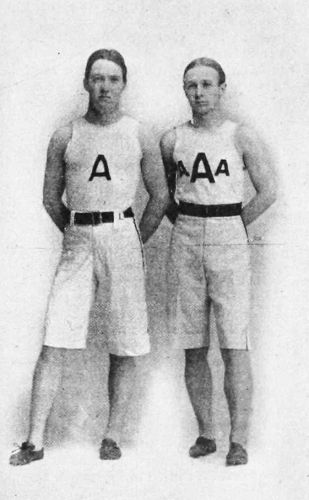
Arrangements are being made to bring about a meeting between the track-athletic teams of Phillips Andover and Worcester academies. As yet no date has been set for the games, but if the two schools can come to an understanding on certain minor points, it is probable that they will be held at Worcester during the week previous to the big Interscholastic meeting at Cambridge in June. The games will be most interesting, for both the Worcester and Andover academies have strong teams. Readers of this department will remember that the Worcester Academy took second place, with 141 points, at the in-door meeting in Boston last March, and Andover won the Interscholastics in June last year. The programme of the dual games will be the same as the Intercollegiate order of events, and only three candidates will be entered from each school. Worcester's best sprinter, Clark, has been ill, and will not run again this year, and so Senn or Barker of Andover will have a better chance for the 100 and 220. Barker, however, is inclined to be indolent, and is not careful or regular in his training. Laing of Andover is pretty sure to win the mile. He won that event in the Interscholastics last June in 4.32-2/5, but as he is twenty-one years old this year, he is debarred from competing on Holmes Field in June. This I.S.A.A. rule would not affect his status in the Worcester-Andover games, however, and Laing will there try to lower his record. Holt will take the shot event for Andover, and Malby, his schoolmate, will probably get second. Holt should also win the hammer throw. Lorraine of Andover will do no better than to secure a place in the 440, which will be won by Judd of Worcester, if he runs. But Judd may reserve himself for the half-mile, which he is sure to take. As Andover has no good men in the jumps, Worcester should get 10 points or more there, and Johnson of Worcester will easily take the pole vault, having a record of 10 feet 8 inches. Barker will give Hine a close race over the low hurdles, and may win. Hine took the event at the Interscholastics last year. These dual games will be an excellent thing for the advancement of the sport, and I hope some of the other large schools, situated at a distance from one another, will take up the idea and arrange similar meetings.
A field meeting of Pacific Coast amateurs was held at the Olympic Club Grounds, San Francisco, April 20th, and the school-boys who entered made a very good showing. The games were held for the benefit of the University of California team, now in the East, and the young athletes of the A.A.L. compared very favorably with the men who have come on to joust with Yale, Princeton, and Pennsylvania. Jackson of the Oakland High-School won the mile run in 4 min. 38-3/5 sec., with Brown of the University of California second. Brown led in the last lap until the stretch, when Jackson spurted and won by the very narrow margin of ten inches. Jenks, O.H.-S., won the quarter in 52-3/5 secs. by ten or twelve yards, with two university men, Barnes and Parkhurst, behind him. Cheek, the captain of the O.H.-S. team, got second in the broad jump, covering 21 feet, and cleared 10 feet 2-1/2 inches in the pole vault. McConnell, O.H.-S., cleared 5 feet 3 inches in the high jump, and took second in the event. The Pacific Coast scholars may well be proud of these achievements in a competition with men so much older and more experienced than themselves.
The Graduate.
This Department is conducted in the interest of Girls and Young Women, and the Editor will be pleased to answer any question on the subject so far as possible. Correspondents should address Editor.
Ailsie Bond came to see me on last Saturday afternoon, and I noticed at a glance that something was wrong. I knew it by her very step and her look. Ailsie is one of my darlings, such a bright, brave girl, always just where one expects to find her, the sweetest, dearest, sunniest of companions. But she was under a cloud last week. Let me add that she is sixteen years old, and a school-girl.
"I am so homesick," she said, sitting in her favorite corner of the lounge, with her elbow resting on a cushion. "Here I've kept up for months working hard and learning ever so much, and feeling every day that father and mother are so good in sparing me to stay away so long, and in giving me these advantages, and now, when the last school term of the year is almost ended, examinations coming on, and then so soon home, sweet home and a long vacation, I can't stand it. I want my mother. I want to sleep in my own little room. I want to hug the baby. I want to count the silver, and dust the parlor, and keep the library in order, and run to meet my father when he comes home from the office. Oh, I know it is silly!" she said, laughing and crying both at once, "but I can't help it. I'm homesick, and I'd rather have the toothache. It wouldn't hurt any more."
There was no use in arguing with dear Ailsie, so I comforted her as best I could. You girls who are away at school know all about it. The homesick hours must come, and you wouldn't be really home-loving girls if you didn't have them. But if one never went away from home, she couldn't have the joy of going back there, and being met at the station by her big brother, and having father and mother welcome her, and the little ones show how much they had grown in her absence, even the cat and dog showing their delight that one they had missed was with them again. Poor puss, and poor collie and terrier, I often wonder at their dumb wonder and speculation as to what has become of their friends when somebody in the house goes off and stays away a long while. They cannot talk, but they purr or wag their tails, and all but laugh when the friends return. Yes, girls, brace up, as your brothers say. A half-hour at home will console you for the homesickness you suffer from when absent. Keep up your courage, and at the worst remember that
"The darkest day, Live till to-morrow will have passed away."
The woods are perfect dreams of beauty in these May days, and what with the dogwood blossoms shining in starry splendor, and the laurel getting ready to bloom, and the orchards drifting their pink-and-white blossoms on the softly caressing winds, the world is a beautiful place. Be on the lookout for exquisite things and you will surely find them. It is a pity to go blindly through so much splendor. Use your eyes and observe; every day will show you something new.
Did you ever notice how cunningly some birds hide their nests, weaving them of twigs just the color of the ground, and then sitting on their eggs almost in your sight, yet so unobtrusively that you discover them only by accident? The little sociable wrens, less timid and more friendly, build their nests by the very house door, and are not afraid to let you have a peep at their pretty housekeeping. Birds are interesting neighbors to my mind.
Anna C. asks what you must have at an afternoon tea. You may have anything you choose, sandwiches, small cakes, salads, ices, candies, and, of course, tea served with cream and sugar, or with thin slices of lemon and sugar. But you must have, or, rather, you need only have, if you wish, tea and very thin, daintily served slices of bread-and-butter. The idea of afternoon tea is merely a light refreshment about five o'clock in the afternoon, when you may have a few moments' pleasant chat with the family and your friends, and when what you eat and drink is a delicate accompaniment to the conversation. Among the most acceptable sandwiches are those made with a crisp green lettuce leaf between thin slices of bread-and-butter, the lettuce salted and sprinkled with vinegar, or of very dainty brown bread with cottage cheese thinly spread on the two inner sides.