Part 3 — KNICKERBOCKER GRAYS.
Reading edition
BY ANNE HELME.
"IN TIME OF PEACE PREPARE FOR WAR."
IN COLUMN OF COMPANIES.
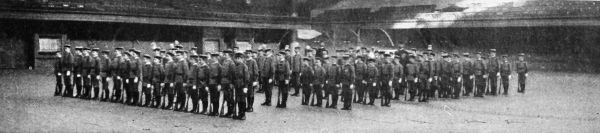
The clear tones of the bugle sound through the big arsenal, and there is a rush of small gray-clad boys carrying guns to their proper places. Again it sounds attention! Assemble! And a long line is formed of apparently motionless statues. Then comes the roll-call. As in the regular army, the First Sergeant in command calls out the name. His voice is not stentorian, and neither are the answers, but there is a very effective military tone and ring to them, and answering every purpose. The orders are given by the different boys in command—First, Second, and Third Corporal, First, Second, and Third Sergeant, First, Second, and Third Lieutenant, Sergeant-Major, Color-Sergeant, Captain, Adjutant, and Major.
THE MAJOR.
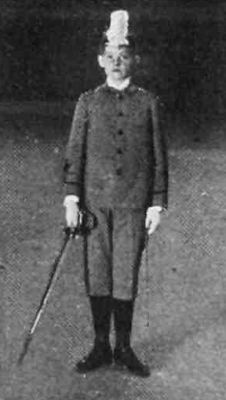
THE MAJOR AND HIS OFFICERS.
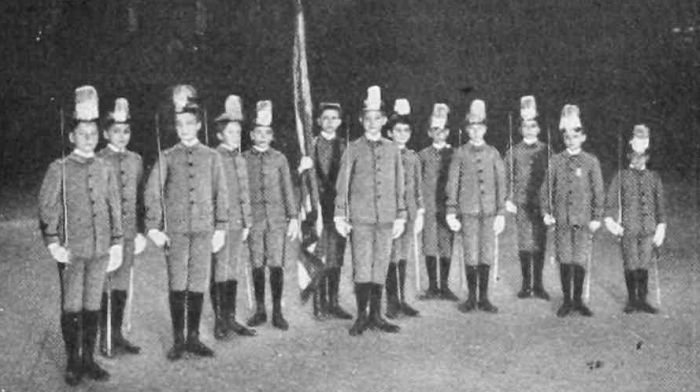
To one who is not conversant with the manual of arms, the commands given are somewhat bewildering; but so well trained are the boys that they answer, and some with military precision, and present arms and carry arms in a delightful manner, eminently military, not always satisfactorily, for the small boys in command have sometimes to repeat their orders, and occasionally Captain Hoyt, the officer in command, and also an officer of the United States army, has to enforce the orders in a more far-reaching voice and authoritative manner.
THE DRUMMER.
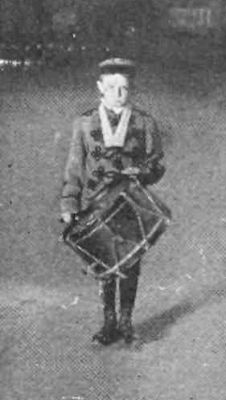
The Knickerbocker Grays is a private organization intended to instruct the sons of New-Yorkers in the knowledge of drilling. It is managed by several ladies, who give their personal supervision to it. The class meets twice a week during the winter season in the arsenal of the Seventy-first Regiment, at Thirty-fourth Street and Park Avenue. The ages are limited, no boy under seven being allowed to enter. The uniform is gray, with black trimming, and all the military rules as to the number of straps, epaulettes, and accoutrements are rigidly adhered to. The boys learn to march well, although it is a comical sight to see some of the very small boys carrying their muskets and making superhuman efforts to keep time. Perhaps the pathetic note in the picture adds the finishing touch in the little drummer-boy, who, clad in the same uniform, drums with might and main. He is paid to drum, but there is a look of pride and delight in his profession which quite prevents any thought of pity at the contrast in his lot to those of the boys of his own age who go into the drill merely for the sake of occupation and amusement.
The boys love Tuesday and Friday afternoons, and although the stimulus of the medal given to the one who does not miss a single drill has something to do with the wonderful attendance, still it would be difficult to keep the boys away even without having the prize to look forward to. To answer to the name in roll-call is counted necessary, and many a boy who has been far too sick to go to school or study finds it quite possible to be on hand to answer to his name, even if, after a few marches around the armory, his legs do get tired and he has to be excused.
Promotion is eagerly looked forward to, and there is an immense amount of pleasant rivalry over who shall be promoted to be Sergeant, Corporal, and the other officers. The Color-Sergeant carries the colors around with a most heroic disregard to fatigue, while the four boys who make up his body-guard look at him most admiringly, and not in the least enviously. Round and round the hall they go, while the notes of the drum rattle out the time to keep. The officers give their commands, and the companies go from right to left as they are bidden. The officers look very stern, and the soldiers themselves seem thoroughly impressed at the importance of their duty, although the boy nature will crop out at times, and there are occasionally ebullitions of sheer good nature and animal spirit which would hardly do in the regular army. Of course each boy intends fully to be a soldier, and if a war should break out it is to be feared that a number of young recruits would insist upon being of service to their country.
The awkward squad is as amusing as all awkward squads always are, but is only to be seen at the commencement of the winter. It is composed entirely of beginners, who have to attain a certain degree of efficiency before they can be put with the others. But as the American boy is very imitative, he soon learns, and at the end of the term it would be difficult for any one to pick out the boys who had only belonged for one winter. The Captains and Lieutenants are fine, manly-looking fellows, and their plumed caps and glittering accoutrements are extremely becoming. They have a full sense of the dignity of their position, as why should they not have, when promoted from the ranks, step by step, to the proud office which they now hold? They have not bought their commissions, but have earned them by good, conscientious work. The boy who shirks, fools, and carries on has the mortification of staying a private, while his comrade goes steadily upward. The two officers in charge, Captain Hoyt and assistant, have, the boys complain, regular lynx eyes, and sometimes find out trifling acts that are not compatible with military discipline, much to the surprise of the fellows themselves. When a boy is promoted, his promotion receives no end of congratulation and applause from his fellow-soldiers, and it is doubtful if a prouder moment can come in any man's life than comes to the boy when he is put in command of the Knickerbocker Grays.
There is considerable emulation among the different companies. The Grays, by-the-way, are divided into four companies, A, B, C, and D, and each officer endeavors to have his company the best of all. And woe be to the boy who is insubordinate. However, cases of real insubordination are extremely rare, for the boys soon catch the spirit of true military life, and realize that the commands given must be obeyed at once and without any question. It is contended, and with reason, that one of the best features of the drill is this very spirit of discipline, which every mother knows is one of the most difficult things in the world to inculcate in boys.
"RIGHT FORWARD, FOURS RIGHT."
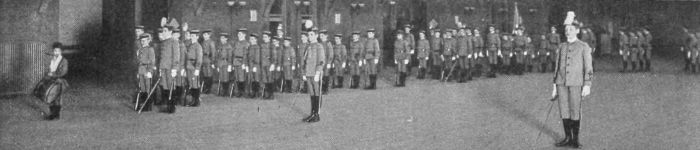
The first movements of the regiment are quite picturesque. After the roll-call the First Sergeant in command calls out "Count fours!" in other words dividing off four boys at a time; if they are more than make even fours, the Second or Third Sergeant takes the extra boys and reports with them to the Color-Sergeant, who takes them for his guard. "Right four, fours right," is then called, and the boys take their positions. The First Sergeant faces about and salutes his Captain. When the Captain has returned his salute, the Sergeant takes his post two paces behind the company. Now is heard the tread of feet, and the Captain to whose company the colors belong commands "Carry arms! Present arms!" Then the Color-Sergeant and the body-guard march in front of the company, and the Color-Sergeant takes his place two paces to the left of the Third Sergeant, who is on the left guard of his company—and the drill begins.
This Department is conducted in the interest of Girls and Young Women, and the Editor will be pleased to answer any question on the subject so far as possible. Correspondents should address Editor.
Do I ever have the blues? Why, Lottie, what a question to come from a girl of sixteen? Am I to infer that you do, at your age, with the world a blaze of beauty, and your feet so light and your heart so young that you ought to go skipping instead of walking, if only you dared to let the gladness of your life overflow.
But girls do have the blues, insists Gretchen, at my elbow; and she adds that they have reasons enough: that they are not always understood, that they have fancies and thoughts which they cannot always explain, that, in short, girls are not always as happy as they look.
Granting that this may be true of some girls, what are they to do? As a person not subject to these disagreeable visitations, I can speak with the sort of authority the doctor has when he enters the room of a patient. The doctor need not have a fever in order to prescribe for it. In fact, he will prescribe more successfully if he be well himself. The blues make the person suffering from their presence extremely uncomfortable, and her discomfort in a subtle way acts upon others, so that nobody is quite cheerful in her neighborhood. People who are "blue" are quite often cross as well, and are unable to accept pleasantly the ups and downs of every day. Now, when you think of it, you must admit that it is a very humiliating experience to be cross, for cross people are 'disagreeable, and none of us wishes to be that.
The best way to get rid of the blues is not to own that they have you. Put on your hat and go for a walk. Call on a friend and take her the piece of music you are to try together, or the book you have just finished, which you would like to lend her. Do something kind for somebody, and stop thinking about yourself. The greatest waste of time in this world, dears, is to think too much about one's self. Mrs. Browning gives the right idea in her poem, "My Kate," where she says,
"'Twas her thinking of others made you think of her."
Don't laugh at me, girls, when I tell you that half the low spirits one hears of springs from a very prosaic source. That pound of chocolates, that rich pudding, that piece of frosted cake, all of them very delicious, but all very indigestible, are to blame, in most instances, for a young girl's depression. Try what Emerson called "plain living and high thinking," and see how cheery life will become.
One of my girls writes that she had a vexatious little problem. She has been accustomed to correspond freely with one or two friends—boys of her own age—and "people tell her it is wrong." My dear child, pray explain whom you mean by "people," and what they have to do with it?
Of course you do not write letters to any one without your mother's approval, and I suppose your mother reads your letters, that you love to share all those you receive with her, and that you show her those you write. If you do this, nobody else is concerned. A girl should write no letters, and should receive none, which she is not only willing but very glad to show to her mother. When she has had the great misfortune to lose her mother, then her aunt, or her elder sister, or some kind matronly friend should be her confidante. It makes no difference to whom she writes, if only she does it openly, and with the sympathy, advice, and loving approval of those who are older than she, and able to guide her.