PRACTICAL GOLF.
Reading edition
BY W. G. van TASSEL SUTPHEN.
(In Five Papers.)
III.—THROUGH THE GREEN, AND BUNKER PLAY.
THE WAGGLE.
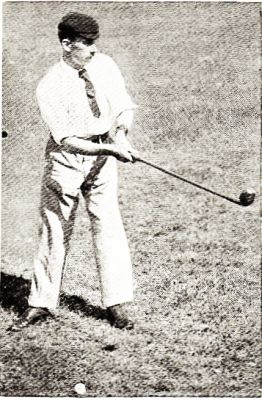
The "green" is used generically to designate the whole course, specifically it is the putting green. Now we know that after the tee-shot we must "address" and play the ball as we find it. We are not permitted to tee it again, nor must we touch it with anything except a club, under penalty of one stroke. The choice of club naturally depends upon the distance from the hole, but more especially upon the "lie" of the ball. Should it be resting cleanly on close firm turf, we may be able to use the driver again; but, generally speaking, our American courses are too rough and cuppy to permit the employment of so fragile an instrument as the wooden driver. On some of the English "greens," and notably Westward Ho, the lies are so good that one's ball seems to be always teed, and proficiency with the wooden club is consequently at a premium. But on ordinary courses the "lie" is pretty sure to be more or less bad, and the play-club, as the driver is sometimes called, must be laid aside in favor of a coarser and more effective weapon. Speaking roughly, the brassy is first choice, followed by cleek, medium iron, lofter, mashie, and niblick, the last being used only in the most desperate of straits, and where nothing more is expected than to get the ball upon the course again.
The fascination of golf lies in its variety and difficulty. If it were only a question of holing balls, one long hole laid out over a smooth meadow would be all that would be necessary. But it would be very monotonous and uninteresting kind of work, and certainly not golf. Given six or nine or eighteen holes of different lengths, and the task at once becomes interesting through the introduction of the element of variety.
GETTING OUT OF A BUNKER.
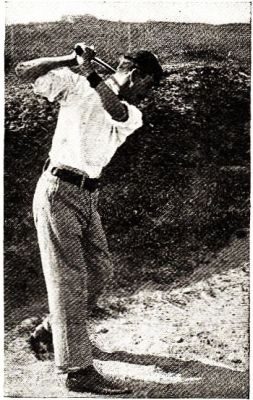
But a simple variation in distance is not enough; the game is still too easy. We must have difficulties to avoid or overcome, and these difficulties, lumped under the general name of "hazards," may be either natural or artificial. The idea is that these hazards should be so placed as to punish only poor strokes, and that with perfect play we may avoid them altogether. But for present purposes we may ignore their existence, and assume that the way is clear, and that our only difficulty is the particular position, or "lie," of the ball.
Now there are many kinds of bad lies, but the one oftenest encountered is the "cupped" ball. Here the ball is lying in a shallow hole or depression, making it very difficult to get the club well under it. If the cup be not too deep we may take a brassy, but the stroke will differ slightly from the regular full drive. It should be what is called a "jerked" shot, although the "jerk" has nothing to do with the swing proper. That must be as smooth and regular as possible, but it may be permissible to keep the arms in a trifle, and thereby bring the club up straighter. The principal difference is that the club head cuts into the ground instead of sweeping cleanly over it. The ball is struck in precisely the same manner, and the jerk is simply the after impact of the club head upon the turf. This stroke is particularly effective with the iron clubs, and indeed many players use it for all their iron shots. It certainly drives the ball almost if not quite so far as the clean swing; but the author of the Art of Golf thinks that its constant use tends to unsteadiness at the tee. Nevertheless, it is the only effective treatment for a cupped ball, and it must be learned. When playing the stroke do not think about the jerk. Swing down so as to nip in between the lip of the cup and the ball, and let the club head make its own explanations to the ground. Should the ball be badly cupped you may have to take the mashie or even the niblick to get it out; but the cleek will generally do the work if you hit accurately.
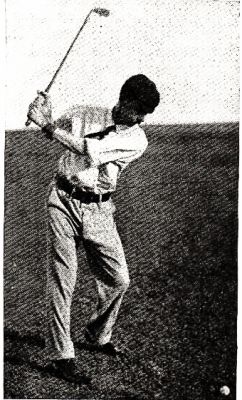
BEGINNING OF HALF-IRON SHOT.
A hanging ball is one that is lying upon a slope that runs down in the direction of the proposed drive. It looks hard to handle, but the difficulty is purely imaginary. The brassy, or any other club whose face is laid back, will easily raise it into the air if you swing properly and trust to the club to do the work. The beginner is apt to think that he must make an extra turn with his wrists to get the ball up, but he is mistaken. Place the club so that it rests naturally on the slope behind the ball, and swing precisely as though you were at the tee, and the "spoon" of the club will do the rest.
Balls lying on a side hill, whether above or below you, are best played with an easy swing, and with the grip of the right hand comparatively loose. Long grass is very annoying because it interferes with the swing. You will have to take the lofter or mashie, and play with a firm grip. But do not "press" or try to strike extra hard. Generally speaking, the worse the lie the more particular you should be to swing and not to hit. Accuracy and not strength is the essential thing. And get well under the ball.
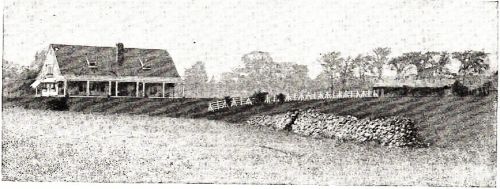
Coming now to hazards and bunkers, it may be said that bunkers are, properly speaking, sand-pits; while a hazard is any permanent feature of the course, such as briar-islands, roads, water, trees, or fences. Of course you will try to avoid these difficulties, but to be successful in doing so you must be reasonably sure of always getting your ball well into the air. A ball trundling along the ground may often make more yards of distance than a nicety lofted one, but then the "green" must be comparatively smooth and clear. If there is a brook or a fence in the way, it must be cleared on the fly, or you will find yourself in trouble. Now the lofter and mashie, from their shape of head, tend to raise the ball higher in the air than the straighter-faced clubs, and the novice should especially cultivate the use of the first-named. If the ball be struck clean and true, it may be lofted higher than is absolutely necessary, but that is better than too low. There is a particular stroke, called the high loft, but that need not concern us now. Use the regular driving swing, and get well under the ball.
Being fairly in a bunker or hazard is a painful situation, and the one thing to do is to get out with all possible expedition. If you are in a bunker proper, or sand-pit, you will have to take the niblick or mashie, and you must remember that you are not allowed to "sole" the club—that is, rest it on the ground as in the ordinary address. The idea is that the mark made on the sand by the club head is an unfair guide for the eye, and therefore if you touch sand you lose a stroke. It is often effective in a sand-bunker to aim at a point a little behind the ball, rather than at the "gutty" itself. The club cuts into the yielding sand, and, as it were, explodes the ball into the air and out of danger. An experiment or two will make this clear to you.
With the ball in an ordinary hazard, play to get it back on the course, rather than to make any extra distance by a little extra effort. If you "press," you will probably leave yourself worse off than before. In a "score" game a player has the option of lifting his ball out of a difficulty of any description and teeing it behind the same, the penalty being two strokes. Of course you must use your judgment as to when this course is the part of wisdom.
In match play, where the scoring is by holes, a lost ball means the loss of the hole. In medal or score play the player must return as nearly as possible to the point where the ball was struck, and tee a new one, the penalty being one stroke.
There are several other contingencies noted in the rules of the game; it is worth while to procure a copy of these and study them carefully.
A HAZARD.
It is to be remembered that all of the foregoing refers to play through the green when the hole is at an indefinite distance away, and we are simply trying to drive the ball the greatest distance possible. But in playing out of a hazard it is often advisable to use what is called, in approaching the hole, a half or a three-quarter swing. Roughly speaking, if the full distance covered by your regular drive be not desirable, make the length of your swing shorter in proportion, but do not try to hit a little more easily. Distance is measured by the length of the swing and not by the force applied. Let the left wrist be taut; and, finally, Keep your eye on the ball.