FROM CHUM TO CHUM.
Reading edition
BY GASTON V. DRAKE.
XV.—FROM JACK TO BOB.
White Mountains.
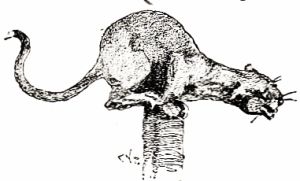
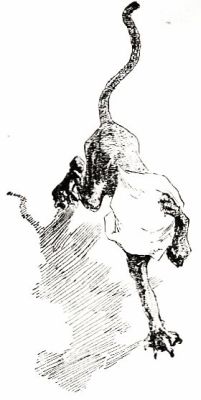
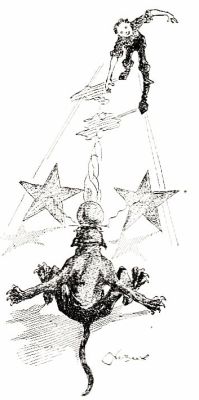
DEAR BOB,—I haven't written for some time because I tried an experiment over in the bowling-alley one day week before last which wasn't pleasant. I tried to put my finger in between two of the balls and get it out again before anything happened and couldn't, so I've had to have my whole hand swathed in a bandage ever since, and that's why Sandboys is writing this letter for me. It was too bad it happened the way it did, because we've been having a bowling turnement, and our side was way ahead when I smashed my finger, and we got beaten on the last game by five pins. Sandboys says when he was young his life was saved by a bowling-ball. It was before all the panthers that used to be thick in these mountains had all died out. They used to play havick with this part of the country eating up all the sheep and cows and horses and even tourists with good money in their pockets, and very few families living hereabouts dared to have their windows open at night in the summer-time for fear a panther might jump in and devour them up, even on the top floor. He says they are wonderful jumpers those panthers. He has seen one go up Mount Washington in sixty-three springs, and come down in twenty-nine, and as for jumping from the piazza of this hotel up into the cupola he says that would be about as easy for a healthy panther as falling off a chair would be to you or me. He lived over at a place called Littleton at that time and had a room in the top floor of his father's house. It was in midsummer and an awfully hot night, but being afraid of the panthers that were prowling around, when he went to bed he shut his window and his shutters up tight. Three or four times some of the panthers tried to break through and banged up against the shutters pretty hard, but without success, and finally an hour went by without any more attempts being made, and forgetting that strategy was one of the panther's strong points Sandboys thought they'd gone away and that it would be safe to open his window and get a breath of fresh air because his room had become like an oven, being right under the roof. So he opened the window softly and threw the shutters wide, peeping carefully out first to see if there were any panthers in sight. Unfortunately he looked down into the yard and didn't see the wild animal sitting on top of the telegraph pole across the street, waiting for his pray. "Good," said Sandboys, "they're all gone. I can get a chance to cool off." And he crept back into bed leaving the window wide open, and then the trouble began. He'd hardly got into bed when there came a fearful bang on the side wall just over him. The horrid beast that had been perched on the telegraph pole opposite had jumped across the street, through the window and landed ker-flump against the wall. Fortunately the force of the bang stunned the panther for a minute and Sandboys had presence of mind enough to snatch his pillow out of its case and to pull the pillow-case over the panther's head. It was the work of an instant, as the story-books say, and then he was off. That is, Sandboys was off. He fled through the window, dropped down to the soft earth and made a bee-line for the hotel. "Why did you go to the hotel?" I asked. "Because," he replied, "nobody else ever went there and I thought that would be the last place in which an animal with ingenious instinctiveness would think of looking for me."
My, but Sandboys is wise, but it didn't work. The panther soon recovered from his stun and after pawing at it for a minute managed to get the pillow-case off his head, and began to look around for Sandboys. He looked under the bed, and in the wardrobe and maybe in the bureau drawers. Nobody knows where he didn't look, and finally seeing that the door was still locked he of course knew that Sandboys had escaped by the window which shows you what sagacious animals panthers can be when they try. Well, when the panther saw that, he was mad. When panthers start out to pray they want to pray, and if they don't pray they want to know why, being, as I said, sagacious. So he says to himself it's Sandboys or nothing for supper and out he starts in pursuit and as luck would have it, being hungry, he thought he'd stop at the hotel a minute and take a bite out of the landlord. He stopped and the first thing he knew was that he was face to face with Sandboys. Sandboys was nonplussed—which is Latin for rattled—for a minute and so was the panther, for Sandboys was the last person he expected to find there. The panther's surprise was Sandboys' chance and he took it. He rushed from the room before the panther had recovered and was soon on the top floor whence, by a back staircase he rushed down, and out into the night. But the panther started in pursuit as usual. As he ran along Sandboys reasoned thus: "Nobody who has ever been to that hotel once, ever was known to go back again. I'll go back and delude the beast," which he did, but the door was locked and he had to take refuge in the bowling-alley. But the panther knew a thing or two and as Sandboys went in one door of the alley and locked the door after him and threw the keys away, he climbed in the window at the other end and there they were again, face to face: Sandboys at one end of the alley, the panther at the other and all was dark except one could see the glittering eye of the other. The panther was delighted. Everything seemed to be going his way and Sandboys was in despair. Escape seemed impossible. "I'll play with him," thought the panther and he took one step and crouched, smiling softly to himself when all of a sudden Sandboys thought, "Here I'm the champion bowler of this town, it's my only chance." The panther took another step and crouched. Sandboys took a ball. "I'll aim between his eyes and hit his nose," said Sandboys and he let go. It was dark, but it was a strike. The ball rolled thunderously down the alley. The panther didn't know what it was, and the first thing he knew as he laid his nose flat in the middle of the alley the ball came crashing into it, broke his neck and he lay dead, and Sandboys was saved.
How's that for an adventure?
Yours truly Jack per Sandboys.
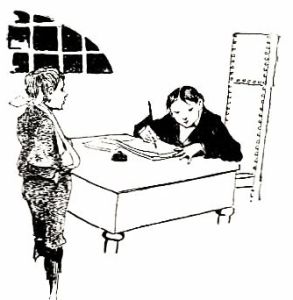
P.S. (in an almost unreadable hand). I don't know what Sandboys has told you in this letter from me, but whatever it is, the head waiter says it must be a exagravation because Sandboys is given to exagravations—by which I mean he draws the long bow when he tells things about himself. Love to all,
Jack.
LONDON ATHLETIC CLUB GROUNDS.
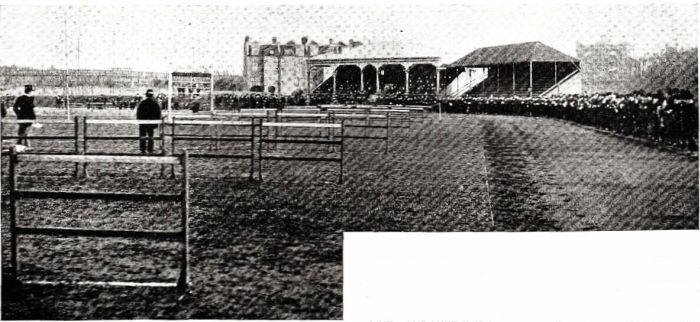
The spring meeting of the London Athletic Club was held on the club grounds at Stamford Bridge on April 11th. There were three scholastic events on the card, and as they do things somewhat differently in England from the way we do them over here, it may be interesting to the readers of this Department to hear of how this meeting was conducted. The first event for the schools was a 120-yard hurdle race on turf over ten hurdles 3 ft. 6 in. high. The English hurdles are fixed firmly in the ground, so that hitting an obstacle there means a fall—and this happened at these games to at least one man in each heat. After all, however, it seems a better arrangement than our way, for it compels the racers to jump the hurdles, and if a fall does result it is a good deal more like sport to fall on turf than to carry away several ounces of cinders in one's face and arms. As may be seen from the accompanying illustration, the course is laid towards the grand stand, instead of past it, which does not afford so good a view of a race as might otherwise be the case.
One pleasant feature of the occasion was that the in-field was kept perfectly clear. None but the half-dozen officials whose business required their presence there were allowed inside the track. Another improvement over our method was that the contestants came out for their heats without any clownlike bath-robes about them, and trotted down to their stations unassisted and unaccompanied by a horde of attendants, trainers, or rubbers. Their costumes, too, were more sightly than those seen in America, each man's shirt being provided with quarter sleeves. In many cases the hem of the sleeves and the bottoms of the running trousers were trimmed with the school colors, and the emblem, when the contestant wore any, was generally small and inconspicuous. In America, as we all know, there is frequently more emblem than athlete. The crouching start has not yet become popular in England; in fact, in all these races only one man leaned on his hands. The rest stood up, and they were by no means as steady on their marks as they would have been if they had adopted the American method of starting.
The hurdle-race was run in two heats and a final, and resulted in a win for Pilkington of Clifton School, who, I take it, is a relative of the Cambridge athlete who came over last fall with the English team that competed against Yale. His time was 17-2/5 sec., which is very fast over turf, and which he could doubtless improve upon on a cinder track. The best interscholastic record for the same event in this country was made by E. C. Perkins, of the Hartford High-School, at the Connecticut H.-S.A.A. games in '94, and was 17 sec. Jarvis of Bedford was second, and Kember of Ramsgate was third.
On the programme this race was set down as "120 yards hurdles Public Schools Championship Challenge Shield," with the additional information that the shield was "presented by Godfrey and Cecil Shaw." The former will be remembered as having given Stephen Chase a hard tussle over the hurdles at the international games last fall. In addition to this championship shield, which stands for a number of years, and on which the winner each year presumably has his name engraved, there was a first prize of a silver cup and a second prize of a silver beaker. This idea of having a challenge shield is an excellent one, as it adds an incentive to true sportsmanship, and makes the honor of winning the race greater than it would otherwise be. It would be a good fashion to introduce challenge cups and shields in this country.
The quarter-mile was run in three heats and a final. This was also for a championship challenge cup, and for three individual prizes. Harrison of Haileybury, who had the honor of seeing his name set down on the programme as the "holder" of the challenge cup, because he won it last year, was not fast enough on this occasion to maintain his supremacy. He took second place in his heat, and as his time for second was the fastest second of any of the heats, he was allowed to run in the finals, the programme stating that "First in each heat, and fastest second, to start in final." In this last heat were Holland and Hardie of Giggleswick, Davison of Sutton Valence, and Harrison. Davison ran too easily at first, and was some fifteen yards behind the rest at the 220 mark; but he then came away in great style. He was too late, however, to catch Holland, who won in 53-2/5 sec., with Davison second, and Hardie third. The best American interscholastic time for this event was made by T. E. Burke, the champion, in 1894, at the New England interscholastic games, when he was at the Boston English High-School.
RECORDS OF THE N.Y.I.S.A.A.
Event.Record.Holder.
100-yard dash10-3/8sec.Wendell Baker, Bettins, 1880.
100-yard dash (Jun.)11"D. C. Leech, Cutler's, 1890.
220-yard dash22-4/5"E. W. Allen, Berkeley, 1895.
220-yard dash (Jun.)23-4/5"H. Moeller, Col. Gram., 1894.
440-yard run52-2/5"C. R. Irwin-Martin, Berkeley, 1895.
880-yard run2m.4-1/5"J. A. Meehan, Condon, 1895.
Mile run4"52"C. Southwick, Harvard, 1893.
Mile walk7"30-2/5"L. B. Elliman, Berkeley, 1894.
Mile bicycle2"34-2/5"I. A. Powell, Cutler's, 1895.
120-yard hurdle15-3/5"A. F. Beers, De La Salle, 1895.
220-yard hurdle26-3/5"S. A. Syme, Barnard, 1895.
High jump5ft.11in.S. A. W. Baltazzi, Harvard, 1895.
Broad jump21"5"F. L. Pell, Cutler's, 1891.
Putting 12-lb. shot40"¾"A. C. Ayres, Condon, 1895.
Throwing 12-lb. hammer117"5½"C. R. Irwin-Martin, Berkeley, 1895.
Pole vault10"3/8"E. F. Simpson, Barnard, 1895.
For the mile run ten starters turned out. They stayed bunched for the first quarter, but by the time three-quarters of the distance had been covered there were practically only four in the race. Down the straight Elliot of Giggleswick and Dyke of Sherborne were never more than a yard apart, and a fine finish resulted in a dead heat. The time was excellent—4 min. 42-3/5 sec. Both men fell exhausted at the finish, and Tippets of St. Paul's came in third, not far behind. The best American interscholastic time for the mile is 4 min. 34-2/5 sec., made by W. T. Laing of Andover in 1894, at the New England Interscholastics. The American figures given here are all records, and so the comparison with the English times is not exactly fair, since the English school records in every case may of course be better than the performances on this particular occasion.
The prizes were distributed in a much better way than is done in this country. After each event Mrs. Walter Rye, whose name appeared on the programme, presented the winners with their cups. This is a custom which has not yet been adopted in this country, although at St. Paul's School, Concord, a young lady usually presents the prizes to the winners at the spring meeting. It would be a pleasant and graceful feature if, at the National Games, some lady interested in the sports of our young men in the schools were invited to hand to them their prizes.
The fourth annual tournament of the Yale Interscholastic Tennis Association was held a week ago Saturday, on the grounds of the New Haven Lawn Club. There were thirteen entries from Hartford High, Hillhouse High, Black Hall, Hopkins Grammar, Taft's, and Hotchkiss schools. The day was cold and raw, but, nevertheless, the play on the whole was good.
In the first round the Lyman-Finke match was very interesting. Lyman made a plucky fight in the last set, but Finke won, 6-2, 6-4. The Whitmore-Watrous match showed some pretty tennis. In the first set the score changed many times, each man doing his best to win. Watrous got it, 9-7. Whitmore won the second set, 6-2, but Watrous took the last rather easily, 6-2.
The final round was between two Hotchkiss School players, Finke and Coy. At times the play was excellent, each man showing good judgment and coolness. Finke won 6-2, 6-1, 6-1. Coy might have done much better, but he seemed to be afraid to let himself out. Finke made the remarkable record of winning the tournament without losing a set. He outclassed all the other players. With practice he ought to develop into a player of the first class. He plays with coolness and excellent judgment. The prizes were a cup for first and second, and a banner to the school winning the greatest number of points, each match won counting one point. The banner went to Hotchkiss this year, as it did last year.
The Harvard Interscholastic tournament was held the same day on Jarvis Field, Cambridge, with twelve schools, represented by sixty-seven entries. With so large a number of contestants, the play dragged on into the early part of last week, making the finals come too late for proper notice in the present issue of this Department. Comment will be held over until next week.
The standard of performance of New York school athletes has improved so rapidly within the past few years that it is very difficult now to make any very definite prophecy as to what men will win events at the big Interscholastic meetings. This year the struggle for the cup will probably be between Berkeley and Cutler's, with the chances largely in favor of the former, Barnard's team not being so strong as it was either last year or the year before. For individual winners next Saturday, I think it is reasonably certain to count on Moore of Barnard to take first in the 100, with Harris of Cutler's second. Both men have done 10-2/5 in smaller games this spring, and with this in view we may hope to see Wendell Baker's 10-2/5 record, which has stood so many years, go by the board. The junior event for the same distance will be a close thing between Wilson of Barnard and Leech of Cutler's, the former having won the event in '94, and the latter having won it last year. Armstead of Berkeley will get a place, but I doubt if he does better than third.
Moore is beyond any doubt the best sprinter in the New York association, and will score a double win by taking the 220, unless something unforeseen occurs. Irwin-Martin of Berkeley should be second, with Washburn a close third. There is little room for doubt that Martin will be an easy winner in the quarter, for that is his special event, and Draper of Cutler's will come in second if Hipple of Barnard does not crowd him out. It is possible, however, that White of Berkeley, who has developed great speed of late, may overthrow these place calculations, and take three more points in the event for Berkeley. Hipple is a man that Barnard must depend on for a good many points, and as he will be especially depended upon to take the half-mile, it is possible that he may not run in the quarter, or, if he does, he may save himself and only try for a place. He is sure to break the record in the half, and if these two races do not tire him too much he ought to make a place in the mile, for he broke the scholastic record for that distance in the Trinity games only a few weeks ago.
Clark of Condon's is a good man to look to for second in the half-mile. Bedford of Barnard has not been doing very good work this year, but unless Turner of Cutler's develops unexpected speed and Hipple unforeseen endurance, he stands an excellent chance of scoring five points in the mile run. The high hurdles will go to Beers of De la Salle, with Bien of Berkeley second. The low hurdles are a fairly sure thing for Harris of Cutler's, with the other two places in dispute among O'Rourke of Trinity, Beers, and Bien. Walker of Berkeley should come in first in the walk, if he can maintain the form he has been displaying all winter, with Blum of Sachs' second.
In the field events, Irwin-Martin of Berkeley will probably score another win for his school by taking the hammer, while the shot will probably also go to Berkeley with Young. Taves of Trinity may be counted upon for places in both events. No one will approach the record established by Baltazzi last year in the high jump, but Pell of Berkeley will probably clear the greatest height, with Wenman of Drisler's and Brown of Columbia Grammar behind him. In the broad jump Pell also stands an excellent chance to get first place, unless Harris develops unexpected ability, and Beers may be able to take the other place. I think we may count upon seeing the pole-vaulting record broken by Hulburt, who has been surpassing himself and everybody else in the open games this spring. The bicycle race will probably go to Cutler's.
INTERSCHOLASTIC RECORDS
Corrected to May 1, 1896.
Event.Record.Maker.School.
100-yard dash10-1/5sec.F. H. Bigelow.Worcester H.-S.N.E.I.S.A.A. games, 1894.
220-yard dash22-2/5"F. H. Bigelow.Worcester H.-S.N.E.I.S.A.A. games, 1894.
440-yard run50-3/5"T. E. Burke.Boston English H.-S.N.E.I.S.A.A. games, 1894.
Half-mile run2m.4-1/5"J. A. Meehan.Condon, N. Y.N.Y.I.S.A.A. games, May 11, 1895.
Mile run4"34-2/5"W. T. Laing.Phillips Academy, Andover.N.E.I.S.A.A. games, 1894.
Mile walk7"17-3/5"A. N. Butler.Hillhouse H.-S., New Haven.Conn. H.-S.A.A. games, June 8, 1895.
120-yard hurdle (3 ft. 6 in.)17"E. C. Perkins.Hartford H.-S.Conn. H.-S.A.A. games, 1894.
220-yard hurdle (2 ft. 6 in.)26½"Field.Hartford H.-S.Conn. H.-S.A.A. games, June 8, 1895.
Mile bicycle2"34-1/5"I. A. Powell.Cutler, N. Y.N.Y.I.S.A.A. games, May 11, 1895.
Two-mile bicycle5"18-2/5"Baker.Hotchkiss, Lakeville, Conn.Conn. H.-S.A.A. games, June 8, 1895.
Running high jump5ft.11in.S. A. W. Baltazzi.Harvard, N. Y.N.Y.I.S.A.A. games, May 11, 1895.
Running broad jump21"7"Cheek.Oakland, Cal., H.-S.A.A.L. field day, Oct. 16, 1894.
Pole vault10"7"B. Johnson.Worcester Academy.N.E.I.S.A.A. games, June 15, 1895.
Throwing 12-lb. hammer125"R. F. Johnson.Brookline H.-S.N.E.I.S.A.A. games, 1894.
Throwing 16-lb. hammer111"10"F. G. Beck.Hillhouse H.-S., New Haven.Conn. H.-S.A.A. games, June 8, 1895.
Putting 12-lb. shot40"¾"A. C. Ayres.Condon, N. Y.N.Y.I.S.A.A. games, May 11, 1895.
Putting 16-lb. shot39"3"M. O'Brien.Boston English H.-S.N.E.I.S.A.A. games, 1894.
The accompanying table of Interscholastic records should perhaps not properly be called such, because the records were not made at any single meeting, but are the best performances made at a number of interscholastic meetings in various parts of the country. After the National games, we shall have established regular "Interscholastic" records, but until then these figures must serve that purpose.
The Graduate.