THE AMERICAN NIGHTS' ENTERTAINMENTS.
Reading edition
THE KITE MASQUERADE.
BY EMMA J. GRAY.
March had come in like a lion, but, contrary to the old prediction, was going out in the same fashion. At least, so thought Dick Atwater as he violently pulled his friend Joe Jacobs's door bell. Only a second or two, and the door opened, when, rapidly passing through, he bounded up two staircases, and in response to a hasty knock, was joyfully welcomed in Joe's den, room, sanctum, or whatever the third-floor front might be denominated.
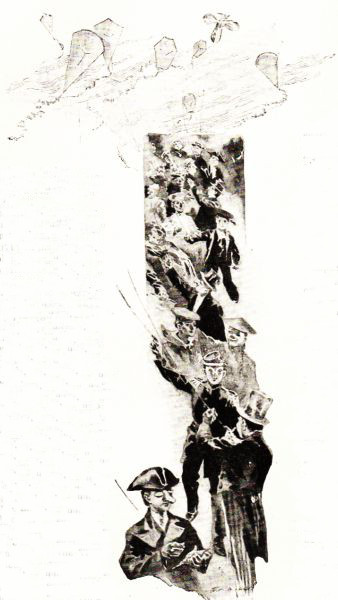
"Hello, old chap!" was the cheery, familiar greeting. "What's up now? for that some scheme's afloat I know"; and immediately Joe commenced to laugh, though, had any one inquired what at, he could not have told, unless it was the merry twinkle in Dick's eyes—enough to make a judge laugh, much less a rollicking, good-natured boy—the hale-fellow sort—and Dick's boon companion and greatest friend.
So, without further parley, the two boys sat down opposite to each other, one face all expectancy, knowing he was to hear something awfully jolly; the other all animation, for so sure he was that he was about to unfold a really taking scheme.
And this is what Joe heard: "You know April-fool's day will soon be here, and as it's blowing great guns now, I don't imagine that all the wind will die down by that time. So my plan is to give a kite masquerade on the afternoon of that day."
"Fine!" and Joe Jacobs immediately jumped up to get out his new "sky-scraper," as he called it, though it was altogether perfect; kite, tail, string, everything was there, and his friend Dick had seen it possibly fifty times before. But the simple thought of anything novel in the kite line seemed too much for Joe's excitable temperament; besides, he was very proud of this kite; it was brand-new, and none of the fellows, if we will except Dick, knew that he had it.
So Joe, having gotten out his kite, again sat down, and with his treasure in hand, holding it scrutinizingly up, looking at it most attentively—indeed, surveying it backwards, forwards, every sort of a way, even to an occasional unwinding and winding again of the string, and unfastening of the tail—he yet was full of inquiry to discover more. And as for Dick, he talked as excitedly, rapidly, and earnestly as if Joe was as still as the Sphinx. He was not in the very least nervous or ruffled, so entirely does one boy understand another. The scheme was to give the exhibition in the lot in which they played baseball, and, as Dick said, "Wear costumes, with masks, and we'll have lots of fun fooling one another—just the sport for the 1st of April." And then he added, "We'll tell the fellows to-morrow; I'm not afraid but what they'll join us, and they can do as they like about their clothes, but we'll dress each other up, Joe. What do you say to that for a fool trick?" and a quick slap on the shoulder added emphasis to the boy's enthusiasm.
"It's immense, that's what I think, and our kites are boss too. I wonder if they'll suspect who we are?"
"Not if I can help it."
"I say, what will we wear, though, Dick? I don't care how ridiculous I make myself."
"I know you don't; and I've thought you might go as an old soldier. There is your father's cast-off suit—how would that do?"
"But there's some difference in our size."
"Well," laughed his friend, "about a hundred or so pounds. But that will go for nothing when I get hold of the wadding. What fun I'll have stuffing you! Fortunately your height's about right. I say, though, Joe, you'd better wear a mask with a big gray beard, Santa Claus fashion, and that will cover over any wrinkles there might be about the neck. And don't forget the sabre. Go as a sure-enough soldier, or don't go as a soldier at all. And for myself, there is always so much talk about my leanness, gaunt, hungry-looking style, that I shall wear the costume of a real down-East Yankee; and in order to make myself look taller than ever I shall ask my sister to sew several red cloth stripes down my trouser legs, long-tailed coat, and vest."
"You'll be a sight for mortal eye," complimented Joe, laughing so heartily that he lost his balance and rolled off his chair full length onto the new kite, which, however, was not in the least hurt by this fantastic antic.
"I hope I will. I want to be a sight. And say, Joe, where do you suppose I can borrow a tall gray beaver hat and a big"—and he held his hands at arms'-length apart—"red cotton handkerchief?"
"I can get you the bandanna right enough, but the hat's a poser." And Joe screwed up his mouth thoughtfully awhile; then, with a triumphant nod, said: "I've got it. Go to Dr. Worth; he always wears 'em, and keeps 'em, too, for centuries almost. I once saw a whole stock of them on the top shelf in his store-room. He'll let us have one all right enough, I'll wager."
"That's good, and I'll get the dudest style of false face too, for I mean to be a dandy; and our fun—well, it will beat a house afire."
After a little more laughter, comment, and explanation, the boys began to talk about a game that Joe had learned the year before while in Germany, and that both the boys thought would be a good thing to follow the masquerade.
"What did you say it was called?"
"Schlaglaufen."
"My jaw is broken," and Dick rapidly raised his left hand, laying it with a piteous cry across his lower jaw.
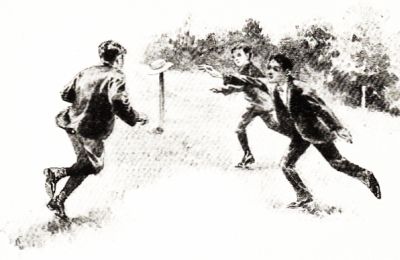
At this action Joe gave him a sharp look; and then came the words. "You needn't be so gay," and again the boys laughed merrily, Joe afterwards adding, "Well, another name for the game, and a much more pronounceable one, is 'Running for the Cap,' because a post is fixed in the ground, and on it a cap is placed and run for. The boys must be equally divided; one set is called catchers, the other runners, and these sets must stand fifty yards apart. The catchers' position is thirty yards from the post, and the runners' twenty. The call, one, two, three, is given, and on the second three is spoken one boy from each party runs to the post. The runner will naturally get there first, and he has to put the cap on his head, and then replace it. He must do this with the utmost rapidity, as, should the catcher overtake him on his way back to the position which he held before starting to run, the boy becomes the catcher's prisoner, and can no longer play."
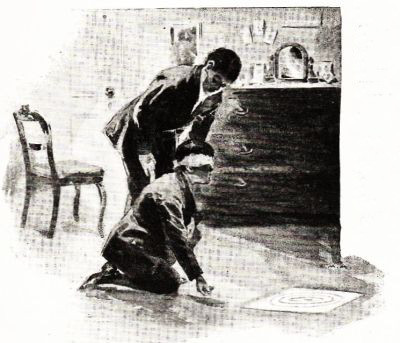
The rest of the time Dick spent in Joe's room was given to marble-playing. Both boys were experts, and it was oftener than otherwise a tie game rather than that either boy could honestly be counted as being ahead of the other. Indeed, so evenly they played, it was a great delight to play without other boys being in the game, and, therefore, whenever there was opportunity, they, so to speak, challenged each other. Joe's floor was carpeted in a square pattern measuring six inches each way. Having selected a convenient square, an agate was placed in each of three angles, counting the nearest one ten, the middle twenty, and the other thirty. Two marbles were then rolled from the fourth angle, the inside marble being on the angle, the other immediately back of it, the object being to hit each agate with both marbles. For this five shots were allowed. When done the numbers were counted and the agates replaced for the next player. This amusement was succeeded by the three following games:
The Bagatelle-board Count Game.—Chalk a floor or mark a space in exact copy of a bagatelle board ten feet long by three wide. In the enclosure, at correct distances, mark the numbers; this may be done with chalk, or the numbers may be painted on thin wooden blocks and laid in position. Each player must start his marble at the extreme left-hand corner, and state before starting the number he wishes to roll to. Should the marble go to that number, and not roll on so as to touch another, the player counts the number selected, and can then state another number and play for that, and can so continue for seven minutes, provided his marble always hits the number selected, and though rolling on, does not touch or stop at any other. When his time is up his count is scored, and the next player follows, subject to the same rules. Should the marble stop on the number selected, it is counted double in favor of the player. Again, should the marble, having reached the selected number, still roll on and touch another, no count is allowed, and the player must stop until his turn comes again.
Five-arch Discount Game.—A strip of wood two inches thick, five inches wide, and one yard long will be required. In this cut five arches, making the centre one four inches in width, the others three inches each; stand it up on the floor or on a table, and make the starting-point six feet away. Four marbles may be rolled by each player. When a marble goes through the centre arch it counts sixty, but if, instead, it goes through either of the small arches, thirty is counted off. If a marble fails to pass through either, it is counted out of the game, and must be removed. The next turn around the player will use only three instead of four marbles. The boy who has the highest tally has won; should there be a tie they must roll again.
This game requires practice, or some players will find that they have lost more than they have made.
Circle Game.—Make a target of brown wrapping-paper, and put the number 100 on the bull's eye. Outside of this mark five rings, making the largest one two feet in diameter, the others proportionately smaller. Inside of these rings put the numbers 10, 20, 30, 40, 50, the centre as stated, being 100. Mark out a space on the ground for a base five feet away; place the target on the ground, blindfold a player, lead him to the base, turn him around twice, and leave him facing the target. He is now entitled to roll three marbles, and then remove the blindfold. His count will be the added numbers in the rings at which his marbles have stopped. Should any of them stop on a line, he is entitled to the largest number adjoining. No marbles must be moved, and each boy has the privilege of trying the ground once with each marble, before being blindfolded.
At the Zoological Garden Railway Station, in Berlin, a restaurant has been opened where rolls of bread and various kinds of eatables, etc., are dispensed automatically. On depositing in the slots ten-pfennig pieces or fifty-pfennig pieces—according to the kind of refreshment required—the apparatus delivers either rolls of bread or glasses filled with drinkables—cups of coffee, tea, cocoa, etc. The bread rolls are of different kinds, each kind being in a separate glass machine. In front of them is a marble counter, and before each machine is a plate. When a ten-pfennig piece is dropped into the slot the plate sinks below the surface of the counter, and a roll of bread glides into it. The restaurant has lately been thronged with customers. On one single Sunday 20,000 glasses and cups were paid for and emptied by the public, and 8000 penny rolls were demanded, and for the most part eaten.